INFS1200 — Introduction to Information Systems
Semester 1, 2026 — teaching weeks run from 23/02/2026 (week 1 on the semester plan) to the week beginning 25/05/2026, with the exam period after it. St Lucia, in person. Information systems analysis, design and implementation, relational database technology, data modelling, data querying using SQL, and building a small-scale information system using a relational DBMS.
Lectures run Friday 3–5pm. About 370 students are enrolled in INFS1200, and the course runs alongside INFS7900 — the Ed Discussion board and the in-class polls are both labelled INFS1200/INFS7900.
Staff
- A/Prof Archie Chapman — course coordinator & lecturer, archie.chapman@uq.edu.au
- A/Prof Hassan Khosravi — lecturer, h.khosravi@uq.edu.au
- Course admin enquiries: INFS1200@eecs.uq.edu.au
- Tutors: Allan Chuang, Samiha Prima, Ian Pinto, Kai Li Lim, Eden Mehr, Kate Duan, Daniel Goh, James Fearon, Daniel Camp
Textbook
Elmasri & Navathe, Fundamentals of Database Systems (7th edition, Global Edition) — available online via the UQ Library. Chapters 1 and 2 cover Module 0.
Learning outcomes
- LO1 Extract information systems requirements to create basic conceptual models
- LO2 Map basic conceptual data models to relational database schema
- LO3 Express natural language queries using the SQL language
- LO4 Reason with the logical foundation of the relational data model and the fundamental principles of correct relational database design
- LO5 Explain key security concepts related to database control measures and SQL injection
- LO6 Construct a small-scale information system in a relational database management system
The five modules
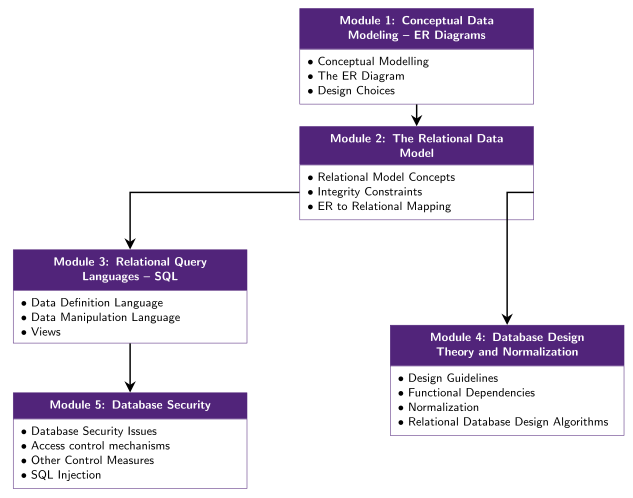
Figure 1: How the five content modules depend on one another. There are exactly four dependencies: Module 1 into Module 2, Module 2 into both Module 3 and Module 4, and Module 3 into Module 5. So Module 2 forks — SQL on one branch, carrying on into database security, and design theory and normalisation on the other — and the two branches never rejoin. (The semester still teaches them in sequence rather than in parallel: SQL in weeks 5-8, normalisation in weeks 9-11.)
Module 0 (introduction and DBMS fundamentals, dbms-fundamentals) sits in front of all of these and is not in the figure.
Course learning activities
- Lectures — weeks 1-13, introduce concepts and techniques in information systems analysis, combined with a series of in-class formative exercises; the exercises are run through UQ Poll.
- Applied classes — weeks 2-13, practice the techniques introduced in lectures.
- Practicals — weeks 2-13, hands-on experience implementing small-scale databases.
- Ed Discussion — the course discussion board, also used for per-lecture Q&A megathreads.
- RiPPLE personalised learning activities — a UQ-developed learner-sourcing platform: students create study resources, moderate peers’ resources, and practise against an AI-generated study plan based on their own mastery level.
Ed Discussion protocol
- General questions about course content → public posts. If your peers can’t answer, bring it to a tutorial or prac.
- Assignment questions that might reveal part of the solution → discuss with tutors in tutorials/practicals; if that isn’t possible, private posts.
- Personal/admin enquiries → private posts.
- Staff reserve the right to change the visibility of a post.
The RiPPLE weekly cycle
One activity per week from week 2 to week 13, cycling create → moderate → practise over each module:
| Weeks | Task order | Topic(s) |
|---|---|---|
| 2 / 3 / 4 | Create / Moderate / Practice | Modules 0 & 1 |
| 5 / 6 / 7 | Create / Moderate / Practice | Module 2 |
| 8 / 9 / 10 | Create / Moderate / Practice | Module 3 |
| 11 / 12 / 13 | Create / Moderate / Practice | Modules 4 & 5 |
Each weekly activity is worth 1 mark and the component is capped at 10, so two missed or sub-standard submissions cost nothing.
Assessment
Weights and dates:
| Component | Weight | Due |
|---|---|---|
| Weekly RiPPLE activities (best 10 of 12) | 10% | Weekly, Fri 4pm from week 2 to week 13 (week 6 exception: Thu 2/04/2026) |
| Assignment 1 (ER models + relational data model) | 25% | Thu 2/04/2026 5:00pm |
| Assignment 2 — SQL, online submission | 25% | Fri 8/05/2026 5:00pm |
| Assignment 2 — oral assessment | — | During week 12 practicals (week beginning 18/05/2026) |
| Final exam | 40% | Exam period |
The hurdle rules — whether the exam and the Assignment 2 oral are pass-required, the mark caps that follow a failed exam, the exam’s length and permitted materials, and the exact exam-period dates — are in the course profile on Blackboard. Read them off the profile rather than trusting a remembered version.
Both assignments are question-based tasks — questions and tasks aligned to the learning objectives of the module the assignment covers, in the same style as those attempted in tutorial and practical sessions.
Tentative weekly plan
The authoritative version lives on the Learning Resources page on Blackboard.
| Wk | Week beginning | Lecture (Fri 3–5pm) | Applied class | Practical |
|---|---|---|---|---|
| 1 | 23 Feb | Introduction + ER Model | — | — |
| 2 | 2 Mar | ER diagrams + EER | ER Model (basic) | Intro to course tools |
| 3 | 9 Mar | Relational Model | ER Model (advanced) | Case study 1 — ER diagrams |
| 4 | 16 Mar | Relational Model | ER→Relational | Labwork overview; case study 2.1 — the relational model |
| 5 | 23 Mar | SQL | Mapping | Case study 2.2 — ER mapping |
| 6 | 30 Mar | SQL (recorded lecture) | SQL: DDL and intro DML | Prac book module 3 — working with MySQL |
| — | 6 Apr | Mid-semester break | ||
| 7 | 13 Apr | SQL | SQL: aggregation and GROUP BY | Case study 3.1 — SQL: DDL |
| 8 | 20 Apr | SQL | SQL: multi-relation queries | Case study 3.2 — SQL: DML |
| 9 | 27 Apr | FDs and normalisation | SQL: subqueries | SQL notebooks consult |
| 10 | 4 May | FDs and normalisation | Database design theory (basic) | Case study 4.1 — FDs and normalisation |
| 11 | 11 May | FDs and normalisation | Database design theory (advanced) | Case study 4.2 — FDs and normalisation |
| 12 | 18 May | Database Security | Database design theory (review) | Assignment 2 oral assessment |
| 13 | 25 May | Revision | Database Security | Database Security |
There is also a practice assignment across weeks 2–3, with no weight against it. The week 6 RiPPLE task is the single exception to the Friday 4pm deadline — that one is due Thursday 4pm.
Academic integrity and generative AI
Academic integrity is “acting with the values of honesty, trust, fairness, respect and responsibility in learning, teaching and research” (Universities Australia, 2017). Academic integrity = professional integrity = personal integrity.
The six forms of misconduct staff look for: plagiarism, collusion, falsification, fabrication, impersonation, contract cheating. Note-sharing sites (Thinkswap, Course Hero, Chegg, StudentVIP, StuDocu) are checked. UQ recorded over 9,900 cases between January 2017 and December 2021 — plagiarism 6,542 and collusion 1,919 are by far the two largest categories. Penalties run from re-submission or zero marks at the lower end, through automatic failure of a course, to suspension or expulsion.
Generative AI is permitted in the assignments, on one condition: collate every prompt and response, with the URL and date, into a single PDF submitted as an appendix. Failing to reference or acknowledge AI use may itself constitute misconduct under PPL 3.60.01 (Student Code of Conduct). The final exam is invigilated and AI is not permitted in it, so practise under exam-like conditions without those tools. AI tools can generate incorrect or misleading results.
Lectures
- 2026-02-23-conceptual-database-design-and-the-er-model
- 2026-03-02-weak-entities-the-eer-model-and-design-choices
- 2026-03-09-the-relational-model-and-integrity-constraints
- 2026-03-16-er-to-relational-mapping
- 2026-03-30-basic-sql-ddl-and-dml
- 2026-04-06-aggregation-grouping-and-multiple-relation-queries
- 2026-04-13-nested-queries-views-and-generative-ai
- 2026-04-27-database-design-guidelines-and-functional-dependencies
- 2026-05-04-normalisation-and-relational-database-schema-design
- 2026-05-11-database-security
Reference / concept notes
Notation and style guides
- er-diagram-notation · relationship-constraints · relational-mapping-notation · infs1200-diagram-notation
Module 1 — conceptual design (ER/EER)
- dbms-fundamentals · conceptual-database-design
- entity-types-and-attributes · relationship-types · specialisation-and-generalisation
- er-design-choices · interpreting-er-diagrams
Module 2 — the relational model
- relational-model · relational-keys · foreign-keys
- integrity-constraints · update-operations-and-constraint-violations
- er-to-relational-mapping · er-mapping-pitfalls
Module 3 — SQL
- sql-ddl · sql-dml · sql-select-statement
- sql-joins · sql-aggregation-and-grouping · sql-set-operations
- sql-nested-queries · relational-division · sql-views · sql-nulls
Module 4 — design theory and normalisation
- update-anomalies · functional-dependencies · attribute-closure
- normal-forms · minimal-cover · decomposition · 3nf-synthesis
Module 5 — security
Exercises
- week1-lab-practical-1-course-tools
- week2-tutorial-applied-class-1-intro-to-dbms-and-basic-erd
- week3-tutorial-applied-class-2-entity-relationship-diagrams
- week2-tutorial-case-study-1-dirt-road-driving
- week4-tutorial-applied-class-3-relational-integrity
- week5-tutorial-applied-class-4-entity-relationship-mapping
- week3-tutorial-case-study-2-dirt-road-driving
- week4-tutorial-case-study-3-dirt-road-driving
- week6-tutorial-applied-class-5-basic-sql-ddl-and-dml
- week6-tutorial-case-study-4-easydrive-insurance
- week7-tutorial-applied-class-6-aggregation-and-grouping
- week7-tutorial-case-study-5-easydrive-insurance
- week8-tutorial-applied-class-7-multiple-relation-queries
- week9-tutorial-applied-class-8-nested-queries-and-views
- week10-tutorial-applied-class-9-functional-dependencies
- week10-tutorial-case-study-8-dirt-road-driving
- week11-tutorial-applied-class-10-normalisation-bcnf-3nf-synthesis
- week11-tutorial-case-study-9-payroll-system
- week12-tutorial-5-1-database-security