Functional Dependencies
A functional dependency (FD) is the formal way to state a business rule of the form “if you know this, you know that”. It’s the unit of information every design-theory tool in this course consumes: closures, keys, normal forms and both schema-design algorithms are all defined in terms of a set of FDs. Introduced in 2026-04-27-database-design-guidelines-and-functional-dependencies.
The motivating question is the one left hanging by update-anomalies: how can we be sure every employee at the same level earns the same salary, rather than it merely happening to be true of today’s rows? By declaring level → salary — “level determines salary”.
Formal definition
An FD X → Y holds on relation R if, for every legal instance r of R and every pair of tuples \(t_1, t_2 \in r\):
\[t_1[X] = t_2[X] \implies t_1[Y] = t_2[Y]\]
i.e. any two tuples that agree on X must also agree on Y. X is the left-hand side (LHS) or determinant, Y the right-hand side (RHS). Both are sets of attributes, so {sName, pNum} → qty is a perfectly ordinary FD; single-attribute sets are written without braces.
An FD is a constraint between two attribute sets — it restricts which tuples may legally appear together in an instance of R, exactly as a key or referential-integrity constraint does (see integrity-constraints). A key is in fact a special case: X is a superkey of R precisely when X → R holds, which is how relational-keys’s “minimal set that uniquely identifies” becomes something you can compute rather than assert — see attribute-closure.
An FD is a statement about all instances
This is the single most important thing about FDs, and the thing exam questions probe most often:
You can check whether a given instance violates an FD, but you can never prove an FD holds by looking at one instance.
FDs come from the semantics of the application — the Universe of Discourse and its business rules — not from reverse-engineering a data sample. A sample can only ever rule FDs out.
Ruling one out: given R [A, B, C, D] with rows (1,2,3,4), (2,3,4,6), (6,7,8,9), (1,3,4,5) — B → D cannot be true, since rows 2 and 4 both have B = 3 but disagree on D (6 vs 5). B → C and D → B are still possible — meaning only “not yet contradicted”, never “proven”.
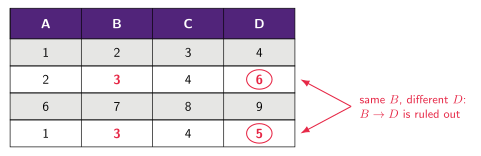
Figure 1: The only thing an instance can do to an FD. Rows 2 and 4 agree on B and disagree on D, so B → D is refuted outright; nothing in the table can establish B → C or D → B, which merely survive un-contradicted. The crimson ellipses mark the two D values that clash.
Reading candidate FDs off a sample instance
Case-study questions do ask you to identify the FDs a sample table suggests. The mechanical procedure is: for each candidate X → Y, group the rows by their X value; if any group disagrees on Y, the FD is dead, otherwise it survives as a potential FD. Two traps:
- An
Xvalue that never repeats makesX → Ytrivially survive — there is no pair of rows to contradict it. In week10-tutorial-applied-class-9-functional-dependencies Section A,A → B,A → Cand{A, B} → Call “hold” only becauseAis distinct in every row. That’s evidence of nothing. - The surviving FDs still have to make sense. In week10-tutorial-case-study-8-dirt-road-driving, the FD worth reporting on
EmployeeHistoryisseniorityLevel → baseSalary, securityLevel— everyJuniorrow has{70,000, Limited}and everyExecutiverow has{80,000, Full Access}— because seniority genuinely determines pay band in the UoD, not merely in the sample.
Trivial and non-trivial FDs
- A trivial FD holds regardless of
F, because the LHS already contains the RHS — e.g.A → A,{A, B, C} → {A, B}. - A non-trivial FD depends on the specific
F— e.g.A → B.
Every normal-form test is stated over non-trivial FDs only, since a trivial FD can never be a design flaw.
Explicit and implicit FDs; the closure of F
Given a set F of explicit FDs, further implicit FDs follow: from id → level and level → salary we can infer id → salary. Implicit FDs are also called inferred FDs. The notation
\[F \models X \rightarrow Y\]
means X → Y can be inferred from F — equivalently, “Y can be derived from X under F”, or “X implies Y under F”.
The closure of F, written F⁺, is the set of all FDs — trivial and non-trivial — implied by F.
Armstrong’s axioms and what is actually examinable
F⁺ can be computed by applying Armstrong’s Axioms as inference rules, but doing so is difficult and time consuming, and it is outside the scope of this course. The individual rules — reflexivity, augmentation, transitivity, and the derived union, decomposition and pseudotransitivity rules — are outside it too, so there is nothing to memorise and no question can ask you to name or apply one.
What replaces them is attribute-closure (X⁺), which answers the only question the rest of the module ever asks of F⁺: given X, which attributes are determined? Every inference you actually need — the transitive chain id → level → salary, say — falls out of one closure computation, and that is the examinable skill.
F⁺ still matters conceptually, because every normal-form test is phrased “for every non-trivial X → A in F⁺” — the implied FDs count too. Missing an implicit FD is the classic way to declare a relation BCNF-compliant when it isn’t; in practice you compute the closures first, spot that F ⊨ A → C, add A → C to F, and then run the algorithm. See decomposition.
Why FDs create redundancy
FDs are also the precise account of where redundancy comes from. In R [A, B, C] with no FDs at all, no value constrains any other and there is no redundancy. Add A → B, and any two tuples sharing an A value are now forced to repeat the same B value. That forced repetition is exactly what normalisation identifies and removes — which is why the normal-form tests in normal-forms are all conditions on the LHS of an FD relative to the keys.
A running instance makes the mechanism concrete. Employee [ID, name, level, salary] with level → salary stores Developer, 60,000 twice and Manager, 700,000 twice — not by accident but because the FD forbids anything else. Project the relation onto [ID, name, level] and [level, salary] and each level’s salary is recorded exactly once, with nothing lost: the natural join on level rebuilds the original rows. The two halves are named StaffAppointment [ID, name, level] and StaffIncome [level, salary] in the 3NF treatment; see normal-forms and decomposition.
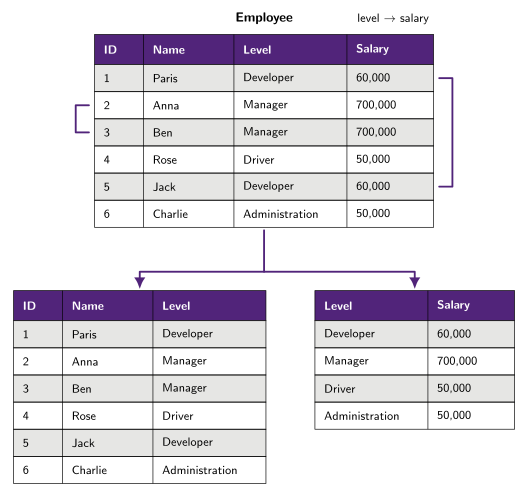
Figure 2: An FD is a redundancy generator, and the split is the cure. level → salary forces every Developer row to carry 60,000 and every Manager row 700,000 — the purple brackets mark the two groups the FD ties together. Splitting off a [level, salary] table records each level’s salary once; the natural join on level rebuilds the six original rows.
The three anomalies that repetition causes — and which the split fixes — are catalogued in update-anomalies.
See also
- attribute-closure · normal-forms · minimal-cover · decomposition
- update-anomalies — the symptoms FDs explain
- 2026-04-27-database-design-guidelines-and-functional-dependencies — Module 4, part 1
- week10-tutorial-applied-class-9-functional-dependencies — FD identification and closure practice