Minimal Cover
A minimal cover (or canonical cover) G of an FD set F is an equivalent set of FDs with all the slack squeezed out — nothing can be deleted or shortened without changing what the set implies. It’s the required input to 3nf-synthesis, and it makes reasoning about BCNF easier by hand too. Introduced in 2026-05-04-normalisation-and-relational-database-schema-design.
Equivalence of FD sets
Two FD sets are equivalent when they imply exactly the same FDs: F⁺ = G⁺. Equivalence is what makes the reduction safe — a minimal cover constrains the data identically to the original set, it just says so with fewer, smaller rules.
Definition
The goal is to transform the FDs to be as small as possible while still implying exactly the same things.
G is a minimal cover for F iff:
- Equivalent —
F⁺ = G⁺. - Nothing redundant — deleting any FD from
G, or any attribute from any FD’s LHS, gives someG'withG'⁺ ≠ G⁺. Every FD and every LHS attribute is necessary.
Informally: every FD in G is needed, and is as small as possible, while still closing to the same set as F.
The smallest illustration: F = {A → B, B → C, A → {B, C}} reduces to G = {A → B, B → C} — the third FD asserts nothing the first two don’t already imply.
The textbook definition adds a third condition — single-attribute RHS, every FD in G having exactly one attribute on its right — but this course explicitly does not require it. Splitting the RHS is still the first working step, because condition 2’s tests are only correct per-attribute; but the answer may then be written back up with same-LHS FDs recombined ({E,F} → G and {E,F} → H as {E,F} → {G, H}). Both presentations are accepted, and 3nf-synthesis recombines them anyway as its second step.
Finding a minimal cover — three steps
The steps run in this order, and each is decided by an attribute-closure computation:
| Step | What to do | Test |
|---|---|---|
| 1. RHS simplification | Split every FD so its RHS is a single attribute: X → {Y, Z} becomes X → Y and X → Z |
— (always applies) |
| 2. LHS simplification | For an FD X → A whose LHS has several attributes, drop any attribute B that isn’t pulling its weight |
Replace X → A with (X - {B}) → A when (X - {B})⁺ = X⁺ |
| 3. FD set simplification | Delete any FD that the rest of the set already implies | Delete X → A if X⁺, computed without that FD, still contains A |
Two things make this reliable in practice:
- Do step 1 first, completely. A compound RHS can hide the fact that one of its attributes is redundant while another isn’t — the case-study
Departmentexample below is exactly that. - In steps 2 and 3, recompute the closure against the FD set as it currently stands, including edits already made. Each removal changes what the remaining FDs can derive.
Worked example — the mechanical case
R [A, B, C, D, E, F, G, H] with F = {A → B, {A,B,C,D} → E, {E,F} → G, {E,F} → H, {A,C,D,F} → {E, G}}:
| Step 1: RHS split | Step 2: LHS simplify | Step 3: delete redundant |
|---|---|---|
A → B |
A → B |
A → B |
{A,B,C,D} → E |
{A,C,D} → E (B redundant, since A → B) |
{A,C,D} → E |
{E,F} → G |
{E,F} → G |
{E,F} → G |
{E,F} → H |
{E,F} → H |
{E,F} → H |
{A,C,D,F} → E |
{A,C,D,F} → E |
dropped — {A,C,D,F}⁺ already contains E without it |
{A,C,D,F} → G |
{A,C,D,F} → G |
dropped — same reason (E then {E,F} → G) |
Minimal cover: {A → B, {A,C,D} → E, {E,F} → G, {E,F} → H}, often written with the last two recombined as {E,F} → {G, H}.
The B in {A,B,C,D} → E is the classic step-2 case: A → B already puts B in the closure of anything containing A, so naming it in the LHS adds nothing.
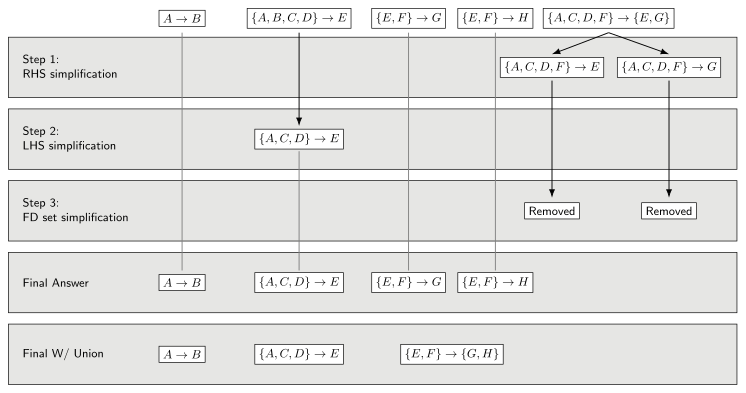
Figure 1: The same reduction seen as a flow, one band per step. Each original FD enters at the top; a black arrow means that step transformed it (split it, or shortened its LHS), a thin grey line means it passed through untouched, and the Removed boxes are where step 3’s closure test deleted an FD outright.
Worked example — a wide right-hand side
Here step 1 does almost all the work. R [C, S, J, D, P, Q, V] with
F = {C → {S, J, D, P, Q, V}, {J,P} → C, {S,D} → P, J → S}.
| Step 1: RHS split | Step 2: LHS simplify | Step 3: delete redundant |
|---|---|---|
C → S |
C → S |
dropped |
C → J |
C → J |
C → J |
C → D |
C → D |
C → D |
C → P |
C → P |
dropped |
C → Q |
C → Q |
C → Q |
C → V |
C → V |
C → V |
{J,P} → C |
{J,P} → C |
{J,P} → C |
{S,D} → P |
{S,D} → P |
{S,D} → P |
J → S |
J → S |
J → S |
- Step 2 changes nothing. Only
{J,P} → Cand{S,D} → Phave a compound LHS, and neither attribute can go:{J}⁺ = {J,S}and{P}⁺ = {P}both missC;{S}⁺ = {S}and{D}⁺ = {D}both missP. - Step 3 deletes two.
C → Sgoes becauseC → JthenJ → Salready reachesS.C → Pthen goes too: with it removed,Cstill reachesS(viaC → J,J → S) andDdirectly, and{S,D} → PsuppliesP. Neither removal depends on the other being made first — test them in the opposite order and both still come out redundant.
Minimal cover: {C → J, C → D, C → Q, C → V, {J,P} → C, {S,D} → P, J → S}, or with same-LHS FDs recombined, {C → {J, D, Q, V}, {J,P} → C, {S,D} → P, J → S}.
With C → P removed, the only surviving statement about P is {S,D} → P, which is exactly the FD 3nf-synthesis will turn into its own relation. Steps 2 and 3 are not tidying — they decide the shape of the schema you end up with.
Worked example — spotting a false answer
R [A, B, C, D, E, F] with {D,E,F} → C, {A,B} → {D, C}, D → F.
- Step 1 gives
{D,E,F} → C,{A,B} → D,{A,B} → C,D → F. - Step 2: in
{D,E,F} → C, isFredundant?{D,E}⁺already containsFviaD → F, so{D,E}⁺ = {D,E,F}⁺— yes. It becomes{D,E} → C. - Step 3: nothing further can go; all four are necessary.
Minimal cover: {{D,E} → C, {A,B} → D, {A,B} → C, D → F}.
The wrong answers to this question are instructive: keeping the redundant F in the first LHS (step 2 skipped), dropping {A,B} → C (it is not implied by the others — {A,B}⁺ without it reaches D and F, never C), or dropping D → F (which the simplified {D,E} → C now depends on).
Worked example — on a real schema
From week11-tutorial-case-study-9-payroll-system, the Department relation [code, name, manager, buildingID, buildingName, buildingLocation, floor] with code as the key, plus buildingID → {buildingLocation, buildingName} and buildingName → {buildingLocation, buildingID}.
After splitting the key’s FD into single-attribute FDs, step 3 removes three of them:
code → buildingName— derivable viacode → buildingIDthenbuildingID → buildingName.code → buildingLocation— derivable the same way.buildingID → buildingLocation— derivable viabuildingID → buildingNamethenbuildingName → buildingLocation.
Minimal cover: {code} → {name, manager, buildingID, floor}, {buildingID} → {buildingName}, {buildingName} → {buildingLocation, buildingID}.
Feeding that straight into 3nf-synthesis yields Department [code, name, manager, buildingID, floor] and Building [buildingName, buildingLocation, buildingID] — the transitive code → building… redundancy removed exactly because step 3 removed the transitive FDs.
Redundancy can hide behind a chain
Step 3’s test is “is A still reachable without this FD”, which catches FDs whose work is done indirectly by two or more others. From week11-tutorial-applied-class-10-normalisation-bcnf-3nf-synthesis, R [A, B, C, D, E, F] with A → {B,C,D,E,F}, {B,C} → A, {D,E} → B, C → D:
A → Bis redundant —A → D,A → E, then{D,E} → B.A → Dis redundant —A → C, thenC → D.
leaving A → {C, E, F}, {B,C} → A, {D,E} → B, C → D. Neither removal is visible from a single FD; both need the closure test.
See also
- 3nf-synthesis — the algorithm that consumes a minimal cover
- attribute-closure · functional-dependencies · normal-forms · decomposition
- 2026-05-04-normalisation-and-relational-database-schema-design — Module 4, part 2
- week11-tutorial-applied-class-10-normalisation-bcnf-3nf-synthesis · week11-tutorial-case-study-9-payroll-system — practice