Integrity Constraints
Integrity constraints are the rules that enforce the correctness of a database: conditions stated on the schema that must hold on every instance of it. A DBMS’s job is to reject any operation that would leave them unsatisfied. Introduced in 2026-03-09-the-relational-model-and-integrity-constraints and practised in week4-tutorial-applied-class-3-relational-integrity; these are constraints on a relational schema, distinct from the relationship-constraints placed on an ER diagram.
The five kinds
| Constraint | Violated when | Enforced by |
|---|---|---|
| Domain | An attribute’s value isn’t a member of its domain | The column’s declared type/format |
| Key | Two tuples share the same value for a key | The declared key |
| Entity integrity | Any part of a tuple’s primary key is NULL |
The declared primary key |
| Referential integrity | A non-null foreign key value matches no primary key value in the referenced relation | The declared foreign key |
| Semantic | A business rule that isn’t derivable from the schema’s structure is broken | Application-level rules — triggers, assertions, CHECK |
The first four are structural: they follow from the schema itself, so the DBMS enforces them for free once the types and keys are declared. The fifth is not — nothing in the schema’s shape implies it, so it has to be stated separately.
Enforcement is unconditional and the default outcome is refusal: any insert, modification or deletion submitted to the DBMS that would violate integrity — that would leave the database in an inconsistent state — must be rejected. The only constraint whose violation has other sanctioned outcomes is referential integrity on a delete, and only because the foreign key was declared with a policy saying so (see update-operations-and-constraint-violations).
Which operation can break which constraint is not symmetric, and the asymmetry is examinable:
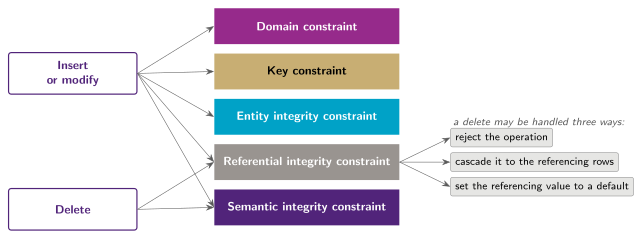
Figure 1: Insert and modify can violate all five constraints; delete can only violate the last two, and a referential violation on delete has three sanctioned outcomes rather than one. The banner colours are the course’s fixed fills for the five constraint types.
A delete cannot break a domain, key or entity-integrity constraint because it adds no value and duplicates no key — it can only strand something that was pointing at the row it removed, or break a business rule about what must continue to exist.
Domain constraint
The domain is the set of legal atomic values for an attribute (see relational-model), so a domain violation is simply a value that isn’t in that set. Employee.id = "LOL" violates it when id is a four-digit integer.
The domain need not be a plain data type — a format counts. A bank rejecting the password password123 with “your password must contain at least one capital letter and a number” is enforcing a domain constraint: the domain of password is defined as the strings matching that format, and password123 isn’t a member of it. Likewise a course code declared as four letters followed by four digits, or an enumerated domain: inserting VehiclePurpose = 'Personal' when the column is ENUM('Private', 'Business') is a domain violation, not a semantic one.
The commonest exam version of a domain violation is subtler — a value of the wrong kind in the right position. Inserting (2644, James, Smith, 1) into Employee [id, name, salary, department] breaks the domain constraint because the third value lands in salary, whose domain is integer or float, not a surname.
Key constraint
No two tuples may share a value for a key. Violated by inserting a tuple whose key duplicates an existing one, or by modifying an existing tuple into a duplicate. See relational-keys for what qualifies as a key in the first place.
Entity integrity constraint
No part of a primary key may be NULL — for a composite primary key, no component may be null, not merely “not all of them”. Inserting (677678989, null, 40.0) into WorksOn [essn, pNo, hours] violates entity integrity because pNo is half of the primary key.
The rationale is that the primary key is the relation’s identity: a tuple with an unknown key value cannot be distinguished from, or referred to by, anything. This is the one place a NULL is categorically banned — sql-nulls has the table of which declarations do and don’t permit one.
Referential integrity constraint
A non-null foreign key value must match some existing primary key value in the referenced relation. Inserting an Employee with department = 5 when no Department has id = 5 violates it; so does deleting Department 5 while employees still reference it, and so does updating a foreign key to a value that doesn’t exist. NULL is always allowed — see foreign-keys for the formal statement.
Semantic (business-rule) constraint
Semantic constraints are defined by the business or organisation during client consultation — they come from the organisation, not from the data structure:
- “An employee’s salary must not exceed their supervisor’s.”
- “The maximum number of hours an employee can work on a project is 56.”
- “A department cannot have more than three active projects at a time.”
- “A customer must be at least 18 years old.”
Take the first and third. Inserting Grace Chan on 58000 with superSSN = 888665555 — James Borg, on 55000 — violates the salary rule and nothing else; inserting a fourth project for department 5, which already has ProductX, ProductY and ProductZ, violates the three-project rule and nothing else. In both cases every structural check passes, which is exactly the signal that the answer is “semantic”.
Nothing about the relations’ shape rules these out, so they’re expressed in a constraint specification language — in SQL’s case, the mechanisms are CHECK clauses, assertions and triggers. This course files the latter two under DCL, alongside transaction control and privilege management. Only CHECK is developed and examined (see sql-ddl for the CHECK and named-constraint syntax); assertions and triggers are the general-purpose fallback and are not defined further, so “enforced by an assertion or a trigger” is as far as the course goes. This is also the category to fall back on when asking “which constraint does this break?” and none of the structural four apply.
The converse matters just as much: a rule that was never stated isn’t a constraint. Updating Department (2, Development, 1751) to (2, Development, 2034) where employee 2034 works in a different department violates nothing, unless the business rule “a manager must work in the department they manage” has actually been specified.
Naming an example of each
The other exam shape is the reverse: given a schema, point at one instance of each kind of constraint. For the enrolment schema
Student [stID, name, email]

Enrolment [stID, cCode, sem, year]
Enrolment.stID references Student.stID
Enrolment.cCode references Course.cCode

Course [cCode, title, units]
a key is stID in Student, a foreign key is stID in Enrolment, and a domain constraint is cCode being four letters followed by four digits. stID supplies both of the first two answers depending on which relation it is read in — the same attribute name is a key where it identifies and a foreign key where it refers.
Diagnosing a violation
Given an operation and a schema, work down the five in a fixed order. The order isn’t significant in itself; checking all five every time is, since one operation can break several at once.
- Domain — is every value of the right type/format for its column?
- Key — does this key value already exist?
- Entity integrity — is any part of the primary key null?
- Referential integrity — does every non-null foreign key point at a row that exists? And, for a delete, does anything still point at the row being removed?
- Semantic — does it break a stated business rule?
A single operation can violate more than one at once. Inserting ('ProductA', 'A', 'Bellaire', 2) into Project [pName, pNumber, pLocation, dNum] breaks both the domain constraint (pNumber is an integer, not 'A') and referential integrity (no department 2). Inserting ('Production', 4, 943775543, …) into Department breaks the key constraint (dNumber = 4 exists) and referential integrity (mgrSSN isn’t a real employee). Don’t stop at the first one found.
And the operations that violate nothing
Three of the applied class’s ten answers are “No”, and they are the ones worth rehearsing, because each looks like a violation and isn’t:
| Operation on the company schema | Why it is legal |
|---|---|
Insert ('Robert', 'F', 'Scott', 943775543, '1942-06-21', '2365 Newcastle Rd, Bellaire, TX', 'M', 50000, 888665555, 1) into EMPLOYEE |
Fresh ssn, every value in its domain, superSSN 888665555 and dNo 1 both exist, and 50000 is under the supervisor’s 55000 |
Delete the WORKS_ON tuples with essn = 333445555 |
Nothing references WORKS_ON, so no reference is stranded |
Modify DEPARTMENT’s mgrSSN/mgrStartDate for dNumber = 5 to 123456789 and '1988-10-01' |
123456789 is a real employee (John Smith), so the foreign key still resolves, and no other constraint touches the manager column |
Compare that last row with the case where the new manager works in a different department: it still violates nothing. A manager who works elsewhere offends intuition, not any declared constraint.
See update-operations-and-constraint-violations for which constraints each kind of operation can possibly violate, and what a DBMS does about it; sql-dml shows the same violations as the error messages MySQL actually returns.