Foreign Keys
A foreign key is a set of attributes in one relation that links it to another relation’s primary key — the only mechanism the relational model has for expressing a relationship between two relations, and therefore the thing almost every mapping step in er-to-relational-mapping produces. Introduced in 2026-03-09-the-relational-model-and-integrity-constraints; see relational-keys for keys within a relation and relational-mapping-notation for the references notation used throughout.
Definition
Let FK be a set of attributes in relation R1, and PK the primary key of relation R2. FK is a foreign key referencing PK if:
FKandPKare drawn from the same domain(s) — the names need not match, only the domains (see relational-model on why attribute names and domains are independent), and- for every tuple \(t_1\) in
R1, either \(t_1[\mathit{FK}]\) isNULL, or there exists a tuple \(t_2\) inR2with \(t_1[\mathit{FK}] = t_2[\mathit{PK}]\).
Condition 2 is the referential integrity constraint. Note what it permits: a foreign key value may be NULL (the row simply doesn’t participate), but it may never be a value that points nowhere. A dangling reference is the violation; an absent reference is not.
Department [id, name, manager]
Department.manager references Employee.id

Employee [id, name, sex, salary, department]
Employee.department references Department.id
Foreign keys can point in both directions between the same pair of relations, as here — Department.manager says who runs the department, Employee.department says who works in it. They are two separate constraints expressing two separate relationships.
An instance makes the permission concrete: Department 4 (Human Resources) has a NULL manager and employee 2034 a NULL department, and both rows are legal. An employee whose department read 5, with no department 5 in the referenced relation, would not be.
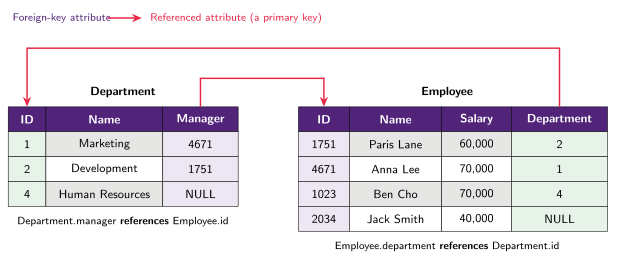
Figure 1: A two-way foreign key between Department and Employee. Each arrow starts at the foreign-key column and its head lands on the referenced primary key — the direction never varies in this course. The tinted columns pair each foreign key with the primary key it points at; the two NULLs are legal, because a foreign key may be absent but may never point nowhere.
Shapes a foreign key can take
Self-referencing
A relation can reference itself, because the two attributes involved share a domain even though they play different roles. Adding a managerId column to the same Employee relation gives one:
Employee [id, name, salary, department, managerId]
Employee.managerId references Employee.id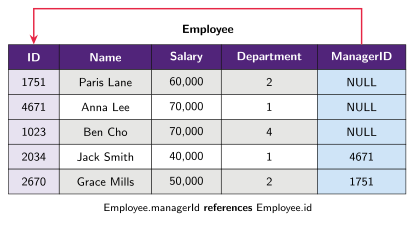
Figure 2: A self-referencing foreign key: the arrow leaves ManagerID and returns to ID in the same relation. The three top-level employees carry NULL, which is what stops the reference chain rather than a special case in the constraint.
The company schema does the same thing with different names:
Employee [ssn, fName, lName, dob, superSSN]
Employee.superSSN references Employee.ssn
This is what a recursive relationship (relationship-types — SUPERVISION: an employee supervises many employees) maps to: the N-side role, the supervisee, carries the foreign key back to the 1-side role, the supervisor. It is also what a sql-joins self-join follows back.
Composite
If the referenced primary key is composite, the foreign key must be composite too, and the whole thing is one constraint over a tuple of columns:
Student [sid, name]

Course [cid, department, manager]

Enrollment [sid, cid, department, grade]
Enrollment.sid references Student.sid
Enrollment.{cid, department} references Course.{cid, department}Course’s key is the pair (cid, department), so Enrollment must carry both columns to name one course, and its own key is all three of (sid, cid, department).
Splitting a composite foreign key into several single-column constraints is a real and commonly-marked mistake — see er-mapping-pitfalls — because it no longer forces all the columns to jointly match one referenced row.
Two foreign keys to the same relation
When a relationship uses the same entity type in two different roles, the referencing relation gets two separate foreign keys to it, given distinct column names so the roles stay readable:
PeerEvaluation [studentSid, assessmentSid, number, evaluationId, sidGrades, mark]
PeerEvaluation.studentSid references Student.sid
PeerEvaluation.sidGrades references Student.sid
PeerEvaluation.{assessmentSid, number} references Assessment.{sid, number}
studentSid is the evaluator submitting the mark; sidGrades is the student whose assessment is being marked.
Is the foreign key part of the primary key?
This is the question that decides most mapping answers, and the rule is structural rather than a matter of taste:
| Situation | Foreign key is… |
|---|---|
| 1:N relationship, FK on the N side (an entity with its own key) | A plain, non-key attribute |
| 1:1 relationship, FK on the chosen side | A plain, non-key attribute |
| Weak entity, FK to its owner | Part of the weak entity’s composite primary key |
| M:N relationship’s own relation | Part of the primary key (the pair of FKs is the key) |
| N-ary relationship’s relation, FK from a many-side participant | Part of the primary key |
| N-ary relationship’s relation, FK from a 1-side participant | A plain, non-key attribute |
| Multivalued attribute’s relation | Part of the primary key (with the value itself) |
| Subclass relation | Is the primary key — the subclass’s key is the superclass’s key |
So in Employee [ssn, …, dNumber, superSSN] the department and supervisor foreign keys are ordinary columns, whereas in Dependent [ssn, depName, …] the inherited ssn is underlined as part of the key. Treating an ordinary 1:N foreign key as key material is a standard wrong answer.
The dividing line is whether the referencing entity has a key of its own. An entity that doesn’t — the cinema Viewing, identified only by which movie, which customer and when — is being identified through its owners, so the inherited foreign keys do join its key: Viewing [name, id, date, time, attendant], keyed on all four of (name, id, date, time). That reads as weak-entity behaviour with two owners rather than as an exception to the rule, and the shape is straight out of the mapping rules: a weak entity with more than one owner takes a foreign key to each owner and is keyed on every owner key plus its partial key (step 2 of er-to-relational-mapping). Reading Viewing as a weak entity with two owners or as a strong entity whose key happens to be composite produces the same relation, so the mapping answer is the same either way.
Nulls, and when to avoid them
Because a foreign key may be NULL, embedding a 1:1 or 1:N relationship directly into an existing relation produces a null in every row that doesn’t participate. When a relationship is sparse — few of the rows actually take part — mapping it as its own relation instead (the M:N treatment) avoids all those nulls at the cost of an extra join. That trade-off is noted under step 5 of er-to-relational-mapping; see sql-nulls for what nulls then do to queries.
Enforcement
Referential integrity is declarative — the DBMS rejects any insert, update, or delete that would leave a dangling reference, with no application code involved (see integrity-constraints).
Three operations from week4-tutorial-applied-class-3-relational-integrity show the full range, and they are worth reading together because two of them look dangerous and are not:
| Operation on the company schema | Verdict |
|---|---|
Delete the EMPLOYEE tuple with ssn = 987654321 |
Violates referential integrity — tuples in WORKS_ON, DEPENDENT, DEPARTMENT and EMPLOYEE itself all reference it |
Modify EMPLOYEE.superSSN of 999887777 to 943775543 |
Violates referential integrity — no employee has that ssn; an update to a foreign key is checked exactly like an insert |
Delete the WORKS_ON tuples with essn = 333445555 |
No violation — nothing references WORKS_ON, so removing rows from it cannot dangle anything |
The last row is the shape people get wrong: whether a delete is safe depends on what points at the relation, not on how many foreign keys the relation itself carries. WORKS_ON is all foreign key and is still free to delete from. The EMPLOYEE delete is dangerous precisely because four relations, one of them EMPLOYEE itself through superSSN, point back at it.
What happens to dependent rows when a referenced row is deleted or its key updated is a policy choice attached to the foreign key itself: the violation can be rejected, cascaded, or the referencing attribute values modified to a default value. See update-operations-and-constraint-violations for those conceptual options and sql-ddl for the four named ON DELETE / ON UPDATE actions that spell them out in SQL.