Update Operations and Constraint Violations
There are three update operations on a relational database — insert, delete, and modify — and each can break a different subset of the integrity-constraints. Knowing which subset turns “does this operation violate anything?” from a search into a checklist. Introduced in 2026-03-09-the-relational-model-and-integrity-constraints, drilled across week4-tutorial-applied-class-3-relational-integrity and week6-tutorial-case-study-4-easydrive-insurance. This is the model-level account; sql-dml is the same three operations as SQL statements.
Which operation can violate what
| Domain | Key | Entity integrity | Referential integrity | Semantic | |
|---|---|---|---|---|---|
| Insert | ✓ | ✓ | ✓ | ✓ | ✓ |
| Delete | ✓ | ✓ | |||
| Modify | ✓ | ✓ | ✓ | ✓ | ✓ |
Insert can violate all five: it supplies fresh values for every attribute, so any of them can be out of domain, duplicate an existing key, leave a primary key component null, point at a nonexistent row, or break a business rule. Five candidate tuples for the same two-table schema, differing in one value each, show one of each:
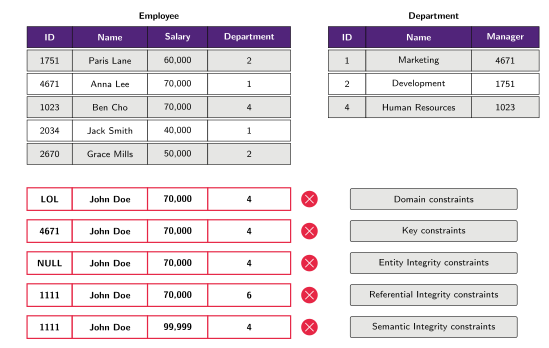
Figure 1: One insert, five ways to break it. Each candidate row differs from a legal Employee tuple in exactly one value, and each trips a different constraint: LOL is not a four-digit integer (domain), 4671 already exists (key), a null ID is a null primary key (entity integrity), department 6 is not in Department (referential integrity), and 99,999 exceeds the supervisor’s salary, which the business rule forbids (semantic). The crimson outline plus ✗ badge is the course’s notation for an illegal tuple.
Modification is the same picture: it can produce any of those five rows out of a legal one, so it inherits the whole column.
Delete is the interesting row. It supplies no values at all, so it cannot possibly produce an out-of-domain value, a duplicate key, or a null primary key. What it can do is remove a row that something else still references — a referential integrity violation on the other relation — or break a business rule. Both happen on the same two-table Employee/Department schema: deleting the department with id = 2 violates referential integrity, because employees still sit in it, while deleting employee 1023 violates a semantic constraint if the rule “every department must have at least one employee” has been stated. This asymmetry is worth remembering: for a delete, the only question is who points at the row being deleted.
Modify behaves like an insert restricted to the columns it touches: changing a key column risks a key violation, changing a foreign key risks a referential one, and changing a primary key component to NULL risks entity integrity.
Handling a referential violation on delete
Rejecting the operation isn’t the only option. At the relational-model stage there are exactly three outcomes for a referential integrity violation — it can be:
| Policy | Effect |
|---|---|
| Rejected | Refuse the delete; the referencing rows keep the referenced row alive |
| Cascaded | Delete the dependent rows too |
| Modified to a default value | Keep the dependent rows, but reset the referencing attribute’s value |
That three-way choice is what is examinable here; the finer-grained named actions — RESTRICT (the default), CASCADE, SET NULL and SET DEFAULT, each available on both delete and update — arrive with SQL DDL and are examined there, not at the model level. See sql-ddl for their exact semantics and syntax, and foreign-keys for the constraint itself.
The choice is a property of the foreign key, decided at design time from what the dependent rows mean without the row they reference: an insurance claim makes no sense without its policy, so EasyDrive declares its claims ON DELETE CASCADE.
Worked diagnoses
Against the company schema Employee [ssn, …, superSSN, dNumber], Department [dName, dNumber, mgrSSN, mgrStartDate], DeptLocations [dNumber, dLocation], Project [pName, pNumber, pLocation, dNum], WorksOn [essn, pNo, hours], Dependent [essn, depName, …], plus two business rules — an employee’s salary cannot exceed their supervisor’s, and a department cannot have more than three active projects:
| Operation | Violates |
|---|---|
Insert an employee with a fresh ssn, a real supervisor, salary below the supervisor’s |
Nothing — a well-formed insert |
Insert ('ProductA', 'A', 'Bellaire', 2) into Project when no department 2 exists |
Referential integrity and domain (pNumber is an integer, not 'A') |
Insert a department whose dNumber already exists and whose mgrSSN doesn’t |
Key and referential integrity |
Insert (677678989, null, 40.0) into WorksOn, essn not an employee |
Entity integrity (pNo is part of the key) and referential integrity |
| Insert an employee earning more than their supervisor | Semantic |
Delete the WorksOn rows for one employee |
Nothing — nothing references WorksOn, and no rule requires an employee to have assignments |
Delete an Employee row |
Referential integrity — WorksOn, Dependent, Department and Employee itself may all reference that ssn |
Modify a department’s mgrSSN to another existing employee |
Nothing, absent a stated rule about who may manage a department |
Modify an employee’s superSSN to an ssn that doesn’t exist |
Referential integrity |
| Insert a fourth active project for a department | Semantic |
Two habits fall out of this. First, always check whether the row being deleted is referenced, not just whether it exists. Second, “no violation” is a legitimate answer — several of the operations above are perfectly legal, and the temptation is to invent a rule that forbids them.
Failures cascade
A rejected operation changes nothing, which means later operations that assumed it succeeded fail too. In the EasyDrive case study, inserting a Vehicle with VehiclePurpose = 'Personal' fails on a domain constraint (the column is ENUM('Private', 'Business')); the next insert, a Policy referencing that vehicle, then fails on referential integrity even though its own values look fine. When a sequence of operations is being analysed, each one has to be judged against the state the previous ones actually left behind — not the state they were intended to leave.
The transaction concept
A transaction is an executing program containing database operations — reads, inserts, deletes, updates. The consistency requirement applies at the end of a transaction, not between its individual steps: constraint violations are permitted at intermediate points, as long as the final state satisfies every constraint specified on the schema.
A transaction is a walk between two consistent states. It starts from consistent state 1, and each INSERT, UPDATE or DELETE moves the database through intermediate states that need not satisfy the constraints; a COMMIT ends the walk at consistent state 2, while a ROLLBACK — or any error or failure along the way — returns the database to consistent state 1 as though nothing had happened. Either way the database is never left inconsistent.
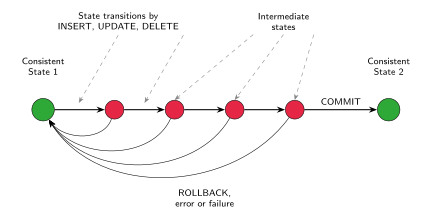
Figure 2: The transaction as a walk between consistent states. Green = a state satisfying every constraint, red = an intermediate state that need not. Only COMMIT and ROLLBACK end the walk, and both end it on a green state. The course has no house notation for transaction diagrams, so the shapes and colours here are not a convention to reproduce in an answer.
This is what makes mutually-dependent business rules satisfiable at all. Given “every department must have at least one employee” and “every employee must work for a department”, neither a new department (no employees yet) nor a new employee (no department yet) can be inserted on its own without breaking a rule. A single transaction that inserts the department and its first employee resolves the deadlock: the intermediate state after the first insert is inconsistent, but the final state after both inserts is valid, and that is the state the constraints are judged against.