Relational Keys
A key is a minimal set of attributes that uniquely identifies the tuples of a relation. Everything else in this note is a refinement of that one sentence. Introduced in 2026-03-09-the-relational-model-and-integrity-constraints and drilled in week4-tutorial-applied-class-3-relational-integrity; see relational-mapping-notation for how keys are written down (the primary key is underlined) and foreign-keys for the cross-relation case.
Minimality is the whole point
Uniqueness alone isn’t enough — a key must also be minimal, meaning it contains no redundant attributes. Minimal does not mean “the shortest set anyone could find”: it means that removing any attribute from the set destroys the uniqueness property.
Given Department [id, name, manager] where department IDs are unique:
| Candidate set | Unique? | Minimal? | Key? |
|---|---|---|---|
(id) |
Yes | Yes | Yes |
(id, name) |
Yes | No — id alone already suffices |
No |
(id, manager) |
Yes | No — same reason | No |
Adding anything to an already-unique set keeps it unique but destroys minimality, so (id, name) is never a key while (id) is one.
Ask the same key question twice on one instance, changing only the assumptions, and the pair is the whole lesson:
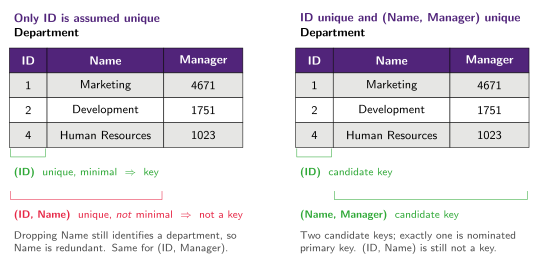
Figure 1: Two key questions on one instance. Left: only ID is assumed unique, so (ID) is the sole key and (ID, Name) fails minimality. Right: (Name, Manager) is also assumed unique, which adds a second candidate key without making (ID, Name) one.
Nothing in the data changed between the two panels — only what the question tells you to assume. Keys are a property of the schema and its stated uniqueness assumptions, never something you can read off one instance.
The vocabulary
| Term | Meaning |
|---|---|
| Superkey | Any set of attributes that uniquely identifies tuples — not necessarily minimal |
| Candidate key | A minimal superkey; a relation may have several |
| Primary key | The one candidate key chosen as the key for the relation; exactly one per relation |
| Composite key | A key made of more than one attribute |
Every key is a superkey; the reverse doesn’t hold. In the table above, (id, name) is a superkey but not a candidate key. The relational-model material works with key, candidate key and primary key only — superkey enters later, with design theory, where the formal treatment of it lives: attribute closure, and how to find all the candidate keys of a relation from its functional dependencies (see functional-dependencies and attribute-closure).
Textbook terms the course never uses are worth not importing: there is no alternate key, secondary key or surrogate key anywhere in INFS1200. A candidate key that lost the nomination is just “another candidate key” and becomes an ordinary attribute in the relational schema; an artificial identifier is just a key that was chosen. Answers should stay inside the four terms above.
Several candidate keys
If department IDs are unique and the combination of name and manager is also unique per department, then Department has two candidate keys: (id) and (name, manager). Both are minimal and both are unique; (id, name) still isn’t a key because (id) alone already suffices. Exactly one of the candidate keys is then nominated as the primary key — a design choice, not something the data dictates.
Composite keys
A key can perfectly well span several attributes. Composite primary keys turn up constantly, and mostly for structural reasons rather than arbitrary ones:
- A weak entity’s relation is keyed on its owner’s primary key plus its own partial key, e.g.
Dependent [ssn, depName, …]. - An M:N relationship’s relation is keyed on the pair of foreign keys it carries, e.g.
WorksOn [ssn, pNo, hours]. - A multivalued attribute’s relation is keyed on the owner’s key plus the value itself, e.g.
DeptLocs [dNumber, location].
All three come out of er-to-relational-mapping. In this course’s notation a composite primary key is written as one continuous underline spanning all of its attributes — one key, not several.
Common misconceptions
From the true/false drill in week4-tutorial-applied-class-3-relational-integrity:
| Statement | Verdict |
|---|---|
| A key is a unique identifier of a tuple in the relation | True — that’s the definition |
| The key constraint (or uniqueness constraint) implies that no two tuples in a relation can have the same values for all attributes | True (as the course marks it) |
| A primary key is a candidate key chosen as the main key for a relation | True |
| A key cannot have multiple attributes | False — composite keys exist |
| An entity may have more than one primary key | False — several candidate keys, but only one is the primary key |
The second row is worth pausing on, because the obvious objection is a good one: no two tuples can agree on all attributes in any relation, declared key or not, since a relation is a set. The course still marks it true, reading it as “the key constraint implies uniqueness of tuples” — so answer it the course’s way, and keep the set-semantics point as the reason the statement is weak rather than as a reason to call it false.
Matching the four terms
Matching definitions to names is a compact statement of all four:
| Definition | Term |
|---|---|
| Any minimal set of attributes that can uniquely identify tuples in a relation | Candidate key |
| A candidate key that is chosen to identify tuples in a relation | Primary key |
| Defines the structure of a relation; specified during database design | Relational schema |
| Data in a relation, modified via create, update and delete operations | Relational instance |
Worked example — electoral roll
Region [prefix, suffix]

Member [enrolmentId, passportNum, regionPrefix, regionSuffix]
Member.{regionPrefix, regionSuffix} references Region.{prefix, suffix}

Candidate [enrolmentId, name, regionPrefix, regionSuffix]
Candidate.enrolmentId references Member.enrolmentId
Candidate.{regionPrefix, regionSuffix} references Region.{prefix, suffix}- Candidate keys:
Member.enrolmentId,Member.passportNum,Candidate.enrolmentId,Region.{prefix, suffix}—Memberhas two, since a passport number identifies a member just as well as an enrolment ID does. - Primary keys:
Member.enrolmentId,Candidate.enrolmentId,Region.{prefix, suffix}— one per relation,passportNumlosing out toenrolmentIdas a design choice. - Composite primary key:
Region.{prefix, suffix}. - Foreign keys:
Member.{regionPrefix, regionSuffix},Candidate.{regionPrefix, regionSuffix},Candidate.enrolmentId— note the last one is simultaneouslyCandidate’s primary key and a foreign key, which is exactly what a subclass relation looks like.
What keys enforce
Two of the five integrity-constraints exist to protect keys:
- The key constraint — no two tuples may share a value for a key. Violated by inserting or modifying a tuple so that it duplicates an existing key value.
- The entity integrity constraint — no part of a primary key may be
NULL. For a composite primary key this means every component must be non-null; a single null component is already a violation.
Both are declarative: the DBMS enforces them automatically once the key is declared, without any application code (see sql-ddl for the PRIMARY KEY / UNIQUE syntax that declares them).