Database Access Control
Access control is the DBMS’s answer to “who is allowed to do what to which data”. It’s one of four categories of database control measure, and by far the largest — three distinct authorisation mechanisms (DAC, MAC, RBAC), each with its own model and syntax. Introduced in 2026-05-11-database-security.
What security is protecting against
Threats to a database are usually framed with the CIA principle:
| Threat | Meaning |
|---|---|
| Loss of confidentiality | Unauthorised disclosure of confidential information |
| Loss of integrity | Improper modification of information |
| Loss of availability | A legitimate user cannot access data objects |
The motivations for defending against them are legal or policy-driven (government rules protecting medical records or financial ratings), ethical (who may see salary packages or student grades), and technical (malware, performance overloading).
Privacy is not the same as security
- Security concerns how access to data is controlled — availability for use, with integrity, and permitted access only.
- Privacy concerns how data may be used — an individual’s ability to control the terms under which their sensitive data is acquired and used.
Security is a required building block for privacy, but the two are distinct: privacy also covers information that can be inferred from accessible data, not only what is directly readable. Sensitive data is often double-edged — patient records are private but valuable for public-health research; CCTV audio captures private conversations but also evidence of crime — giving a utility/privacy trade-off: protect all sensitive data while making as much non-sensitive data available as possible.
The four control measures
| Measure | Purpose |
|---|---|
| Access control | Provide access only to users with the right access authority |
| Inference control | Ensure information about individuals can’t be derived indirectly (statistical databases) |
| Flow control | Prevent information flowing to unauthorised users |
| Data encryption | Protect sensitive data in transit |
The rest of this note is access control; the other three are summarised at the end.
Discretionary Access Control (DAC)
DAC is built on granting and revoking privileges — GRANT and REVOKE being SQL’s DCL family, alongside the DDL and DML of sql-ddl:
CREATE USER <username> IDENTIFIED BY "<password>";

GRANT  privilegeName
ON     objectName
TO     {userName | PUBLIC | roleName}
[WITH GRANT OPTION];

REVOKE privilegeName
ON     objectName
FROM   {userName | PUBLIC | roleName};
Two levels of privilege
- Account level — privileges held by an account independent of any particular relation:
CREATE SCHEMA/TABLE/VIEW,ALTER/DROP TABLE, and modification (INSERT/DELETE/UPDATE) andSELECTprivileges. - Relation level — privileges on a specific relation or view, and optionally on individual attributes: select (read), modification (insert/delete/update), and references. The
REFERENCESprivilege grants permission to create a foreign key pointing at the named table (see integrity-constraints) — worth noting because it’s a privilege about schema structure, not data access.
The three statement forms that repairing a real set of accounts needs — all three used in week12-tutorial-5-1-database-security:
-- everything the account holds on that object, in one statement
REVOKE ALL PRIVILEGES ON `schema`.`Table` FROM 'user';

-- the ability to delegate, revoked separately from the privilege itself
REVOKE GRANT OPTION ON `schema`.`Table` FROM 'user';

-- attribute level: the column list attaches to the privilege, not the object
GRANT SELECT (`fName`, `lName`) ON `schema`.`Table` TO 'user';
There is no statement that narrows a privilege. Downgrading an account from ALL PRIVILEGES to SELECT is always a REVOKE ALL PRIVILEGES followed by a GRANT SELECT, and taking away someone’s grant option is a second statement on top of taking away the privilege they were delegating.
Privileges can be issued as part of schema creation:
CREATE SCHEMA AUTHORIZATION oe
    CREATE TABLE Product (color VARCHAR2(10) PRIMARY KEY, quantity NUMBER)
    CREATE VIEW RedProduct AS
        SELECT color, quantity FROM Product WHERE color = 'RED'
    GRANT select ON RedProduct TO hr;
The access matrix model
Every relation is assigned an owner account, and owners may grant select/modification/references privileges on anything they own. The resulting state is an access matrix M(i, j) — the privileges user i holds on object j. Attribute-level entries appear as their own rows:
| Jake | Aiden | Nelly | Sham | |
|---|---|---|---|---|
| Customer | READ | READ | MODIFY | — |
| CustOrder | — | — | READ | — |
| CustOrder.amt | — | READ | READ | — |
| Supp.status | — | READ | MODIFY | REFERENCE |
| Supp.address | — | READ | MODIFY | MODIFY |
Building this matrix from a Universe of Discourse is what Section A of week12-tutorial-5-1-database-security asks for: read each person’s stated responsibilities, and grant the narrowest privilege that satisfies them — read-only where they only need to look, nothing at all on tables outside their remit, attribute-level SELECT where they need two columns rather than a whole table.
Propagation and revocation
REVOKE cancels a privilege, which makes temporary grants possible. The complication is delegation: if A grants a privilege to B WITH GRANT OPTION, B can grant it onward without A’s knowledge, so the DBMS must track the resulting chain of dependency:
REVOKE privilegeName ON objectName FROM userName [RESTRICT | CASCADE];CASCADE— revoke the privilege and every dependent privilege granted as a result of it.RESTRICT— refuse the revoke with an error if the privilege has already been passed on.
The governing rule is graph-shaped:
A user’s authorisation is valid iff there is a path from the root of the authorisation graph down to that user’s node.
So for u1 → u2 → u3: revoking u1’s grant to u2 also cuts off u3, because no path to u3 remains. Revoking directly from u3 leaves u2 untouched, and u2 losing authorisation never propagates upward to u1 — the grantor’s own authorisation is independent of what they’ve handed downstream.
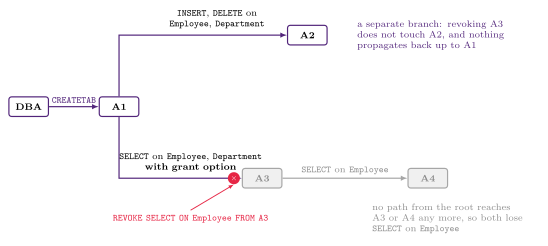
Figure 1: The A1–A4 grant chain from Worked chain below, drawn as the authorisation graph the path rule is stated over. Nothing here is a house convention. Revocation is about reachability, not about who was named in the REVOKE: A4 is never mentioned in the statement and loses the privilege anyway, purely because the edge it depended on is gone, while A2 on the untouched branch keeps everything.
Views as a security mechanism
If an owner wants to give an account a limited read capability — some columns only, or only rows meeting a condition — the idiomatic answer is to create a view and grant on the view rather than the base table (see sql-views):
-- Employee [ssn, name, dob, address, sex, salary, mgrSSN, dNum]
CREATE VIEW A3EMPLOYEE AS
    SELECT name, dob, address
    FROM   EMPLOYEE
    WHERE  dNum = 5;

GRANT SELECT ON A3EMPLOYEE TO A3;
A3 can now only ever see name, dob and address for department 5 — never salary, never ssn, never another department’s staff. The view is doing both column filtering and row filtering that a table-level GRANT could not express.
Worked chain
The DBA runs GRANT CREATETAB TO A1; A1 creates Employee and Department and then runs:
GRANT INSERT, DELETE ON Employee, Department TO A2;
GRANT SELECT ON Employee, Department TO A3 WITH GRANT OPTION;- Can
A3runGRANT SELECT ON Employee TO A4? Yes —A3holds the grant option. - If
A1then runsREVOKE SELECT ON Employee FROM A3, doesA4keepSELECT? No — it’s revoked by propagation; no path from the root reachesA4any more. - What kind of access control is this? Discretionary — privileges are granted and revoked at the discretion of individual account owners, not fixed by a system-wide classification (MAC) or role hierarchy (RBAC).
Mandatory Access Control (MAC)
MAC classifies both data and users into security classes to provide multilevel security. The typical classes, low to high, are Unclassified (U) < Confidential (C) < Secret (S) < Top Secret (TS). Users are subjects; data — a table, tuple, or individual attribute value — are objects.
The Bell-LaPadula model
| Property | Rule | Effect |
|---|---|---|
| Simple security property (“no read up”, NRU) | A subject can’t read an object classified above its own clearance | A U user can’t view a C-classified salary |
| Star property (“no write down”, NWD) | A subject can’t write to an object classified below its own clearance | An S-cleared user can’t insert a tuple containing only C-classified data |
“No write down” is the counter-intuitive one. It exists to stop information flowing downward: if a high-clearance subject could write into a low-classified object, the content of that write would leak higher-clearance context to lower-clearance readers.
Each tuple carries a Tuple Classification (TC) — the highest classification of any of its attribute values — and a table’s classification is in turn the highest TC of any tuple in it, which is the level the star property is applied at when someone writes to the table as a whole. A user sees a filtered version of the relation:
(a) EMPLOYEE (as stored)
Name       Salary      JobPerformance  TC
Smith (U)  40000 (C)   Fair (S)        S
Brown (C)  80000 (S)   Good (C)        S

(b) as seen by a Confidential-clearance user
Smith (U)  40000 (C)   NULL (C)        C
Brown (C)  NULL  (C)   Good (C)        C

(c) as seen by an Unclassified-clearance user
Smith (U)  NULL (U)    NULL (U)        U
There are two levels of hiding, both of which the tutorial tests:
- An individual over-classified cell inside a tuple the user can otherwise see is masked to
NULL— Smith’sJobPerformanceabove, and everyNULLin the tutorial’s Section B answers. - A tuple with nothing readable left in it disappears entirely — it is not returned as a row of
NULLs. That is why Brown vanishes from view (c): atU, none ofBrown(C),80000(S) orGood(C) is readable, so there is nothing left to show.
The exact test for the second case is worth being careful about. A high TC alone does not remove a tuple — in the tutorial, rows classified S are still returned to a C user with their S cells masked. Nor is an unreadable key enough on its own: CodeName’s key is the composite {spyID, name}, and the tutorial’s answers still return the BunnyBunny tuple to a C user with its S-classified name masked. What removes a tuple is having no readable value in it at all. A join between two tables can therefore return the empty set even when matching rows plainly exist, if every candidate pairing has at least one over-classified side — the join condition simply cannot be established at the user’s level.
Polyinstantiation
Suppose a C-clearance user, seeing view (b), runs UPDATE EMPLOYEE SET JobPerformance = 'Excellent' WHERE Name = 'Smith'. The system must not reject it — a rejection would reveal that a higher-classified value already exists, which is itself a leak (a covert channel). The resolution is polyinstantiation: keep multiple tuples with the same key at different classifications.
(d) EMPLOYEE, polyinstantiated
Smith (U)  40000 (C)   Fair (S)        S
Smith (U)  40000 (C)   Excellent (C)   C
Brown (C)  80000 (S)   Good (C)        S
The C user sees “Excellent”; an S-or-higher user still sees the original “Fair”. The same mechanism is why an apparent key-constraint violation can succeed in a MAC database — two “identical” tuples at different classifications are allowed to coexist.
DAC vs MAC
| Discretionary | Mandatory | |
|---|---|---|
| Flexibility | High — owners choose who gets what | Low — rigid, centrally imposed |
| Propagation control | None — once information is accessible, DAC doesn’t restrict onward sharing | Strong — classification rules enforced on every read and write |
| Protection | Weaker | Stronger — prevents illegal information flow |
Role-Based Access Control (RBAC)
Permissions attach to organisational roles; users are assigned to roles, and DAC or MAC methods are then applied to the role as a unit:
CREATE ROLE manager;
DROP ROLE manager;

GRANT ROLE full-time TO emp_typ1;
GRANT ROLE intern TO emp_typ2;

GRANT  privilegeName ON objectName TO   {userName | PUBLIC | roleName} [WITH GRANT OPTION];
REVOKE privilegeName ON objectName FROM {userName | PUBLIC | roleName};
The typical hierarchy is users → groups → roles → privileges — e.g. alice is in group admin, which maps to admin_role, which holds ALL ON SERVER server1. RBAC’s flexibility and much easier administration (change the role, not every user) make it the popular choice for web-based applications.
Beyond access control
Inference control
A statistical database publishes aggregate statistics about a population — for government statisticians or market researchers — without exposing individual records, so only aggregate queries (COUNT, SUM, MIN, MAX, AVG, standard deviation) are permitted (see sql-aggregation-and-grouping):
SELECT COUNT(*)   FROM PERSON WHERE <condition>;
SELECT AVG(Income) FROM PERSON WHERE <condition>;
The risk is that a sufficiently narrow WHERE clause isolates a group small enough — possibly a single person — that the “aggregate” discloses an individual. Mitigations:
- k-anonymity — enforce a minimum number of tuples any result may be based on.
- Prohibit query sequences over the same or overlapping populations, which could be differenced to isolate an individual.
- Differential privacy — add carefully calibrated noise to results.
Flow control
Regulates the distribution of information among accessible objects, verifying that information doesn’t flow — explicitly or implicitly — into less protected objects. This is Bell-LaPadula’s “no write down” generalised beyond a single DBMS. A flow policy names the channels information may travel along; in a simple confidential (C) / nonconfidential (N) scheme, C → N flow is prohibited. Example: an income tax computing service may be allowed to retain a customer’s address, but not their income and deductions.
Data encryption
Encryption converts data into ciphertext using an algorithm and a key; recovering the original requires the corresponding decryption key. DES (Data Encryption Standard) was developed by the US government for general public use; AES (Advanced Encryption Standard) is the newer, harder-to-crack replacement.
See also
- sql-injection — the attack that bypasses all of this by making the application issue the attacker’s SQL under its own privileges
- sql-views · integrity-constraints · sql-aggregation-and-grouping
- 2026-05-11-database-security — Module 5
- week12-tutorial-5-1-database-security — DAC permission-matrix, MAC query and audit practice