Entity Types and Attributes
The two smallest building blocks of an ER diagram: the kinds of thing a database records, and the facts it records about them. Introduced in 2026-02-23-conceptual-database-design-and-the-er-model and practised in week2-tutorial-applied-class-1-intro-to-dbms-and-basic-erd; see er-diagram-notation for the symbols and the naming style guide.
Entity, entity type, entity set
Three words that are easy to blur together, and are worth keeping apart:
| Term | Meaning |
|---|---|
| Entity | A physical or conceptual object with data associated with it — one particular student, one particular chef |
| Entity type | The format for the data that needs to be recorded to represent a particular entity — described by its name and its attributes. Drawn as a rectangle with attribute ovals attached |
| Entity set | The collection of all entities of one entity type in the database at any point in time |
The entity type is the schema-level thing (it doesn’t change as data comes and goes); the entity set is the instance-level thing (it changes with every insert and delete). The entity set is what becomes a table once the diagram is mapped — see er-to-relational-mapping.
Which attributes an entity type carries is decided by the UoD, not by the real-world object: an R&D organisation records an employee’s Degree and Field of Study where a retail organisation records Sales Experience instead. See conceptual-database-design.
Kinds of attribute
Attributes are classified along several independent axes — an attribute can be composite and multivalued, key and composite, and so on:
| Kind | Meaning | Example |
|---|---|---|
| Simple | Can’t be meaningfully split further | Email, DoB |
| Composite | Divides into smaller parts which are simple attributes with independent meaning | Name → Fname, Mname, Lname; Address → Number, Sname, Suburb, Pcode |
| Single-valued | Holds at most one value per entity | DoB |
| Multivalued | Can hold more than one value per entity (double-lined oval) | Degree — one person can hold several; Specialisations, Ingredients, Locations |
| Stored | Physically recorded | BirthDate |
| Derived | Computed from another stored attribute (dashed oval) | Age from BirthDate; Number_of_employees on a department |
| Key | Value is unique across the whole entity set (name underlined) | StudentID, Ssn |
A single EMPLOYEE entity type can carry every kind at once:
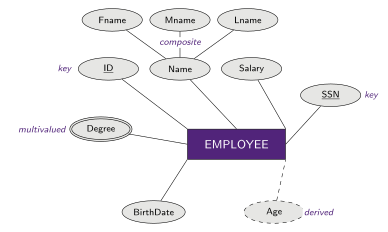
Figure 1: Every kind of attribute on one EMPLOYEE entity type. ID and SSN are two independent key attributes (solid underline). Name is composite — it fans out into Fname/Mname/Lname, and the parent oval itself is unmarked. Degree is multivalued (double outline): one person can hold several degrees. Age is derived from BirthDate, so it gets a dashed outline and a dashed connecting line, and it is never stored.
The single/multivalued split is stated over simple attributes — a composite attribute’s multiplicity is really a property of its components. The distinction between composite and multivalued is the one that catches people out: Name splitting into first/middle/last is composite (one name made of parts), whereas Phone on a student is multivalued (several independent phone numbers). Both attach several ovals to the diagram, but they mean different things and map differently.
Key attributes and candidate keys
Every entity type has at least one key constraint (equivalently, a uniqueness constraint), carried by a key attribute whose value is distinct for each individual entity in the entity set. Two properties matter:
- Multiple keys are possible. An entity type can have several independent candidate keys, each underlined in its own oval — the
EMPLOYEEabove carries bothIDandSSN. Elsewhere in the course: aDISHidentified by either itsNameor itsNumber, aVENUEby either itsIDor the combination ofNameandAddress, aVACCINEby either itsIDorBrand+Name. Any claim that an entity is “only identifiable by X” is false as soon as a second key oval is on the diagram. - A key must hold for every possible extension of the entity type. It isn’t enough that the current data happens to have no duplicates; the key must be a rule about every state the entity set could ever reach.
A composite key is a combination of simple attributes that together must be unique — a car’s Registration = State + Number, alongside a separate simple key VehicleID. On the diagram this is drawn as one underlined parent oval that splits into its component ovals, which is how you can tell “these two attributes are jointly a key” apart from “these are two separate keys”:
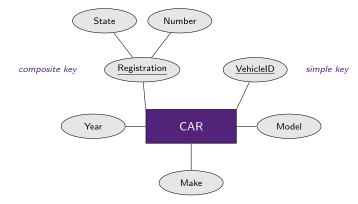
Figure 2: A CAR entity type with two candidate keys side by side: the composite Registration (underlined parent oval, splitting into State and Number — neither of which is unique alone) and the simple VehicleID. Year, Model and Make are ordinary attributes. Which of the two candidate keys is chosen as the primary key is deferred to the mapping stage, and changes the resulting schema — see er-to-relational-mapping.
The single exception to “every entity type has a key” is the weak entity, which has no key attribute of its own and is identified by its owner’s key plus its own partial key — see relationship-constraints. See also relational-keys for the same idea stated over relations rather than entity types.
Value sets and nulls
An attribute’s value set specifies the set of values that may be assigned to that attribute of an entity — employeeAge: integers between 21 and 65; vehicleRegistrationNum: a string of three alphabetic characters followed by three integers. Value sets are never displayed on the ER diagram itself — they resurface later as the domains of the relational-model, enforced as the domain constraint among the integrity-constraints.
A particular entity may not have an applicable value for an attribute, and a null value is used to represent that. Three reasons a null appears are worth keeping apart, because they are different facts about the world:
| Reason | Example |
|---|---|
| Not applicable | tertiaryDegree for a person with no university education |
| Not known whether it exists | homePhone |
| Missing — exists, but not recorded | height |
Nulls are the reason an attribute being “optional” is a real modelling decision rather than an afterthought; see sql-nulls for how they behave once queried.
Why the attribute kind matters later
The classification isn’t decorative — each kind maps differently:
- A multivalued attribute becomes its own relation, keyed on the owner’s key plus the value itself:
Staff’s multivaluedPhonebecomesStaffPhone [id, phone]. It has to — a relational column holds one atomic value (relational-model). Leavingphoneout of that key would cap each staff member at one phone number, defeating the point of making it multivalued in the first place. - A derived attribute is computed on demand, so it gets no column of its own: a trip’s
Fareis derived from its start and end times and simply doesn’t appear in the mappedTriprelation. - A composite attribute is flattened into its simple components (
Name→firstName,middleName,lastName).
All three are worked through in week4-tutorial-case-study-3-dirt-road-driving; the mapping rules themselves live in er-to-relational-mapping.