C Preprocessor and AVR Headers
The preprocessor — #include and #define — and the three lines of avr/io.h that let DDRA = 0xFF; be written as if a hardware register were a variable. First met in 2026-09-10-more-c-programming-on-the-avr; the port registers themselves are in avr-io-ports.
What the preprocessor is
C programs are first parsed by a preprocessor, which replaces preprocessor directives with substitute text. Only then does the compiler see the program. Directives start with #:
| Directive | Does |
|---|---|
#include … |
paste in a file |
#define … |
define a macro — a textual substitution |
#if, #ifdef, #else, #undef, … |
conditional inclusion, un-definition, and others |
The preprocessor does not know C. It edits text. Whatever it produces is what the compiler compiles, and every surprise in this note comes from forgetting that.
#include
| Form | Kind of header | Looks in |
|---|---|---|
#include <filename.h> |
system | the system include directories — where avr/io.h and stdio.h live |
#include "filename.h" |
user-defined | your own project directory first |
The directive is replaced by the whole contents of the named file, at that point. After preprocessing there is one file, with the header pasted in at the top.
Header files
Header (.h) files are used for common macros, function prototypes etc — the C counterpart of m324Adef.inc in assembly (avr-io-ports).
stdio.h— prototypes ofprintf()etc. The AVR has a simplified version (no files);printf()only works if you say where the characters go, e.g. a serial port.avr/io.h— defines the AVR’s useful constants and functions/macros. Definitions depend on the actual device targeted: it reads which chip is being compiled for and pulls in that chip’s register map, soDDRAmeans the right address for the ATmega324A and a different one for another part. It also suppliesuint8_tand the other fixed-width types.
Every program in the course starts with #include <avr/io.h>.
Headers against libraries
A header file is not the library. A header
- defines useful preprocessor macros,
- declares the functions that are in the library, as function prototypes, and
- declares variables that are available externally, with
extern.
The library is the collection of object files that implements the functions (compilation-and-linking).
A prototype such as int printf(const char *fmt, ...); tells the compiler the name, the argument types and the return type. That is enough for the compiler to check a call and generate it. There is no code in it, so in main.o the call to printf is left as an external reference. The code is in the library, an object file printf.o inside it, and the linker joins it on and fills in the address. An extern declaration does the same for a variable: extern int count; says that count exists somewhere else and reserves nothing.
So the header goes to the compiler, through the preprocessor, and the library goes to the linker. The two kinds of mistake show up at different steps:
| Missing | Shows up when | Typical message |
|---|---|---|
the #include |
compiling | implicit declaration of function printf |
the library, or the .c file that defines the function |
linking | undefined reference to printf |
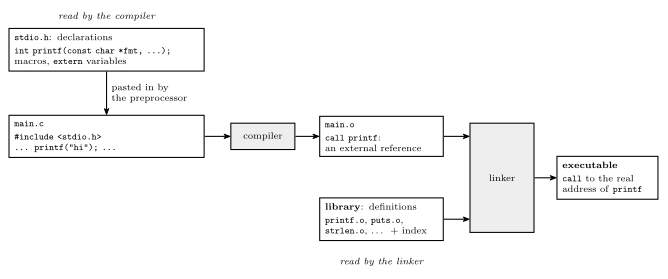
Figure 1: Where a header and a library each come into play, for a program that calls printf. The header holds only declarations. The preprocessor pastes it into main.c so that the compiler can check and generate the call, and in main.o that call is still an external reference. The library holds the definitions, as already compiled object files with an index. The linker finds printf.o through the index, links it in, and fills in the call. The header is used by the compiler and the library by the linker.
#define — macros
Macros are textual substitutions.
| Macro | Effect |
|---|---|
#define pi 3.1415 |
every later pi becomes 3.1415 — A = pi * r²; becomes A = 3.1415 * r²; (the superscript is shorthand; in real C the square would be r * r) |
#define EVER ;; |
for(EVER) becomes for(;;), an infinite loop |
#define sum(a,b) (a+b) |
a macro with parameters: sum(x, 2) becomes (x+2) |
A macro with parameters looks like a function call and is not one: no call happens, the arguments are pasted into the body as text, and the result is compiled in place.
The SQUARE trap
Given
#define SQUARE(x) (x*x), what isSQUARE(1+2)?
5, not 9. Paste the text: (1+2*1+2). Multiplication binds tighter than addition, so it is \(1 + 2 + 2\). The argument was never evaluated first, because there is no function to evaluate it.
The fix is parentheses around every parameter, and around the whole body:
#define SQUARE(x) ((x)*(x)) /* SQUARE(1+2) -> ((1+2)*(1+2)) = 9 */The outer pair matters as much as the inner: without it, 1 / SQUARE(a) becomes 1 / (a)*(a), which is \(a\), not \(1/a^2\). Write every macro this way. The AVR headers below do — note the brackets around (mem_addr) and (io_addr).
A second pitfall: an argument with a side effect is pasted as many times as the parameter appears. SQUARE(i++) becomes ((i++)*(i++)) and increments i twice.
The avr/io.h register macros
The definitions behind the port names, from avr/io.h and the device header it includes:
#define _MMIO_BYTE(mem_addr) \
                (*(volatile uint8_t *)(mem_addr))
#define _SFR_IO8(io_addr) \
                _MMIO_BYTE((io_addr) + 0x20)

/* Input Pins, Port A */
#define PINA      _SFR_IO8(0x00)

/* Data Direction Register, Port A */
#define DDRA      _SFR_IO8(0x01)

/* Data Register, Port A */
#define PORTA _SFR_IO8(0x02)(\ at the end of a line continues a directive onto the next line.)
Upshot: I/O register names can be used as variables.
DDRA = 0xFF;
PORTA = PINC | 0xF0;
Unrolling DDRA
| Step | Text |
|---|---|
| as written | DDRA = 0xFF; |
#define DDRA |
_SFR_IO8(0x01) = 0xFF; |
#define _SFR_IO8 |
_MMIO_BYTE((0x01) + 0x20) = 0xFF; |
#define _MMIO_BYTE |
(*(volatile uint8_t *)((0x01) + 0x20)) = 0xFF; |
Reading the final line from the inside out:
(0x01) + 0x20is0x21— a number.(volatile uint8_t *)casts it: treat this number as the address of an 8-bit unsigned byte. Now it is a pointer (c-pointers-and-arrays).- The leading
*dereferences it: the byte at that address. = 0xFFstores into that byte.
So DDRA = 0xFF; is a store to data address 0x21, and x = PINC; is a load from data address 0x26. There is no variable called DDRA anywhere; the name dissolves before the compiler sees it.
Why + 0x20
The AVR’s 64 I/O registers have two addresses each (avr-io-ports): an I/O-space number 0–63, which is what in and out use, and a data-space address 0x20 higher, where lds/sts — and any C pointer — find the same register. DDRA is I/O 0x01 and data 0x21. The macro takes the I/O number the datasheet lists and adds the offset, because a C pointer can only name data-space addresses. (The compiler, seeing a constant address in the I/O range, will usually emit in/out anyway.)
Why volatile
volatile tells the compiler the value at this address can change without the program changing it, and that every read and write matters. Without it the compiler is entitled to assume that a byte it wrote a moment ago still holds what it wrote, and that two reads with nothing between them give the same answer — both false for a port: PINC changes whenever the pins do, and PORTA is written for its effect on the pins, not to be read back. volatile forbids the optimisations that would break that. It is the one piece of the macro that is about hardware rather than addressing.
The same keyword belongs on any ordinary variable that an interrupt handler writes. To the code in main, a handler’s write is as invisible as a pin changing, and for the same reason: nothing in main’s own flow of control explains it. See avr-interrupts.
Naming bits
The headers also define bit numbers for every flag and pin — for example FLAG_NAME == 5 — so a mask is written from a name rather than a constant:
1 << FLAG_NAME              /* 00100000 when FLAG_NAME is 5 */
PORTA |= (1 << 5);          /* set one bit                   */
PORTA &= ~(1 << 5);         /* clear one bit                 */
The shift and the |=/&= shorthands are in c-operators; the mask patterns are in bit-masking. FLAG_NAME is a placeholder name; the actual names for the ATmega324A’s pins and flags come from the device header, as #define WGM02 3 does in 2026-10-05-more-io.
See also
- avr-io-ports — the port registers, and the I/O-space versus data-space address columns
- c-pointers-and-arrays — what
*(uint8_t *)addrmeans - c-operators —
1 << n,|=,&= - bit-masking · memory-models
- avr-interrupts —
volatileon variables shared with an interrupt handler - compilation-and-linking — what happens after the preprocessor: object files, libraries and the linker · 2026-10-15-compilation-and-linking — Lecture 22
- 2026-09-10-more-c-programming-on-the-avr — Lecture 14