C Pointers and Arrays
Arrays, pointers, and the fact that connects them: an array name is the address of its first element, and pointer arithmetic counts in elements, not cells. Both are made concrete in the AVR’s 8-bit data memory (memory-models), where an int is two cells and so a + 5 is ten cells past a. First met in 2026-09-10-more-c-programming-on-the-avr; the language basics are in c-language-basics.
Arrays
Declaring: type variable_name[size];
char message[16];
int  values[10];
uint8_t seven_seg[10] = { 63,6,91,79,102,109,125,7,127,111 };   /* with initial values */
Accessing: variable_name[index], with index = 0 … size−1 — zero-based indexing. A 365-element array has elements [0] through [364]; [365] is not one of them.
message[0] = 'c';
values[9] = values[8]++;        /* copies the OLD values[8], then increments it */
The declaration reserves size elements of the type contiguously — one after another with nothing between — which is what makes both the indexing and the pointer arithmetic below work. The elements are ordinary variables of the element type; values[3] is an int like any other.
C does not check the index. values[10] and values[-1] compile, and at run time they read or write whichever cell happens to sit past the end or before the start. The seven_seg[digit] lookup is guarded with if(digit < 10) for exactly this reason (c-control-flow).
Pointers
A pointer variable stores a memory address. Declaration: type *variable_name; — variable_name is a pointer to something of the given type.
char a, b;
char *ptr;          /* or all on one line: char a,b,*ptr; */

ptr = &a;           /* & — address-of: ptr now holds a's address  */
b = *ptr;           /* * — indirection: the value at that address */
The two operators are inverses:
| From | To | ||
|---|---|---|---|
&a |
a variable | its address | address-of — makes a pointer |
*ptr |
an address | the value stored there | indirection — follows a pointer |
In memory, say a holds 8 at address 400, b is at 434, and ptr is at 576 holding 400 — an address, not a value (drawn in 2026-09-10-more-c-programming-on-the-avr). ptr is a variable like the others, with its own cell; only its contents are special. On the AVR a data address is 16 bits (memory-models), so a pointer is two cells whatever it points at.
*ptr can also be assigned to: *ptr = 0; writes through the pointer into whatever it points at. That is how the pointer traversal below clears an array.
The * in a declaration and the * in an expression are different things. char *ptr; declares ptr as a pointer; *ptr later uses it. The declaration form reads as the thing *ptr is a char.
The hardware view
A pointer is the indirect addressing mode of addressing-modes as a language feature. ptr plays the part of the X, Y or Z register pair, *ptr is ld rd, X, and *ptr = v is st X, rr. ptr++ is the post-increment form ld rd, X+ that the instruction set provides precisely because walking a table is so common. The compiler chooses which of X, Y, Z it uses.
Arrays are pointers to their first element
An array name can be treated as a pointer to the first element — the address of the first element.
int a[10];
int *ptr;

/* the following are the same */
ptr = a;
ptr = &a[0];
So a on its own is an address, a[0] is the int there, and *a is the same int. In general a[i] is *(a + i) — the bracket notation is shorthand for pointer arithmetic, which is why the arithmetic has the rule it has.
Pointer arithmetic
Addition and subtraction on pointers work in multiples of the size of the object pointed to.
int a[10];
int *ptr;

/* the following are the same */
ptr = a+5;
ptr = &a[5];
If a starts at 300 and an int is 16 bits — two 8-bit cells — then a + 5 is 310, not 305: five elements on, two cells each. The sum is 300 + 2·5 = 310, not 300 + 5 = 305. The array is drawn in memory in 2026-09-10-more-c-programming-on-the-avr.
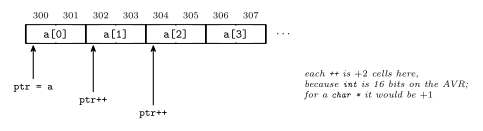
Figure 1: ptr++ on a pointer to int, on the AVR. Each step moves the pointer by one element, which is two 8-bit cells, so the addresses it visits are 300, 302, 304, … and it lands on every element exactly once. The same ptr++ on a char pointer would step by one cell. The compiler multiplies the step by the element size; the source says ++ either way. The pointer is the traversal loop’s, drawn at three successive steps.
The consequences:
- The same expression means different addresses for different types.
a + 5is 310 forint a[]and 305 forchar a[]. The type is part of the arithmetic. ptr - acounts elements, not cells: forptr = &a[5]it is 5.- Comparison works in addresses.
ptr < a + 10is true whileptris inside the array. intis 16 bits on the AVR; on a 32-bit machinea + 5would be twenty cells on. The rule is stated in terms of the size of the object because the number is machine-dependent (c-language-basics).
Traversing an array
Two ways to clear int a[10]:
/* using an index */
int a[10];
int index;
for(index=0; index<10; index++) {
    a[index] = 0;
}

/* using a pointer */
int a[10], *ptr;
for(ptr=a; ptr < a+10; ptr++) {
    *ptr = 0;
}
Adding one to an array pointer makes it point to the next element in the array. The two loops visit the same ten cells in the same order. The index loop computes a + index afresh each pass; the pointer loop keeps that address in ptr and steps it. The bound is the same in both — the address one past the last element, tested with < so it is never touched. See c-control-flow for the for itself.
The pointer form is closer to what the compiler emits either way — a register pair holding an address, an st X+, r in the body — which is why C has it.
Strings, briefly
A string constant "abc" (c-language-basics) is an array of char with a terminating zero byte after the last character, so "abc" occupies four cells. char message[16]; therefore holds at most fifteen characters, though message[16] looks like room for sixteen. The terminator is standard C.
See also
- c-language-basics · c-operators · c-control-flow · c-preprocessor-and-avr-headers
- memory-models — 8-bit data cells, 16-bit addresses, alignment
- addressing-modes — indirect addressing, which a pointer is
- avr-instructions —
ld/stwith X, Y, Z and their post-increment forms - seven-segment-display — the
seven_seg[10]lookup table - 2026-09-10-more-c-programming-on-the-avr — Lecture 14