C Control Flow
The three shapes a C program’s control can take — sequential, selection and repetition — with the statements the course uses for each: if … else, while and for. First met in 2026-09-07-introduction-to-embedded-c-programming and 2026-09-10-more-c-programming-on-the-avr; the assembly equivalents are in avr-program-structure.
The three shapes
| Shape | Statements | |
|---|---|---|
| sequential | statements run one after another | the default — any list of statements |
| selection (decision) | a test picks one of two paths | if … else |
| repetition | a body runs again while a test holds | for, while |
All three are drawn as flowcharts in 2026-09-07-introduction-to-embedded-c-programming. Every program is built from nothing but these, nested.
Truth
There is no boolean type. C interprets any 0 value as false, anything else as true. So:
| Written | Means |
|---|---|
if(a) |
if(a != 0) |
if(!a) |
if(a == 0) |
Comparisons yield 1 or 0, so if (a > b) and if ((a > b) != 0) are the same test. A bitwise test like PINC & 0x01 yields either 0x01 or 0x00, which is why it can sit directly inside an if — anything non-zero is true, and it does not need to be exactly 1.
To the hardware a truth test is a compare against zero and a branch on Z — tst/cp then breq/brne in avr-instructions. if(a) is the C spelling of branch if not zero.
Selection — if
if (expression)
    stmt
else
stmt- The
elseclause is optional. stmtcan be replaced by multiple statements enclosed in braces{ }. Without the braces, only the one statement following theif(orelse) is conditional — a second line at the same indentation runs unconditionally, whatever the indentation suggests. Always use the braces.
An if used as a guard:
if(digit < 10) {
    PORTA = seven_seg[digit];
} else {
    PORTA = 0;
}
Four input bits can hold 0–15, the array has ten entries, and the if is what keeps seven_seg[digit] inside it (c-pointers-and-arrays — C does not check).
An else if chain is an else whose single statement is another if; nothing new is needed for it.
Repetition — while
while (expression)
    stmt
Test first; if true, run the body, then test again; stop when the test is false. If the test is false to begin with, the body never runs.
while(1) — a condition that is always true — is the shape of every embedded program:
int main(void) {
    /* set-up, once */
    DDRA = 0xFF;
    while(1) {
        /* read inputs, compute, write outputs — forever */
        digit = PINC & 0x0F;
        …
    }
}
On the AVR main has nowhere to return to. The program is set-up, then loop forever, and the loop body is one pass of reading inputs and writing outputs. In assembly this was a label and an unconditional rjmp back to it (avr-program-structure); while(1) is the same jump with the label hidden.
Repetition — for
for (init; test; step)
    stmt
is exactly
init;
while (test) {
    stmt
    step;
}
— the for only gathers the three parts of a counted loop onto one line so they cannot drift apart. Two traversals of the array a:
for(index=0; index<10; index++) {     /* init: index=0; test: index<10; step: index++ */
    a[index] = 0;
}

for(ptr=a; ptr < a+10; ptr++) {       /* same loop, counting in addresses */
    *ptr = 0;
}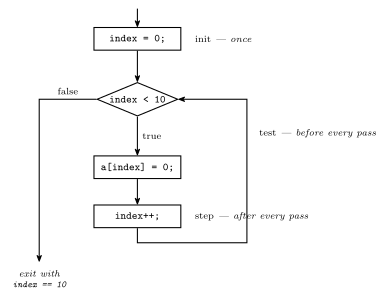
Figure 1: Where the three clauses of a for run, drawn on the repetition shape. init runs once, before anything; test runs before every pass, including the first; step runs after every pass, before the next test. The body of for(index=0; index<10; index++) therefore runs exactly ten times, with index taking 0 through 9 — and when the loop exits index is 10, the first value that failed the test. This is the while equivalence above, drawn.
The bound is the thing to get right. index < 10 runs the body for 0 through 9, the ten legal indices of a[10]; index <= 10 runs it once more, for a[10], which does not exist. The pointer form has the same edge: ptr < a+10 stops at the address one past the end without ever touching it.
Infinite loops, deliberately
The macro #define EVER ;; makes for(EVER) a spelling of for(;;) — a for with no init, no test and no step, which loops forever (c-preprocessor-and-avr-headers). It is while(1) in a different costume; the course’s programs use while(1).
Other control statements
switch, do … while, break and continue are all real C. They are not in these notes yet.
See also
- c-language-basics · c-operators · c-pointers-and-arrays · c-preprocessor-and-avr-headers
- avr-program-structure — labels and branches, the same shapes in assembly
- avr-instructions —
cp,breq,brne: what a test compiles to - 2026-09-07-introduction-to-embedded-c-programming — Lecture 13 · 2026-09-10-more-c-programming-on-the-avr — Lecture 14