C Operators
The operators the course uses, in groups — arithmetic, comparison, bitwise, logical, assignment — with the two families that look alike and are not, the shift operators and what they compile to, and the prefix/postfix rule. First met in 2026-09-07-introduction-to-embedded-c-programming; the signed/unsigned shift rule is in 2026-09-10-more-c-programming-on-the-avr. Types are in c-language-basics.
Binary operators
| Group | Operator | Meaning | AVR instruction behind it |
|---|---|---|---|
| arithmetic | + |
addition | add, adc |
- |
subtraction | sub, sbc |
|
* |
multiplication | mul |
|
/ |
division (integer, truncates toward 0) | a library routine — the AVR has no divide | |
% |
remainder (integer) | likewise | |
| comparison | > >= < <= |
ordering | cp then a branch on the flags |
== |
equal | cp then breq |
|
!= |
not equal | cp then brne |
|
| bitwise | & |
bitwise AND | and, andi |
\| |
bitwise OR | or, ori |
|
^ |
bitwise XOR | eor |
|
| logical | && |
logical AND | compare-and-branch sequences |
\|\| |
logical OR | ||
| assignment | = |
assignment | a mov, ld/st, or in/out — whatever the two sides are |
The instructions in the last column are in avr-instructions.
A comparison produces a value: 1 if true, 0 if false. So a > b is an ordinary expression that can be assigned, and (a > b) + (c > d) counts how many are true.
Unary operators
| Operator | Meaning | Example | AVR |
|---|---|---|---|
! |
logical not | !A ≡ Ā |
test-and-branch |
~ |
one’s complement (invert every bit) | ~A |
com |
- |
two’s complement (negate) | neg |
|
++ |
increment (prefix or postfix) | inc, or subi rd, -1 |
|
-- |
decrement (prefix or postfix) | dec |
Bitwise is not logical
The two pairs &/&& and |/||, and the pair ~/!, are the easiest mistake in C to make and the hardest to see.
- Bitwise
&,|,^,~work column by column: bit \(i\) of the result depends only on bit \(i\) of each operand. This is the eight-parallel-columns picture of bit-masking and theAND/OR/EOR/COMof avr-instructions. - Logical
&&,||,!treat each whole operand as true or false (non-zero or zero) and yield 1 or 0.
unsigned char a = 0x0F, b = 0xF0;

a & b      /* 0x00 — no column has a 1 in both  */
a && b     /* 1    — both are non-zero, so true */

~a         /* 0xF0 — every bit flipped           */
!a         /* 0    — a is non-zero, so "not a" is false */
a & b is zero and a && b is one, from the same two operands. Inside an if, if (PINC & 0x01) tests one bit, which is what is usually meant; if (PINC && 0x01) is true whenever anything on port C is high. The compiler accepts both.
== is not =
Read a = b as a ⇐ b.
=does.a = bcopiesbintoa. The arrow reading is the honest one: data flows right to left, the same destination first rule asmov rd, rrin avr-instructions.==asks.a == bis 1 if they are equal, 0 if not, and changes nothing.
if (a = 0) is legal C. It stores 0 in a, tests the stored value, and never takes the branch — silently.
Assignment shorthands
a += b is shorthand for a = a + b, and similarly -=, *=, /=, %=, &=, |=, ^=, <<=, >>=. a += 1 is the same as a++.
The three that matter most on the AVR are the bitwise ones, because they are the read-modify-write of a port in one line:
PORTA |= 0x01;      /* set bit 0, leave the rest    */
PORTA &= ~0x01;     /* clear bit 0, leave the rest  */
PORTA ^= 0x01;      /* toggle bit 0                 */
each a mask operation from bit-masking — and the ~ in the second is the reason the mask can be written as the bit to clear rather than as its complement.
Shifts
| AVR | ||
|---|---|---|
a << b |
a shifted left by b bits; 0 enters at the bottom |
lsl, b times |
a >> b |
a shifted right by b bits — logical if a is unsigned, arithmetic if a is signed |
lsr or asr, b times |
A left shift by \(n\) multiplies by \(2^n\); a right shift by \(n\) divides by \(2^n\), rounding toward \(-\infty\) for signed values. Two examples: 1 << 5 is \(1 \times 2^5 = 32\) and 3 << 4 is \(3 \times 2^4 = 48\) — worked in bits in the shift figure of 2026-09-07-introduction-to-embedded-c-programming.
The type picks the instruction. In assembly the programmer chose lsr or asr and thereby declared whether the byte was unsigned or signed (2026-09-03-instruction-set-architecture-part-2). In C there is one >>, and the declaration made the choice already:
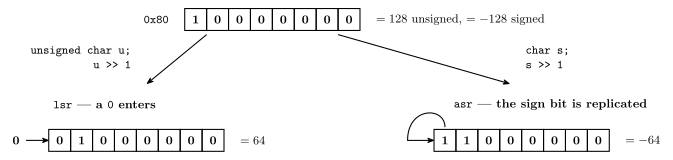
Figure 1: One operator, two instructions. The same bit pattern 10000000 is shifted right by one under two declarations. As unsigned char it means 128, the compiler emits lsr, a 0 enters at the top, and the result is 64. As char it means \(-128\), the compiler emits asr, the sign bit is copied back into the top, and the result is \(-64\). Both are the correct halving of what the bits were declared to mean.
1 << n is the mask with only bit \(n\) set. The AVR headers name every flag and pin as a bit number, so 1 << FLAG_NAME — with FLAG_NAME == 5 giving 00100000 — is how a mask is written from a name rather than a magic constant (c-preprocessor-and-avr-headers). Combined with the shorthands above:
PORTA |= (1 << 5);     /* set bit 5     */
PORTA &= ~(1 << 5);    /* clear bit 5   */
if (PINC & (1 << 3))   /* test bit 3    */
Prefix and postfix ++ and --
a++ and ++a both add one to a. They differ in what the expression is worth:
| Order | Rule | |
|---|---|---|
postfix a++ |
use value, change value | the expression is the old a; then a becomes a + 1 |
prefix ++a |
change value, use value | a becomes a + 1; the expression is the new a |
Every use is two statements in disguise, and only the order differs:
int a,b,c,d,e;
a = 4;
b = a++;    /* b=a;   a=a+1; */   /* b=4, a=5 */
c = --a;    /* a=a-1; c=a;   */   /* a=4, c=4 */
d = ++a;    /* a=a+1; d=a;   */   /* a=5, d=5 */
e = a--;    /* e=a;   a=a-1; */   /* e=5, a=4 */
Final values: a=4, b=4, c=4, d=5, e=5.
Worked: a = 1; b = 3; b += a++; leaves b = 4, because b += a++ is b = b + a with the old a, and only then a = a + 1. An answer of 5 applies the increment first, which is what ++a does.
On its own line, a++; and ++a; are indistinguishable: the value of the expression is thrown away, and only the change remains. The difference exists only when the expression is used — assigned, passed, indexed, as in values[9] = values[8]++; (c-pointers-and-arrays).
Precedence
The one place precedence bites is the SQUARE(1+2) example in c-preprocessor-and-avr-headers, where * binding tighter than + turns (1+2*1+2) into 5. The rule the course relies on is the schoolroom one — *, /, % before +, - — and the practical advice is parenthesise anything you would have to think about. Two cases to know because the natural reading is wrong:
&binds looser than==, sox & 1 == 0isx & (1 == 0), i.e.x & 0. Write(x & 1) == 0.<<binds looser than+, so1 << n + 1is1 << (n + 1). Write(1 << n) + 1if that is what is meant.
These are the two that catch AVR code in particular.
See also
- c-language-basics · c-control-flow · c-pointers-and-arrays · c-preprocessor-and-avr-headers
- bit-masking — the set/clear/toggle/extract patterns the bitwise operators write
- avr-instructions — the instructions each operator compiles to, including
lsl/lsr/asr - boolean-algebra — the laws behind
&,|,^and~ - floating-point-numbers — integer
/against floating point on the AVR:PINA / 3andPINA * 0.334f - 2026-09-07-introduction-to-embedded-c-programming — Lecture 13 · 2026-09-10-more-c-programming-on-the-avr — Lecture 14