C Language Basics
What a C program is made of: the shape of a program, variables and their types, functions, and constants. Operators are in c-operators, the if/while/for statements in c-control-flow, arrays and pointers in c-pointers-and-arrays, and the preprocessor in c-preprocessor-and-avr-headers. First met in 2026-09-07-introduction-to-embedded-c-programming.
Where C sits
C is the top layer of the course’s three blocks — high-level programming over low-level programming over digital logic design — and the course’s C is embedded C for the ATmega324A, the same chip the assembly targeted. The difference from assembly is one extra tool. An assembler turns each line into exactly one instruction; a compiler turns each C statement into however many instructions it needs, chooses the registers, and hands the result to the assembler. The chain from C statement down to control unit is drawn in 2026-09-07-introduction-to-embedded-c-programming, and the steps after the compiler, object files and the linker, are in compilation-and-linking.
What is expected: write small C programs and functions from scratch, understand the meaning of C programs, and write or modify C programs — practised in Labs 11–16, which all use C.
The shape of a program
- There must be a function called
main; it is executed when the program starts. - Blocks of code are enclosed by braces
{ }. - Statements end with a semicolon
;. - C is case sensitive —
variableandVariableare different names. - Comments are
/* … */(any length, may span lines) or//to the end of the line.
/* the smallest useful embedded program: */
#include <avr/io.h>

int main(void) {
    DDRA = 0xFF;        /* a statement */
    while(1) {          /* a block */
        PORTA = 0x55;
    }
}
On the AVR main never returns — there is no operating system to return to — so every program ends in an infinite loop (c-control-flow). #include is the preprocessor’s (c-preprocessor-and-avr-headers).
Variables and types
Declaration: type-name variable-name, variable-name …;
A declaration reserves room in data memory (memory-models) and gives it a name and a type. The type decides two things: how many cells the variable takes, and how the bits are read — the signed/unsigned question of binary-number-representations, now answered once at the declaration instead of instruction by instruction.
| Declaration | Size | Range | |
|---|---|---|---|
char c; |
1 byte | −128 … 127 | two’s complement |
unsigned char x; |
1 byte | 0 … 255 | |
int day; |
machine dependent — 16 bits on the AVR | −32768 … 32767 | two’s complement |
unsigned int count; |
as int |
0 … 65535 on the AVR | |
float |
32 bits | about \(\pm 3.4 \times 10^{38}\), 7 digits | IEEE single precision; no AVR hardware — done in software |
double |
64 bits in general; 32 on avr-gcc | likewise |
On avr-gcc float and double are interchangeable: both are 32 bits (below).
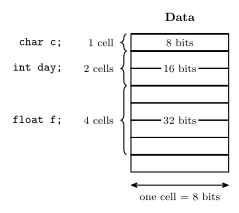
Figure 1: What three declarations reserve in the AVR’s 8-bit data memory, drawn as a memory map. char is one cell. int is two, because int is 16 bits on the AVR — which is why a pointer to an int steps by two in the pointers note. float is four, because single precision is 32 bits. The compiler decides the actual addresses; the addresses here are schematic and the order is arbitrary.
Three consequences worth carrying around:
charis an integer. It is exactly the 8-bit two’s complement byte of the hardware block; the name only promises it can hold a character code. Arithmetic on it is byte arithmetic, and'A' + 1is'B'because'A'is 65.intis not one size. Write code that assumes 16 bits and it breaks on a desktop; assume 32 and it breaks on the AVR. The AVR headers provideuint8_t,int16_tand friends — types with the width in the name — and the course’s example program usesuint8_tfor exactly this reason.- Nothing is checked. Storing 300 in an
unsigned chardoes not fail; it stores 300 mod 256, i.e. 44. (For a signedcharthe C standard leaves the result implementation-defined; gcc also gives 44.) The type is a reading rule, not a guard.
Booleans. There is no boolean type in the course’s C. Any value can be treated as a boolean: zero means false, non-zero means true. This is what lets if(a) mean if(a != 0) (c-control-flow).
Functions
return-type function-name (arg-decl)
{
    variable-declarations;
    …
    statements;
}| Part | Meaning | Example |
|---|---|---|
return-type |
what type is returned, or void for nothing |
int, void |
function-name |
the name; main for the entry point |
average |
arg-decl |
argument (parameter) declarations, comma-separated, each with its type | int a, float b |
variable-declarations |
variables used only within the function | int avge; |
statements |
the code which actually does stuff |
An example:
/*
  Return the average of two integers
  (result will be rounded towards 0)
*/
int average(int a, int b) {
    int avge;

    avge = (a+b)/2;

    return avge;
}
avge = (a+b)/2;is a statement built from expressions —(a+b), then(a+b)/2, then the assignment; the outermost expression plus its semicolon is the statement.return avge;hands the value back and ends the function.avgeis local: it exists only whileaverageis running. Nothing outside can name it.- Integer division truncates toward zero.
average(1, 2)computes3/2and returns1; the.5never exists. The comment says rounded towards 0, and that is the whole of C’s rule for/on integers —-3/2is-1, not-2.
A function with void in front returns nothing and is called for its effect. int main(void) is a function whose argument list is explicitly empty.
Where a variable lives
Where a declaration is written decides where the compiler stores the variable and how long it exists.
| Declaration | Kind | Stored | Exists |
|---|---|---|---|
outside every function: int count; |
global | at a fixed address in data memory, from 0x0100 up |
for the whole run |
inside a function: int avge; |
local | in the call’s stack frame | only while that call runs |
inside a function: static int calls; |
static local |
with the globals, at a fixed address | for the whole run, keeping its value between calls |
outside every function: static int a; |
static global |
like any global | for the whole run; the name is private to its file |
So avge in average above is made fresh on every call and is gone at the return, and a local that is never assigned starts out holding whatever was left on the stack. A static local is the way to have a function remember something from one call to the next. Memory obtained from malloc() comes from a third place, the heap, which grows from above the globals toward the stack. The full picture is in compilation-and-linking, and the frame itself is in procedures-and-the-stack.
Constants
Character constants
Single quotes: 'a', 'b', '1'. A character constant is a number — its ASCII code — so '1' is 49, not 1.
| Range | Codes |
|---|---|
'A' … 'Z' |
65 … 90 |
'a' … 'z' |
97 … 122 |
'0' … '9' |
48 … 57 |
Which makes c - '0' the digit value of a digit character, and c + ('a' - 'A') the lower-case of an upper-case letter — both plain integer arithmetic.
Special characters are backslash escaped:
'\n' |
newline |
'\'' |
single quote |
'\t' |
tab |
'\\' |
backslash |
String constants
Double quotes, escapes allowed inside: "abc \n \" hello\t". A string is an array of char (c-pointers-and-arrays).
Integer constants
| Base | Written | Examples |
|---|---|---|
| Decimal | as usual | 3, -27, 65535, +5 |
| Hexadecimal | leading 0x |
0x5F, 0xFFFF, 0xDEADBEEF |
| Octal | leading 0 |
0377 = 255 |
The octal rule is a trap: a leading zero changes the base. 010 is eight. Do not zero-pad a decimal constant.
Hexadecimal is the natural notation for anything that is really a bit pattern — port values, masks — because each digit is exactly one nibble (binary-number-representations). 0xFF is 11111111 at a glance; 255 is not.
Floating point constants
Include a decimal point and/or an e exponent: 3.1416, -7., 6.02e23, -5.2e-2. 7 is an integer; 7. is floating point. The type of a constant is decided by how it is written, and it decides what arithmetic happens: 7/2 is 3, 7./2 is 3.5.
Floating point on the AVR
float and double are usually IEEE single and double precision, but the C standard only asks for minimums: about 6 significant decimal digits for float and 10 for double, both up to \(10^{37}\). avr-gcc makes double the same 32-bit single precision as float, which gives about 7 digits and so falls short of what the standard asks of double. Code written for a desktop that relies on double quietly loses half its digits on the AVR.
The AVR also has no floating-point hardware: its only hardware data type is the 8-bit integer (instruction-set-architecture). Every float add, multiply or conversion is a call into a software library, hundreds of instructions with branches where an integer operation takes a few. So where integer arithmetic can give the same result, use it:
PORTB = PINA / 3;        /* integer: a handful of instructions, no branches */
PORTB = PINA * 0.334f;   /* float: the same results, 300+ instructions      */
Scaling to whole units (millivolts, tenths of a degree) or using fixed-point-numbers keeps the fractions without the floats. The formats themselves, and why 0.1 cannot be stored exactly, are in floating-point-numbers.
See also
- c-operators · c-control-flow · c-pointers-and-arrays · c-preprocessor-and-avr-headers
- binary-number-representations — the signed/unsigned readings behind
charandunsigned char - floating-point-numbers — what
floatanddoublehold, and their cost on the AVR · fixed-point-numbers — fractions in integer arithmetic - memory-models — the 8-bit data cells a declaration reserves
- instruction-set-architecture — the data types the AVR supports in hardware, and the ones it does not
- compilation-and-linking — how the compiler maps globals, locals and statics to memory, and what happens after compiling · procedures-and-the-stack — the stack frame a local lives in
- 2026-09-07-introduction-to-embedded-c-programming — Lecture 13 · 2026-10-15-compilation-and-linking — Lecture 22 · 2026-10-19-floating-point-numbers — Lecture 23