AVR Branches and Jumps
How an AVR program’s control leaves the straight line: the ten conditional branches and which status flag each one reads, why greater than needs two different instructions for signed and unsigned bytes, the three unconditional jumps and how far each can reach, and the assembly idioms — if, if … else, counted and conditional loops — built from them. First met in 2026-09-14-flow-of-control, with the compare instructions and breq/brne first met in 2026-09-03-instruction-set-architecture-part-2. Procedure calls, the other way control moves, are in procedures-and-the-stack.
Flow of control
The flow of control is the sequence in which instructions actually execute. By default it is linear: every fetch-decode-execute cycle ends with \(PC \leftarrow PC + 1\) (fetch-decode-execute-cycle), so the next instruction is the next one in memory. Four kinds of instruction replace that increment with a new value:
| Decides | ||
|---|---|---|
| Branches | conditional | a status-register flag |
| Jumps | unconditional | nothing — always taken |
| Procedure calls and returns | unconditional, and they remember where they came from | procedures-and-the-stack |
| Interrupts / traps | triggered by hardware, not by an instruction | polling-and-interrupts · avr-interrupts |
Everything below is one instruction that writes the PC.
Conditional branches
A conditional branch tests one bit of the status register (avr-architecture) and, if the bit has the value the instruction wants, loads the PC with the address of a label; otherwise execution falls through to the next instruction. There is one instruction per flag per value:
| Branch if flag = | C | N | V | S = N ⊕ V | Z | T | H | I |
|---|---|---|---|---|---|---|---|---|
| 0 | brsh (= brcc) |
brpl |
brvc |
brge |
brne |
brtc |
brhc |
brid |
| 1 | brlo (= brcs) |
brmi |
brvs |
brlt |
breq |
brts |
brhs |
brie |
The first five columns are the ten branches counted above; the last three are the same pattern applied to the remaining flags and are in the instruction set reference. The mnemonics read as the condition, not the flag: brsh is branch if same or higher and happens to be branch if carry clear; brge is branch if greater or equal and happens to be branch if S clear. Learn them as conditions and the flags take care of themselves.
Every branch is relative and short. The offset is seven bits, so a conditional branch can reach only about 64 words either side of itself. For a farther target, branch on the opposite condition around a jmp:
    cp   r5, r6
    brne skip          ; opposite of the condition wanted
    jmp  far_away      ; taken only when r5 == r6
skip:
A taken branch costs two cycles, a not-taken one; the branch itself is one 16-bit word.
Setting the flags first
A branch reads flags; something has to have written them. Usually that is a compare (avr-instructions):
| Computes | Keeps | |
|---|---|---|
cp rd, rr |
rd − rr |
flags only |
cpi rd, K |
rd − K |
flags only — rd must be r16–r31 |
tst rd |
rd AND rd |
flags only — Z and N say whether rd is zero or negative |
but any ALU instruction sets flags, and a branch straight after an add, sub, dec or andi tests the result of that. dec r17 followed by brne loop is the standard loop counter, and no cp is needed. The rule from avr-program-structure holds either way: nothing that disturbs the flag may sit between the setter and the branch.
Signed and unsigned comparisons
Equality is the same question for signed and unsigned bytes, so breq and brne serve both. Ordering is not: whether 1111 1111 is bigger than 0000 0001 depends on whether it means 255 or −1, and the bits alone cannot say (binary-number-representations). The cp sets the same flags either way; the programmer chooses which pair of branches to read them with, and thereby declares the type:
Branch if rd ≥ rr |
Branch if rd < rr |
Reads | |
|---|---|---|---|
| unsigned | brsh — same or higher |
brlo — lower |
C: an unsigned subtraction needs a borrow exactly when the result went below zero |
| signed | brge — greater or equal |
brlt — less than |
S = N ⊕ V: the sign of the result, corrected for overflow |
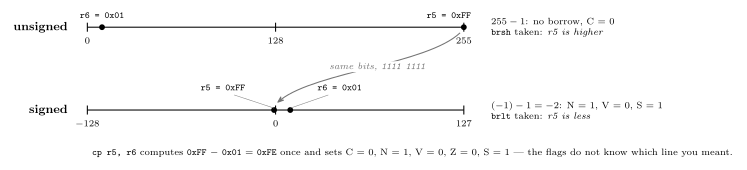
Figure 1: The same two bit patterns on the two number lines an 8-bit register can be read against. As unsigned values, 0xFF is 255 and sits at the far right, above 0x01; as two’s complement values it is \(-1\) and sits just left of zero, below 0x01. One cp r5, r6 produces one set of flags for both readings. The unsigned branches take their answer from the carry flag, which records whether the subtraction had to borrow; the signed branches take theirs from S, which is the sign of the difference with any overflow undone. Choosing brsh or brlt after the compare is the only place the program says which line it meant.
Why S and not N. N is the top bit of the 8-bit result. When a signed subtraction overflows — a large positive minus a large negative, say — the true difference does not fit in 8 bits, the stored result wraps, and its top bit is the opposite of the true sign. V is set in exactly that case. So \(S = N \oplus V\) is the true sign whether or not overflow happened, and one flag test decides < correctly across the whole range; the four cases are drawn in 2026-09-14-flow-of-control. In C none of this is visible: the compiler reads the variable’s declared type and emits brlo for unsigned char and brlt for char, the same way it picks lsr or asr for >> (c-operators).
Unconditional jumps
| Instruction | Target | Size | Cycles | Reach |
|---|---|---|---|---|
jmp label |
absolute address | 32-bit (two words) | 3 | anywhere in program memory |
rjmp label |
PC + signed offset | 16-bit | 2 | ±2 K words (12-bit offset, −2048 to +2047) |
ijmp |
the address held in Z | 16-bit | 2 | anywhere; the target is a run-time value |
jmp carries a full program-memory address — 14 bits for the ATmega324A’s 16 K words of flash — which does not fit beside an opcode in one 16-bit word, so it takes two words and an extra cycle. rjmp carries a 12-bit offset from the instruction’s own position in one word, one cycle less, and reaches ±2 K words; in a program of a few hundred instructions every jump is within range, and it is the normal choice. ijmp takes the destination from Z, the pointer register of addressing-modes, so a program can compute where to go — a jump table, or C’s switch. The assembler resolves labels to addresses or offsets for all three; the programmer writes the label.
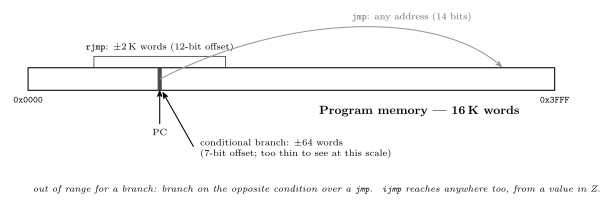
Figure 2: How far each kind of jump can reach from the instruction executing it. Program memory is the ATmega324A’s 16,K words; the marker is the current PC. A conditional branch carries a 7-bit offset and reaches about 64 words either way, an rjmp carries a 12-bit offset and reaches 2,K words either way, and a jmp carries the whole 14-bit address and reaches anywhere. The three are drawn to scale against the memory: the branch window is a sliver, the rjmp window covers a quarter of the chip, and the labs’ programs never leave either. The narrower the reach, the shorter and faster the instruction.
The idioms
Every C control structure (c-control-flow) compiles to a handful of these shapes. The branch is always on the opposite of the source condition, because what the branch does is skip the body.
if:
    cp   r5, r6
    brlt endif         ; skip the body when r5 < r6 (signed)
    ...                ; body: runs when r5 >= r6
endif:
if … else — the else part is the code the branch does not skip, and it needs a jmp past the if part:
    cp   r5, r6
    brge then
    ...                ; else part
    rjmp endif
then:
    ...                ; if part
endif:
while — test at the top, jump back at the bottom:
loop:
    cp   r5, r6
    brsh done          ; exit when r5 >= r6 (unsigned)
    ...                ; body
    rjmp loop
done:
Counted loop — count down to zero so the decrement sets Z for free:
    ldi  r17, 10       ; ten times
loop:
    ...                ; body
    dec  r17           ; sets Z when r17 reaches 0
    brne loop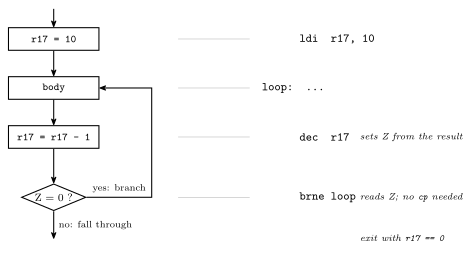
Figure 3: A counted loop, as a flowchart and as the four instructions that implement it. The counter is loaded once; the body runs; the decrement both updates the counter and sets the zero flag from the result; brne reads that flag and either returns to the label or falls out. Counting down rather than up saves the compare: dec leaves Z = 1 exactly when the counter has reached zero, so the branch tests the arithmetic directly. The body executes ten times, with r17 holding 10 down to 1 inside it and 0 on exit — the assembly form of for (i = 10; i != 0; i--).
Picking the branch. Write the C condition, decide signed or unsigned, and take the opposite instruction from the table:
| Source condition | Unsigned: skip with | Signed: skip with |
|---|---|---|
a == b |
brne |
brne |
a != b |
breq |
breq |
a < b |
brsh |
brge |
a >= b |
brlo |
brlt |
a > b |
swap operands: cp b, a then brsh |
cp b, a then brge |
a <= b |
cp b, a then brlo |
cp b, a then brlt |
There is no greater than branch; a > b is b < a, so compare the other way round.
See also
- avr-program-structure — labels, the template, and compare-then-branch drawn out
- procedures-and-the-stack —
call,rcall,icallandret: the jumps that come back - polling-and-interrupts — the fourth way the PC leaves its sequence, with no instruction asking
- avr-instructions —
cp,cpi,tst,dec, and which flags each instruction sets - avr-architecture — the status register; \(S = N \oplus V\)
- c-control-flow — the same shapes in C · binary-number-representations — signed and unsigned bytes
- assembly-process — how the assembler gives a label its address, counting each
jmpas two words - 2026-09-14-flow-of-control — Lecture 15 · 2026-09-03-instruction-set-architecture-part-2 — Lecture 12