Lecture 28 — Definitions and Examples of Fields
The cyclic subgroups of \(\mathbb{Z}_8\) and which groups are cyclic, then fields: a set with two operations that is an abelian group under each of them, joined by the distributive laws. Which of \(\mathbb{Z}\), \(\mathbb{Z}_4\), \(\mathbb{Z}_7\) and \(\mathbb{Z}_{15}\) are fields, and how to solve a linear equation in \(\mathbb{Z}_{11}\) and \(\mathbb{Z}_{17}\). Pre-work: Video 036 (Definitions and Examples of Fields). Fields are collected in fields, cyclic subgroups and cyclic groups in subgroups-and-cyclic-groups, and \(\mathbb{Z}_p\) and multiplicative inverses mod \(p\) in integers-modulo-n. The group definition everything here leans on is in groups.
Goals
- Review the concepts of groups, abelian groups, subgroups and cyclic subgroups.
- Become familiar with calculations in fields.
- Learn how to solve equations in fields.
The four terms in the first goal, in one line each:
- Group. A set with a binary operation, \((G, *)\), satisfying closure, associativity, identity and inverses (groups).
- Abelian. \(a * b = b * a\) for all \(a, b \in G\).
- Subgroup. A subset of \(G\) that is a group under the same operation (subgroups-and-cyclic-groups).
- Cyclic subgroup. \(\langle a \rangle = \{a^n : n \in \mathbb{Z}\}\), every power of \(a\): positive, zero and negative.
Cyclic subgroups
If \((G, *)\) is a group and \(a \in G\), then \[\langle a \rangle = \{a^i : i \in \mathbb{Z}\}\] is a subgroup of \(G\), and is called the cyclic subgroup of \(G\) generated by \(a\).
The powers are taken with the group’s own operation: \(a^2 = a * a\), \(a^0 = e\), and \(a^{-i} = (a^{-1})^i\). In an additive group such as \((\mathbb{Z}_n, +)\) a “power” is a repeated sum, so \([a]^i = [ia]\), and \(\langle [a] \rangle\) is the set of multiples of \([a]\). The full treatment is in subgroups-and-cyclic-groups.
Worked: the cyclic subgroups of \((\mathbb{Z}_8, +)\)
Determine all the cyclic subgroups of \((\mathbb{Z}_8, +)\).
\(\mathbb{Z}_8 = \{[0], [1], [2], [3], [4], [5], [6], [7]\}\), so there are eight elements to try. For each, keep adding \([a]\) until the sum comes back to \([0]\); after that the list repeats. The negative powers add nothing new: if \(k\) copies of \([a]\) make \([0]\), then \([a]^{-1} = [a]^{k-1}\), so every negative power is already one of the positive ones.
\[\begin{aligned} \langle [0] \rangle &= \{[0]\} \\ \langle [1] \rangle &= \{[1], [2], [3], [4], [5], [6], [7], [8] = [0]\} = \mathbb{Z}_8 \\ \langle [2] \rangle &= \{[2], [4], [6], [8] = [0]\} = \{[0], [2], [4], [6]\} \\ \langle [3] \rangle &= \{[3], [6], [9] = [1], [4], [7], [10] = [2], [5], [8] = [0]\} = \mathbb{Z}_8 \\ \langle [4] \rangle &= \{[4], [8] = [0]\} = \{[0], [4]\} \end{aligned}\]
The other three, \(\langle [5] \rangle\), \(\langle [6] \rangle\) and \(\langle [7] \rangle\), need no new work, because of two rules that hold in any group:
- \(\langle e \rangle = \{e\}\). Every power of the identity is the identity. That is \(\langle [0] \rangle = \{[0]\}\) above.
- \(\langle a \rangle = \langle a^{-1} \rangle\). The powers of \(a^{-1}\) are \((a^{-1})^i = a^{-i}\), and as \(i\) runs through \(\mathbb{Z}\) so does \(-i\). The two lists are the same powers taken in the opposite order.
In \((\mathbb{Z}_8, +)\) the inverse of \([a]\) is \([-a] = [8 - a]\), so \([5] = [3]^{-1}\), \([6] = [2]^{-1}\) and \([7] = [1]^{-1}\):
\[\langle [5] \rangle = \langle [3] \rangle = \mathbb{Z}_8, \qquad \langle [6] \rangle = \langle [2] \rangle = \{[0], [2], [4], [6]\}, \qquad \langle [7] \rangle = \langle [1] \rangle = \mathbb{Z}_8.\]
So \(\mathbb{Z}_8\) has four distinct cyclic subgroups, \(\{[0]\}\), \(\{[0], [4]\}\), \(\{[0], [2], [4], [6]\}\) and \(\mathbb{Z}_8\) itself, and
\[\langle [1] \rangle = \langle [3] \rangle = \langle [5] \rangle = \langle [7] \rangle = \mathbb{Z}_8.\]
The four elements that reach everything are the odd ones. An even step from \([0]\) only ever lands on even classes. The four subgroups sit inside one another, \(\{[0]\} \subseteq \{[0], [4]\} \subseteq \{[0], [2], [4], [6]\} \subseteq \mathbb{Z}_8\), as drawn in 2026-10-06-elementary-properties-of-groups.
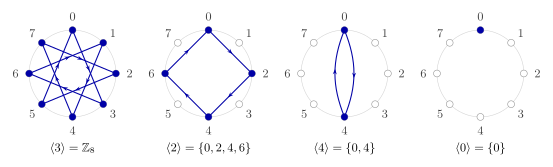
Figure 1: Each cyclic subgroup of \(\mathbb{Z}_8\) as a walk round the eight classes, written without brackets, taking steps of \(a\) from 0 until the walk closes. Filled dots are the classes reached, and they make up \(\langle a \rangle\). Steps of 3 visit all eight classes before returning, so \(\langle 3 \rangle = \mathbb{Z}_8\). Steps of 2 visit only the even classes, steps of 4 only 0 and 4, and steps of 0 never leave 0. Steps of 5, 6 and 7 trace the same walks as steps of 3, 2 and 1, run backwards, which is why \(\langle a \rangle = \langle a^{-1} \rangle\).
Cyclic groups
The group \((G, *)\) is cyclic if there exists an \(a \in G\) such that \(\langle a \rangle = G\).
Such an \(a\) is a generator of \(G\). Every element of a cyclic group is a power of the one element \(a\). By the last section, \((\mathbb{Z}_8, +)\) is cyclic, with four generators. More on cyclic groups is in subgroups-and-cyclic-groups.
Worked: which of these groups are cyclic?
Which of the following groups are cyclic? \((\mathbb{Z}_{10}, +)\), \(\ (\mathbb{Z}_5 - \{[0]\}, \cdot)\), \(\ (\mathbb{Z}, +)\), \(\ (\mathbb{Q}, +)\).
| Group | Cyclic? | Generator |
|---|---|---|
| \((\mathbb{Z}_{10}, +)\) | yes | \([1]\) |
| \((\mathbb{Z}_5 - \{[0]\}, \cdot)\) | yes | \([2]\) |
| \((\mathbb{Z}, +)\) | yes | \(1\) |
| \((\mathbb{Q}, +)\) | no | none |
\((\mathbb{Z}_{10}, +)\). The multiples of \([1]\) are \([1], [2], \dots, [9], [10] = [0]\), all ten classes. So \(\mathbb{Z}_{10} = \langle [1] \rangle\).
\((\mathbb{Z}_5 - \{[0]\}, \cdot)\). The set is \(\{[1], [2], [3], [4]\}\) and the operation is multiplication, so here powers really are powers. \(\langle [1] \rangle = \{[1]\}\), since \([1]\) is the identity. Trying \([2]\):
\[[2]^1 = [2], \quad [2]^2 = [4], \quad [2]^3 = [8] = [3], \quad [2]^4 = [16] = [1].\]
So \(\langle [2] \rangle = \{[2], [4], [3], [1]\} = \mathbb{Z}_5 - \{[0]\}\), and the group is cyclic. A generator only has to exist; \([1]\) failing does not matter.
\((\mathbb{Z}, +)\). In additive notation \(1^n\) is \(n\) copies of 1 added together, \(1^0 = 0\), and \(1^{-1} = -1\). So
\[\langle 1 \rangle = \{1^n : n \in \mathbb{Z}\} = \{\dots, 1^{-2}, 1^{-1}, 1^0, 1^1, 1^2, \dots\} = \{\dots, -2, -1, 0, 1, 2, \dots\} = \mathbb{Z}.\]
An infinite group can be cyclic.
\((\mathbb{Q}, +)\). To show no generator exists, take an arbitrary rational \(r\) and find a rational that is not in \(\langle r \rangle\). In \((\mathbb{Q}, +)\), \(\langle r \rangle = \{kr : k \in \mathbb{Z}\}\), the integer multiples of \(r\).
- If \(r = 0\), then \(\langle 0 \rangle = \{0\}\), which is not \(\mathbb{Q}\).
- If \(r \neq 0\), write \(r = \frac{p}{q}\) with \(p, q \in \mathbb{Z}\), \(q \neq 0\). Then \(\frac{p}{2q} = \frac{r}{2}\) is rational. If it were in \(\langle r \rangle\) there would be a \(k \in \mathbb{Z}\) with \(\frac{r}{2} = kr\), and dividing by \(r \neq 0\) gives \(k = \frac12\), which is not an integer. So \(\frac{p}{2q} \notin \langle \frac{p}{q} \rangle\).
Either way \(\langle r \rangle \neq \mathbb{Q}\), so \((\mathbb{Q}, +)\) is not cyclic. The case \(r = 0\) has to be split off because \(\frac{0}{2q} = 0\) is in \(\langle 0 \rangle\). On the number line, \(\langle r \rangle\) is a row of equally spaced points, and \(\frac{r}{2}\) sits in the first gap (subgroups-and-cyclic-groups draws it).
Worked: \(\mathbb{Z}_2 \times \mathbb{Z}_3\) is cyclic
Consider the group \((\mathbb{Z}_2 \times \mathbb{Z}_3, +)\) where \((a, b) + (c, d) = \big((a + c) \bmod 2,\ (b + d) \bmod 3\big)\). Show that this group is cyclic.
The elements are the six pairs \((a, b)\) with \(a \in \{0, 1\}\) and \(b \in \{0, 1, 2\}\), and the operation adds each coordinate in its own modulus. Try \((a, b) = (1, 1)\), adding \((1, 1)\) each time:
\[\begin{aligned} (1,1)^1 &= (1, 1) \\ (1,1)^2 &= (1,1) + (1,1) = (2 \bmod 2,\ 2 \bmod 3) = (0, 2) \\ (1,1)^3 &= (1,1)^2 + (1,1) = (0,2) + (1,1) = (1 \bmod 2,\ 3 \bmod 3) = (1, 0) \\ (1,1)^4 &= (1,0) + (1,1) = (0, 1) \\ (1,1)^5 &= (0,1) + (1,1) = (1, 2) \\ (1,1)^6 &= (1,2) + (1,1) = (0, 0) \end{aligned}\]
The six powers are six different pairs, so they are all of \(\mathbb{Z}_2 \times \mathbb{Z}_3\), and
\[\mathbb{Z}_2 \times \mathbb{Z}_3 = \langle (1, 1) \rangle. \qquad /\!/\]
Not every element works. \((1, 0)\) only reaches \((1, 0)\) and \((0, 0)\), and \((0, 1)\) only reaches the three pairs with first coordinate 0. \((1, 1)\) works because its first coordinate cycles with period 2 and its second with period 3, and the two are not back at \((0, 0)\) together until the sixth step. The three cyclic subgroups are drawn side by side in subgroups-and-cyclic-groups.
The definition of a field
Definition. A field \((F, +, \cdot)\) is a set \(F\) with two binary operations \(+\) and \(\cdot\) such that
(1) \((F, +)\) is an abelian group;
(2) \((F - \{0\}, \cdot)\) is an abelian group, where \(0\) is the identity of \((F, +)\); and
(3) for all \(f, g, h \in F\), \(\ f \cdot (g + h) = (f \cdot g) + (f \cdot h)\) and \((f + g) \cdot h = (f \cdot h) + (g \cdot h)\).
Condition (3) is the pair of distributive laws. They are the only condition that involves both operations at once; without them \(+\) and \(\cdot\) would be two unrelated groups that happen to share a set.
Condition (1) is five checks: closure, associativity, identity and inverses for \(+\), and commutativity to make it abelian. Condition (2) is the same five for \(\cdot\), on the smaller set \(F - \{0\}\). The “0” there means the additive identity, whatever it is called in \(F\); in \(\mathbb{Z}_n\) it is \([0]\). Why it has to be removed, and a picture of the two groups, are in fields.
Fields already in use
\((\mathbb{R}, +, \cdot)\) and \((\mathbb{Q}, +, \cdot)\) are fields. Arithmetic in them uses both kinds of inverse:
- subtraction is adding an additive inverse, \(a - b = a + (-b)\);
- division is multiplying by a multiplicative inverse, \(a \div b = a \cdot b^{-1}\) for \(b \neq 0\).
Example. Solve \(2x + 3 = 8\) in \(\mathbb{R}\). Add \(-3\) to both sides to get \(2x = 5\), then multiply both sides by \(2^{-1} = \frac12\) to get \(x = \frac52\).
Those two steps are all that solving a linear equation needs, and the field axioms are what guarantee they can be done. The same two steps work in any field, including those where \(-3\) and \(2^{-1}\) are classes mod \(p\).
Worked: is \((\mathbb{Z}_4, +, \cdot)\) a field?
Is \((\mathbb{Z}_4, +, \cdot)\) a field?
No. Condition (1) holds but condition (2) fails.
(1) \((\mathbb{Z}_4, +)\) is an abelian group with identity \([0]\). From the table: closure (only \([0], \dots, [3]\) appear), associativity (inherited from addition of integers), identity \([0]\) (its row and column repeat the headings), inverses (\([0]\) is in every row: \(-[1] = [3]\), \(-[2] = [2]\), \(-[3] = [1]\)), and commutative (the table is symmetric about its diagonal).
| \(+\) | \([0]\) | \([1]\) | \([2]\) | \([3]\) |
|---|---|---|---|---|
| \(\mathbf{[0]}\) | \([0]\) | \([1]\) | \([2]\) | \([3]\) |
| \(\mathbf{[1]}\) | \([1]\) | \([2]\) | \([3]\) | \([0]\) |
| \(\mathbf{[2]}\) | \([2]\) | \([3]\) | \([0]\) | \([1]\) |
| \(\mathbf{[3]}\) | \([3]\) | \([0]\) | \([1]\) | \([2]\) |
(2) \((\mathbb{Z}_4 - \{[0]\}, \cdot)\) is not a group. The set is \(\{[1], [2], [3]\}\):
| \(\cdot\) | \([1]\) | \([2]\) | \([3]\) |
|---|---|---|---|
| \(\mathbf{[1]}\) | \([1]\) | \([2]\) | \([3]\) |
| \(\mathbf{[2]}\) | \([2]\) | \(\mathbf{[0]}\) | \([2]\) |
| \(\mathbf{[3]}\) | \([3]\) | \([2]\) | \([1]\) |
\([2] \cdot [2] = [4] = [0]\), and \([0] \notin \mathbb{Z}_4 - \{[0]\}\). Closure fails. Two non-zero classes multiply to zero. The same row shows a second failure: the row of \([2]\) has no \([1]\) in it, so \([2]\) has no multiplicative inverse either.
Worked: which of these is a field?
Two rules to use:
- \((\mathbb{Z}_n, +)\) is a group for every \(n \in \mathbb{Z}^{+}\) (integers-modulo-n). It is abelian, so condition (1) always holds for \(\mathbb{Z}_n\).
- \((\mathbb{Z}_p, +, \cdot)\) is a field when \(p\) is prime. Why, and why a composite \(n\) never works, is in fields.
Which of the following is a field? (a) \((\mathbb{Z}, +, \cdot)\) \(\quad\) (b) \((\mathbb{Z}_7, +, \cdot)\) \(\quad\) (c) \((\mathbb{Z}_{15}, +, \cdot)\)
(a) \((\mathbb{Z}, +, \cdot)\): not a field.
- \((\mathbb{Z}, +)\) is an abelian group with identity 0. \(\checkmark\)
- \((\mathbb{Z} - \{0\}, \cdot)\) is not a group, because 2 has no inverse: the identity is 1, and \(2 \cdot y = 1\) needs \(y = \frac12 \notin \mathbb{Z}\). \(\times\)
So \((\mathbb{Z}, +, \cdot)\) is not a field. This is where the second step of solving an equation breaks down in \(\mathbb{Z}\): there is no \(2^{-1}\) to multiply \(2x = 5\) by, and indeed no integer \(x\) has \(2x = 5\).
(b) \((\mathbb{Z}_7, +, \cdot)\): a field, since 7 is prime. Checking each condition directly:
- \((\mathbb{Z}_7, +)\) is an abelian group with identity \([0]\), by the first rule. \(\checkmark\)
- \((\mathbb{Z}_7 - \{[0]\}, \cdot)\) is the abelian group whose table is worked in 2026-09-24-definitions-and-examples-of-groups. Its inverses are \([1]^{-1} = [1]\), \([2]^{-1} = [4]\), \([3]^{-1} = [5]\), \([6]^{-1} = [6]\). \(\checkmark\)
- The distributive laws are inherited from the integers: \([a] \cdot ([b] + [c]) = [a(b + c)] = [ab + ac] = [a][b] + [a][c]\), and the other law follows the same way. \(\checkmark\)
(c) \((\mathbb{Z}_{15}, +, \cdot)\): not a field.
- \((\mathbb{Z}_{15}, +)\) is an abelian group with identity \([0]\). \(\checkmark\)
- \((\mathbb{Z}_{15} - \{[0]\}, \cdot)\) is not a group: \([3] \cdot [5] = [15] = [0]\), which is not in the set, so closure fails. \(\times\)
So \((\mathbb{Z}_{15}, +, \cdot)\) is not a field. The factorisation \(15 = 3 \cdot 5\) is exactly what produces the two non-zero classes with product \([0]\).
Solving equations in a field
In a field, a linear equation is solved exactly as in \(\mathbb{R}\): add the additive inverse of the constant to both sides, then multiply both sides by the multiplicative inverse of the coefficient. In \(\mathbb{Z}_p\) both inverses are classes, and the multiplicative one has to be found. The general method, with a picture, is in fields.
Worked: linear equations in \(\mathbb{Z}_{11}\) and \(\mathbb{Z}_{17}\)
(a) Solve the equation \(2x + 3 = 8\) in the field \((\mathbb{Z}_{11}, +, \cdot)\). Hence determine the smallest positive integer \(y\) such that \(2y + 3 \equiv 8 \pmod{11}\).
(b) Solve the equation \(10x + 9 = 6\) in the field \((\mathbb{Z}_{17}, +, \cdot)\). Hence determine the smallest positive integer \(y\) such that \(10y + 9 \equiv 6 \pmod{17}\).
(a) Work mod 11, writing \(2\) for \([2]\) and so on inside the equation.
\[\begin{aligned} 2x + 3 &= 8 \\ 2x + 3 + (-3) &= 8 + (-3) && \text{add the additive inverse of 3, } [-3] = [8] \\ 2x &= 5 \\ 6 \cdot 2x &= 6 \cdot 5 && \text{multiply by the multiplicative inverse of 2, which is 6} \\ [12]x &= [30] \\ 1 \cdot x &= 8 && [12] = [1] \text{ and } [30] = [8] \\ x &= [8] \end{aligned}\]
The inverse of \([2]\) is \([6]\) because \(2 \cdot 6 = 12 \equiv 1 \pmod{11}\).
Check: \(2(8) + 3 = 19 \equiv 8 \pmod{11}\). \(\checkmark\)
The integers \(y\) with \(2y + 3 \equiv 8 \pmod{11}\) are exactly the members of the solution class \([8] = \{\dots, -14, -3, 8, 19, 30, \dots\}\). The smallest positive one is \(\mathbf{y = 8}\).
(b) Work mod 17.
\[\begin{aligned} 10x + 9 &= 6 \\ 10x + 9 + (-9) &= 6 + (-9) && \text{add the additive inverse of 9, } [-9] = [8] \\ 10x &= -3 \\ 12 \cdot 10x &= 12 \cdot (-3) && \text{multiply by the multiplicative inverse of 10, which is 12} \\ 1 \cdot x &= -36 && [120] = [1] \\ x &= [-36] = [-2] = [15] && -36 = (-2) \cdot 17 - 2 \end{aligned}\]
Finding \([10]^{-1}\). In part (a) the inverse of \([2]\) could be seen at once from \(2 \cdot 6 = 12\). Here it takes a search: list the multiples of 10 mod 17 until one is \(\equiv 1\). Each line is the previous one plus 10, with 17 taken off whenever the total passes 16:
| \(k\) | 1 | 2 | 3 | 4 | 5 | 6 | 7 | 8 | 9 | 10 | 11 | 12 |
|---|---|---|---|---|---|---|---|---|---|---|---|---|
| \(10k \bmod 17\) | 10 | 3 | 13 | 6 | 16 | 9 | 2 | 12 | 5 | 15 | 8 | 1 |
\(10 \cdot 12 = 120 = 7 \cdot 17 + 1\), so \([10]^{-1} = [12]\). Along the way, \(10 \cdot 5 = 50 \equiv 16 = -1\), which is another route: \([10]^{-1} = -[5] = [12]\).
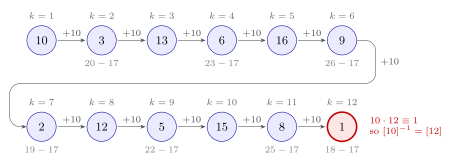
Figure 2: Searching for the inverse of \([10]\) in \(\mathbb{Z}_{17}\). Starting at 10, each hop adds 10 and reduces mod 17; the grey number under a class is the unreduced total, shown where 17 had to be taken off. Because 17 is prime, the hops pass through non-zero classes only and cannot repeat before every non-zero class has appeared, so the class 1 is certain to turn up. It turns up at the twelfth multiple, so \(10 \cdot 12 \equiv 1 \pmod{17}\) and \([10]^{-1} = [12]\).
Reducing the answer. \(-36 = (-2) \cdot 17 - 2\), so \([-36] = [-2]\), and \([-2] = [-2 + 17] = [15]\). A shorter path is to notice \([12] = [-5]\), so \(x = [-5] \cdot [-3] = [15]\) straight away.
Check: \(10(15) + 9 = 159 = 10 \cdot 17 - 11 \equiv -11 \equiv 6 \pmod{17}\). \(\checkmark\)
The integers \(y\) with \(10y + 9 \equiv 6 \pmod{17}\) are the members of \([15] = \{\dots, -19, -2, 15, 32, \dots\}\). The smallest positive one is \(\mathbf{y = -2 + 17 = 15}\). The representative \(-2\) is a correct name for the class, but it is not the positive integer the question asks for.
See also
- fields — the definition, examples and non-examples, why \(\mathbb{Z}_n\) is a field exactly when \(n\) is prime, and solving equations
- subgroups-and-cyclic-groups — subgroups, \(\langle a \rangle\), and cyclic groups
- integers-modulo-n — \(\mathbb{Z}_n\), and multiplicative inverses mod \(p\)
- groups — the four group properties used in conditions (1) and (2)
- cayley-tables — reading closure and inverses off a table, as in the \(\mathbb{Z}_4\) question
- 2026-10-06-elementary-properties-of-groups — Lecture 27 · 2026-10-12-introduction-to-counting — Lecture 29
- practice-problems — §34, where Q4 shows that \((\mathbb{Z}_{11} - \{[0]\}, \cdot)\) is cyclic
- practice-problems — §36, with full worked solutions