Subgroups and Cyclic Groups
A subgroup is a group sitting inside another group under the same operation. The quickest way to build one is to take a single element and all of its powers, positive, zero and negative: that set is the cyclic subgroup the element generates. A group that is the cyclic subgroup of one of its own elements is a cyclic group. The definition of a group is in groups, and most of the examples live in integers-modulo-n. First met in 2026-10-06-elementary-properties-of-groups, and cyclic groups are also worked in 2026-10-08-definitions-and-examples-of-fields.
Subgroups
Definition. If \((G, *)\) is a group and \(H \subseteq G\), then \(H\) is a subgroup of \(G\) if \((H, *)\) is itself a group.
To check that \((H, *)\) is a subgroup of \((G, *)\), check three of the four group properties:
| Property | To show it holds | To show it fails |
|---|---|---|
| closure | Take arbitrary \(g, h \in H\) and show \(g * h \in H\). | Two elements of \(H\) whose result is outside \(H\). |
| identity | Show that the identity \(e\) of \(G\) is in \(H\). | Show \(e \notin H\). |
| inverses | Take arbitrary \(h \in H\) and show its inverse in \(G\) is in \(H\). | One element of \(H\) whose inverse is outside \(H\). |
Associativity is inherited. \((g * h) * k = g * (h * k)\) holds for all \(g, h, k \in G\), and elements of \(H\) are elements of \(G\), so it holds for all \(g, h, k \in H\). Nothing new has to be checked. The other three properties are different: each one says some element must be in the set, and a smaller set can leave it out.
Points to watch:
- The same operation. \(\mathbb{R} - \{0\}\) is a group under multiplication, but it is not a subgroup of \((\mathbb{R}, +)\): under \(+\) it is not closed, since \(1 + (-1) = 0\), and it has no identity (2026-10-06-elementary-properties-of-groups).
- The identity of \(H\) is the identity of \(G\). If some \(f \in H\) worked as an identity for \(H\), then \(f * f = f = f * e\) in \(G\), and cancelling \(f\) on the left (groups) gives \(f = e\). So the identity check is simply: is \(e \in H\)? It also makes sure \(H\) is not empty.
- The inverse of \(h\) in \(H\) is its inverse in \(G\), for the same reason: inverses in a group are unique (groups). So the inverses check is: for each \(h \in H\), is \(h^{-1} \in H\)?
Every group has two subgroups for free: \(\{e\}\), and \(G\) itself.
| \(H\) | \(G\) | Subgroup? | Why |
|---|---|---|---|
| \(\mathbb{Z}\) | \((\mathbb{R}, +)\) | yes | \(a + b \in \mathbb{Z}\), \(\ 0 \in \mathbb{Z}\), \(\ -a \in \mathbb{Z}\) (2026-10-06-elementary-properties-of-groups) |
| \(\mathbb{R} - \{0\}\) | \((\mathbb{R}, +)\) | no | \(1 + (-1) = 0 \notin H\), and \(0\), the identity, is missing |
| \(\{3n : n \in \mathbb{Z}\}\) | \((\mathbb{Z}, +)\) | yes | \(3a + 3b = 3(a + b)\), \(\ 0 = 3 \cdot 0\), \(\ -3a = 3(-a)\) |
| \(\{[0], [2], [4]\}\) | \((\mathbb{Z}_6, +)\) | yes | its block of the table uses only its own elements (cayley-tables) |
| \(\{[0], [1]\}\) | \((\mathbb{Z}_6, +)\) | no | \([1] + [1] = [2] \notin H\) |
The multiples of 3 are Q1 of practice-problems, worked there in full.
Powers of an element
If \((G, *)\) is a group and \(a \in G\), then \(a^i\) is defined for each \(i \in \mathbb{Z}\) as follows:
\(a^0 = e\), where \(e\) is the identity of \(G\);
\(a^i = \underbrace{a * a * \cdots * a}_{i \text{ times}}\) for each \(i \in \mathbb{Z}^{+}\);
\(a^{-i} = \underbrace{a^{-1} * a^{-1} * \cdots * a^{-1}}_{i \text{ times}}\) for each \(i \in \mathbb{Z}^{+}\).
A positive power combines \(a\) with itself; a negative power does the same with the inverse \(a^{-1}\); and the zero power is the identity, the result of combining nothing. The definition agrees with itself at \(i = 1\): \(a^1 = a\), and \(a^{-1}\) is one copy of the inverse of \(a\), which is what \(a^{-1}\) already meant.
The notation does not change with the operation, and in an additive group that takes care:
| Group | \(a^2\) | \(a^3\) | \(a^0\) | \(a^{-1}\) |
|---|---|---|---|---|
| \((\mathbb{R} - \{0\}, \cdot)\) | \(a \cdot a\) | \(a \cdot a \cdot a\) | \(1\) | \(\frac1a\) |
| \((\mathbb{Z}, +)\) | \(a + a = 2a\) | \(3a\) | \(0\) | \(-a\) |
| \((\mathbb{Z}_{12}, +)\), \(a = 3\) | \(3 + 3 = 6\) | \(9\) | \(0\) | \(-3 = 9\) |
| \((S_3, \circ)\), \(a = f_5\) | \(f_5 \circ f_5 = f_6\) | \(f_1\) | \(f_1\) | \(f_6\) |
In an additive group the powers of \(a\) are its multiples, \(a^n = na\), and \(a^{-1} = -a\). “\(3^2\)” in \((\mathbb{Z}_{12}, +)\) is \(6\), not \(9\).
The power laws
For all \(g \in G\) and all \(i, j \in \mathbb{Z}\):
\[g^i * g^j = g^{i + j} \qquad\qquad (g^i)^{-1} = g^{-i} = (g^{-1})^i.\]
Why the first law holds. When \(i\) and \(j\) are both positive it is counting: \(i\) copies of \(g\) followed by \(j\) copies make \(i + j\) copies. When the signs differ, the \(g\)s and \(g^{-1}\)s meet in the middle and cancel in pairs, \(g * g^{-1} = e\), and what is left is the surplus. For example
\[g^3 * g^{-2} = g * g * \underbrace{g * g^{-1}}_{e} * g^{-1} = g * \underbrace{g * g^{-1}}_{e} = g = g^{3 + (-2)}.\]
A zero power is \(e\) and changes nothing, matching \(i + 0 = i\).
Why the second. \(i\) copies of \(g\) followed by \(i\) copies of \(g^{-1}\) cancel completely, so \(g^i * g^{-i} = g^0 = e\), and in the other order \(g^{-i} * g^i = g^0 = e\). That makes \(g^{-i}\) the inverse of \(g^i\). And \((g^{-1})^i\) is \(i\) copies of \(g^{-1}\), which is \(g^{-i}\) by definition.
The laws say powers in a group behave like powers of a number. They are what the cyclic subgroup needs.
Worked: one negative power, three ways
\([3]^{-4}\) in \((\mathbb{Z}_7 - \{[0]\}, \cdot)\), where \([3]^4 = [81] = [4]\) (2026-10-06-elementary-properties-of-groups):
- Invert, then power. \([3]^{-1} = [5]\), because \([3] \cdot [5] = [15] = [1]\). So \([3]^{-4} = [5]^4 = [25] \cdot [25] = [4] \cdot [4] = [2]\).
- Power, then invert. \([3]^{-4} = ([3]^4)^{-1} = [4]^{-1} = [2]\), because \([4] \cdot [2] = [8] = [1]\).
- Go round the loop. The powers of \([3]\) are \([3], [2], [6], [4], [5], [1]\), so \([3]^6 = [1]\). Then \([3]^{-4} = [3]^{-4} \cdot [3]^6 = [3]^2 = [9] = [2]\).
All three give \([2]\). The third uses the fact that the powers in a finite group come round in a loop, which is the next section.
When the powers repeat
In a finite group, some positive power of \(a\) is \(e\). The powers \(a, a^2, a^3, \ldots\) cannot all be different, so \(a^i = a^j\) for some \(0 < i < j\). Combine both sides with \(a^{-i}\): \(e = a^{j - i}\), a positive power.
Let \(n\) be the smallest positive integer with \(a^n = e\). Then:
- \(a, a^2, \ldots, a^n\) are all different. If \(a^i = a^j\) with \(1 \le i < j \le n\), the same step gives \(a^{j-i} = e\) with \(0 < j - i < n\), smaller than \(n\).
- After \(a^n\) the list repeats. \(a^{n+1} = a^n * a = e * a = a\), then \(a^{n+2} = a^2\), and so on.
- The negative powers are already in the list. \(a^{n-1} * a = a^n = e\), so \(a^{-1} = a^{n-1}\), and in general \(a^{-i} = a^{n-i}\). Going backwards round the loop meets the same elements.
So in a finite group
\[\langle a \rangle = \{a, a^2, a^3, \ldots, a^n = e\},\]
with exactly \(n\) elements: list the positive powers until \(e\) appears, and stop. (\(n\) is often called the order of \(a\).) In an infinite group the powers need not repeat, and then the negative powers really are new.
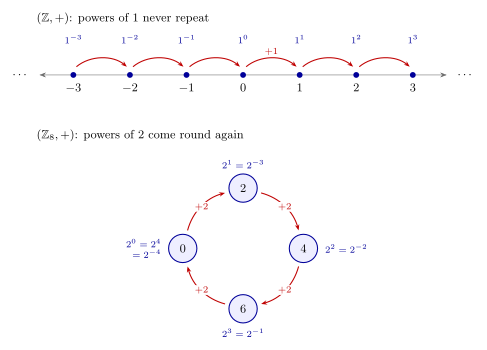
Figure 1: Powers of an element as steps, each step combining with the element once more; going left or backwards combines with its inverse. Top: in \((\mathbb{Z}, +)\) the powers of \(1\) run off in both directions and never repeat, so \(\langle 1 \rangle\) needs the negative powers to reach \(-1, -2, \ldots\). Bottom: in \((\mathbb{Z}_8, +)\) the powers of \(2\) come back to the identity at \(2^4 = 0\), so the line closes into a loop of four. Every negative power lands on a positive one, such as \(2^{-1} = 6 = 2^3\), and \(\langle 2 \rangle = {2, 4, 6, 0}\) is just the positive powers up to the identity.
The cyclic subgroup generated by \(a\)
If \((G, *)\) is a group and \(a \in G\), then \[\langle a \rangle = \{a^i : i \in \mathbb{Z}\}\] is a subgroup of \(G\), and is called the cyclic subgroup of \(G\) generated by \(a\).
Why it is a subgroup. The power laws are exactly the three checks.
- Closure. \(a^i * a^j = a^{i + j}\), and \(i + j \in \mathbb{Z}\), so it is in \(\langle a \rangle\).
- Identity. \(e = a^0 \in \langle a \rangle\).
- Inverses. \((a^i)^{-1} = a^{-i} \in \langle a \rangle\).
It is the smallest subgroup containing \(a\). Suppose \(S\) is any subgroup with \(a \in S\). Closure puts \(a^2, a^3, a^4, \ldots\) in \(S\). The identity puts \(a^0 = e\) in \(S\). Inverses put \(a^{-1}\) in \(S\), and then closure puts \(a^{-2}, a^{-3}, \ldots\) in \(S\). So \(\langle a \rangle \subseteq S\). A subgroup cannot contain \(a\) without containing all of its powers.
Two rules that save work:
- \(\langle e \rangle = \{e\}\). Every power of the identity is the identity.
- \(\langle a \rangle = \langle a^{-1} \rangle\). The powers of \(a^{-1}\) are \((a^{-1})^i = a^{-i}\), and as \(i\) runs through all of \(\mathbb{Z}\) so does \(-i\). The same set, listed in the opposite order. In \((\mathbb{Z}_n, +)\) the inverse of \(a\) is \(n - a\), so \(\langle a \rangle = \langle n - a \rangle\).
To find \(\langle a \rangle\) in a finite group, list \(a, a^2, a^3, \ldots\), each one the previous one combined with \(a\), until the identity appears (above).
Worked examples
\(\langle 3 \rangle\) in \((\mathbb{Z}_{11} - \{[0]\}, \cdot)\). The powers are \(3, 9, 27 = 5, 15 = 4, 12 = 1\), so \(\langle 3 \rangle = \{1, 3, 4, 5, 9\}\), five of the ten elements. Worked and drawn in 2026-10-06-elementary-properties-of-groups.
All the cyclic subgroups of \((\mathbb{Z}_8, +)\) (2026-10-06-elementary-properties-of-groups):
| \(a\) | Powers of \(a\) until \(0\) | \(\langle a \rangle\) | Size |
|---|---|---|---|
| \(0\) | \(0\) | \(\{0\}\) | 1 |
| \(1\), \(7\) | \(1, 2, 3, 4, 5, 6, 7, 0\) | \(\mathbb{Z}_8\) | 8 |
| \(3\), \(5\) | \(3, 6, 1, 4, 7, 2, 5, 0\) | \(\mathbb{Z}_8\) | 8 |
| \(2\), \(6\) | \(2, 4, 6, 0\) | \(\{0, 2, 4, 6\}\) | 4 |
| \(4\) | \(4, 0\) | \(\{0, 4\}\) | 2 |
The rows pair each element with its inverse (\(7 = -1\), \(5 = -3\), \(6 = -2\)), which generates the same subgroup. Eight elements, four different cyclic subgroups, nested one inside the next: \(\{0\} \subset \{0, 4\} \subset \{0, 2, 4, 6\} \subset \mathbb{Z}_8\).
All the cyclic subgroups of \((\mathbb{Z}_6, +)\). By the same method, \(\langle 0 \rangle = \{0\}\), \(\ \langle 1 \rangle = \langle 5 \rangle = \mathbb{Z}_6\), \(\ \langle 2 \rangle = \langle 4 \rangle = \{0, 2, 4\}\) and \(\langle 3 \rangle = \{3, 0\}\). The subgroup \(\langle 2 \rangle = \{0, 2, 4\}\) is the block in the table at 2026-10-06-elementary-properties-of-groups.
Cyclic groups
The group \((G, *)\) is cyclic if there exists an \(a \in G\) such that \(\langle a \rangle = G\).
Such an \(a\) is a generator of \(G\). A cyclic group is one in which every element is a power of one element.
- To prove \(G\) is cyclic, name a generator \(a\) and show every element of \(G\) is a power of it. In a finite group, list the powers of \(a\) until the identity appears and count: if there are \(|G|\) different ones, \(\langle a \rangle = G\).
- To prove \(G\) is not cyclic, show that \(\langle a \rangle \neq G\) for every \(a \in G\). One element that fails to generate proves nothing.
| Group | Cyclic? | Generators found | Where |
|---|---|---|---|
| \((\mathbb{Z}_{10}, +)\) | yes | \(1\) | 2026-10-06-elementary-properties-of-groups |
| \((\mathbb{Z}_8, +)\) | yes | \(1, 3, 5, 7\) | 2026-10-06-elementary-properties-of-groups |
| \((\mathbb{Z}_6, +)\) | yes | \(1, 5\) | above |
| \((\mathbb{Z}_5 - \{[0]\}, \cdot)\) | yes | \(2, 3\) | 2026-10-06-elementary-properties-of-groups |
| \((\mathbb{Z}_{11} - \{[0]\}, \cdot)\) | yes | \(2\), but not \(3\) | practice-problems, Q4 |
| \((\mathbb{Z}, +)\) | yes | \(1, -1\) | 2026-10-06-elementary-properties-of-groups |
| \((\mathbb{Z}_2 \times \mathbb{Z}_3, +)\) | yes | \((1, 1)\), \((1, 2)\) | below |
| \((\mathbb{Q}, +)\) | no | none | below |
| \((S_3, \circ)\) | no | none | symmetric-group |
\((\mathbb{Z}_n, +)\) is always cyclic, generated by \(1\): the powers of \(1\) are \(1, 2, \ldots, n - 1, n = 0\).
\((\mathbb{Z}, +)\) needs the negative powers. \(\langle 1 \rangle = \{\ldots, 1^{-2}, 1^{-1}, 1^0, 1^1, 1^2, \ldots\} = \{\ldots, -2, -1, 0, 1, 2, \ldots\} = \mathbb{Z}\). The positive powers alone give only \(\mathbb{Z}^{+}\).
A cyclic group is abelian. Any two elements are powers \(a^i\) and \(a^j\) of the generator, and \(a^i * a^j = a^{i + j} = a^{j + i} = a^j * a^i\). So a non-abelian group, such as \(S_3\), cannot be cyclic.
Worked: \((\mathbb{Q}, +)\) is not cyclic
In \((\mathbb{Q}, +)\) the powers of \(a\) are its integer multiples, \(\langle a \rangle = \{na : n \in \mathbb{Z}\}\). Take any \(a \in \mathbb{Q}\).
- If \(a = 0\), then \(\langle a \rangle = \{0\} \neq \mathbb{Q}\).
- If \(a = \frac{p}{q} \neq 0\), with \(p, q \in \mathbb{Z}\) and \(q \neq 0\), then \(\frac{p}{2q} \in \mathbb{Q}\). If it were in \(\langle a \rangle\), then \(\frac{p}{2q} = n \cdot \frac{p}{q}\) for some \(n \in \mathbb{Z}\), and dividing by \(\frac{p}{q} \neq 0\) gives \(n = \frac12\), which is not an integer. So \(\frac{p}{2q} \notin \left\langle \frac{p}{q} \right\rangle\).
No \(a\) generates \(\mathbb{Q}\), so \((\mathbb{Q}, +)\) is not cyclic. The same argument works for \((\mathbb{R}, +)\).
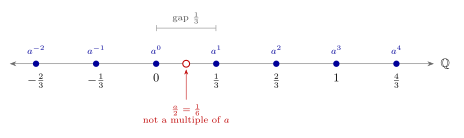
Figure 2: Why no rational number generates \((\mathbb{Q}, +)\), drawn for \(a = \tfrac13\). The powers of \(a\) under addition are its integer multiples, evenly spaced points a distance \(\tfrac13\) apart running off in both directions. Half of \(a\), here \(\tfrac16\), is a rational number that falls in the gap between \(a^0 = 0\) and \(a^1 = \tfrac13\), so it is not a power of \(a\). Any other non-zero \(a\) has gaps of the same kind, and \(a = 0\) generates only \({0}\).
Worked: \(\mathbb{Z}_2 \times \mathbb{Z}_3\) is cyclic
In \((\mathbb{Z}_2 \times \mathbb{Z}_3, +)\), with \((a, b) + (c, d) = \big((a + c) \bmod 2,\ (b + d) \bmod 3\big)\), the powers of \((1, 1)\) are
\[(1,1),\ (0,2),\ (1,0),\ (0,1),\ (1,2),\ (0,0),\]
six different elements, so \(\langle (1, 1) \rangle\) is the whole group and it is cyclic (2026-10-06-elementary-properties-of-groups). Each step adds 1 to both coordinates. The first coordinate is back at \(0\) after every 2 steps, the second after every 3, and both are back together for the first time after 6, so the powers visit all six pairs before returning to \((0, 0)\). Elements that move only one coordinate generate smaller subgroups:
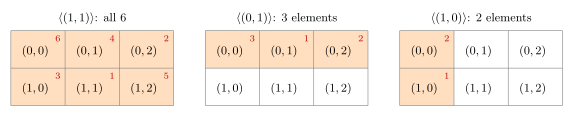
Figure 3: Three cyclic subgroups of \(\mathbb{Z}_2 \times \mathbb{Z}_3\), each shaded inside the six-element group. A shaded cell is a power of the generator, and the small number in its corner is the \(k\) at which the generator’s \(k\)th power first lands there. Left: \((1,1)\) changes both coordinates at every step and reaches all six pairs before \((1,1)^6 = (0,0)\), so it generates the whole group and the group is cyclic. Middle: \((0,1)\) never changes the first coordinate, so its powers stay in the top row and \(\langle (0,1) \rangle\) has three elements. Right: \((1,0)\) never changes the second coordinate, so \(\langle (1,0) \rangle = {(0,0), (1,0)}\).
\((1, 2)\) is a second generator, since it is the inverse of \((1, 1)\): \((1,1) + (1,2) = (2 \bmod 2,\ 3 \bmod 3) = (0, 0)\). Of the other non-identity elements, \((0, 1)\) and its inverse \((0, 2)\) both generate \(\langle (0, 1) \rangle\), and \((1, 0)\), which is its own inverse, generates \(\langle (1, 0) \rangle\).
Common mistakes
- Checking associativity for a subgroup. It is inherited from \(G\) and never fails. The three that need checking are closure, identity and inverses.
- Forgetting that \(e\) must be in \(H\). \(\mathbb{R} - \{0\}\) fails as a subgroup of \((\mathbb{R}, +)\) because the identity was removed.
- Changing the operation. A subgroup of \((G, *)\) uses \(*\). \((\mathbb{R} - \{0\}, \cdot)\) is a group, but not a subgroup of \((\mathbb{R}, +)\).
- Reading \(a^2\) as \(a \cdot a\) in an additive group. In \((\mathbb{Z}_{12}, +)\), \(3^2 = 3 + 3 = 6\).
- Reading \(a^{-1}\) as \(\frac1a\). It is the inverse under the group’s operation: \(-a\) in an additive group.
- Leaving out the negative powers in an infinite group. The positive powers of \(1\) in \((\mathbb{Z}, +)\) are only \(1, 2, 3, \ldots\).
- Confusing \(\langle a \rangle\) with \(\{a\}\). \(\langle a \rangle\) contains every power of \(a\), including \(e\).
- “\(3\) does not generate it, so it is not cyclic.” One generator is enough to be cyclic. \(\mathbb{Z}_{11} - \{[0]\}\) is \(\langle 2 \rangle\) though not \(\langle 3 \rangle\). To show a group is not cyclic, every element must fail.
- Expecting the identity to generate. \(\langle e \rangle = \{e\}\), in every group.
See also
- groups — the four properties, and the elementary properties such as the unique identity and \((g * h)^{-1} = h^{-1} * g^{-1}\)
- cayley-tables — a subgroup as a block of the table, when its elements are listed first
- integers-modulo-n — \(\mathbb{Z}_n\) and \(\mathbb{Z}_n - \{[0]\}\), where most of the cyclic examples live
- symmetric-group — the cyclic subgroups of \(S_3\), a group that is not cyclic
- 2026-10-06-elementary-properties-of-groups — Lecture 27 · 2026-10-08-definitions-and-examples-of-fields — Lecture 28
- practice-problems — §34, with full worked solutions