Lecture 27 — Elementary Properties of Groups
One more group checked from the definition, the functions \(ax + b\) under composition, and then three new ideas: a subgroup, a group sitting inside another under the same operation; powers of an element, including zero and negative powers; and the cyclic subgroup an element generates, which leads to cyclic groups. Pre-work: Video 034 (Elementary Properties of Groups). Subgroups, powers, cyclic subgroups and cyclic groups are collected in subgroups-and-cyclic-groups, the definition of a group and the rules for inverses in groups, and the classes \([a]\) in integers-modulo-n. How a subgroup shows up in a table is in cayley-tables. The cyclic subgroups of \(\mathbb{Z}_8\) and cyclic groups are also worked in 2026-10-08-definitions-and-examples-of-fields.
Goals
- Become more familiar with groups.
- Understand subgroups and other elementary properties of groups.
- Learn how to work with powers of elements in groups and to generate cyclic subgroups.
A question to keep in mind:
- What does it mean for a group \((G, *)\) to be cyclic? That every element of \(G\) is a power of one single element. The definition is below, after the powers it needs.
A group inside a group
Here is the Cayley table of \((\mathbb{Z}_6, +)\) with its elements listed in an unusual order, the even classes \([0], [2], [4]\) first and then the odd ones \([1], [3], [5]\).
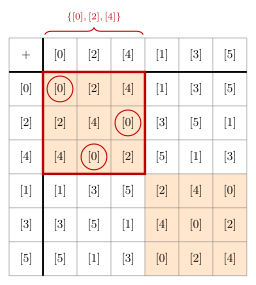
Figure 1: The table of \((\mathbb{Z}_6, +)\) with the even classes listed first. The top-left block, outlined, is a complete table on its own: its headings are \([0], [2], [4]\) and its body uses only \([0], [2], [4]\). So that set is closed under \(+\), it contains the identity \([0]\), and the rings show each element’s inverse inside it: \([0] + [0] = [0]\) and \([2] + [4] = [4] + [2] = [0]\). It is a group in its own right, a subgroup of \(\mathbb{Z}_6\). Shaded cells hold even classes. The bottom-right block is also all even, but its headings are odd, so it is not the table of anything: an odd plus an odd is even.
So \(\{[0], [2], [4]\}\) is a group under the same operation as \(\mathbb{Z}_6\), made of some of its elements. That is what a subgroup is. It is also exactly the set of multiples of \([2]\), \(\{[2], [2] + [2], [2] + [2] + [2]\} = \{[2], [4], [0]\}\), which makes it the cyclic subgroup generated by \([2]\). Listing a subgroup’s elements first, to make it a block, works for any subgroup of any finite group (cayley-tables).
Worked: the functions \(ax + b\) form a group
Show that \((F, \circ)\) is a group, where \(F\) is the set of all functions of the form \(f(x) = ax + b\) where \(a \in \mathbb{R} - \{0\}\) and \(b \in \mathbb{R}\), and \(\circ\) is function composition.
The four properties to check, numbered as in groups:
(1) Closure: for all \(g, h \in G\), \(g * h \in G\).
(2) Associativity: for all \(g, h, k \in G\), \((g * h) * k = g * (h * k)\).
(3) Identity: \(\exists e \in G\) such that \(\forall g \in G\), \(e * g = g * e = g\).
(4) Inverses: \(\forall g \in G\), \(\exists g^{-1} \in G\) such that \(g * g^{-1} = g^{-1} * g = e\).
Here \(G\) is \(F\), \(*\) is \(\circ\), and the identity will turn out to be \(I(x) = x\).
An element of \(F\) is a straight-line function with a non-zero slope, and it is pinned down by two numbers: the coefficient \(a \neq 0\) and the constant \(b\). Every check below comes down to the same move. Work out a composite, collect it into the form \((\text{number})\,x + (\text{number})\), and see whether the coefficient of \(x\) is non-zero.
Throughout, let
\[f(x) = ax + b, \qquad g(x) = cx + d, \qquad h(x) = mx + n,\]
where \(a, b, c, d, m, n \in \mathbb{R}\) and \(a, c, m \neq 0\).
(1) Closure. Show that if \(f, g \in F\) then \(f \circ g \in F\).
\[\begin{aligned} (f \circ g)(x) &= f(cx + d) \\ &= a(cx + d) + b \\ &= (ac)\,x + (ad + b). \end{aligned}\]
This is \(Ax + B\) with \(A = ac\) and \(B = ad + b\). Since \(a, b, c, d \in \mathbb{R}\), both \(ac\) and \(ad + b\) are in \(\mathbb{R}\). Since \(a \neq 0\) and \(c \neq 0\), \(ac \neq 0\). So \(f \circ g \in F\), and \(F\) is closed. \(\checkmark\)
(2) Associativity. Show that \((f \circ g) \circ h = f \circ (g \circ h)\). Let \(y = h(x) = mx + n\). Then, using the closure working,
\[\begin{aligned} \big((f \circ g) \circ h\big)(x) &= (f \circ g)(y) = f(cy + d) \\ &= a(cy + d) + b = (ac)\,y + (ad + b) \\ &= (ac)(mx + n) + (ad + b) \\ &= (acm)\,x + (acn + ad + b), \end{aligned}\]
and
\[\begin{aligned} \big(f \circ (g \circ h)\big)(x) &= f\big(g(mx + n)\big) = f\big(c(mx + n) + d\big) \\ &= f\big((cm)\,x + (cn + d)\big) \\ &= a\big((cm)\,x + cn + d\big) + b \\ &= (acm)\,x + (acn + ad + b). \end{aligned}\]
The two agree for every \(x\), so \((f \circ g) \circ h = f \circ (g \circ h)\). \(\checkmark\) Composition of functions is always associative (groups), so this could have been quoted; the algebra confirms it for this family.
(3) Identity. Show that there is an \(I \in F\) with \(f = I \circ f = f \circ I\) for all \(f \in F\). Suppose \(I(x) = ix + j\) is in \(F\) and works, and find \(i\) and \(j\). For \(f = I \circ f\):
\[\begin{aligned} f(x) &= (I \circ f)(x) \\ ax + b &= I(ax + b) \\ &= i(ax + b) + j \\ &= (ia)\,x + (ib + j). \end{aligned}\]
Two straight-line functions are equal for every \(x\) exactly when their coefficients match, so
\[\begin{cases} a = ia & \Rightarrow\ i = 1 \quad (\text{since } a \neq 0), \\ b = ib + j & \Rightarrow\ b = b + j\ \Rightarrow\ j = 0. \end{cases}\]
So \(I(x) = 1x + 0 = x\). It is in \(F\), because its coefficient \(1\) is non-zero, and it satisfies \(f = I \circ f\) for all \(f \in F\). The other side: \((f \circ I)(x) = f(I(x)) = f(x)\), so \(f \circ I = f\). \(F\) has identity \(I(x) = x\). \(\checkmark\)
(4) Inverses. Show that for every \(f \in F\) there is an \(f^{-1} \in F\) with \(f \circ f^{-1} = f^{-1} \circ f = I\). Let \(f(x) = ax + b\) with \(a \neq 0\), and suppose \(g(x) = cx + d\), with \(c \neq 0\), satisfies \(f \circ g = I\). Then
\[\begin{aligned} I(x) &= (f \circ g)(x) \\ x &= f(cx + d) = a(cx + d) + b \\ &= (ac)\,x + (ad + b). \end{aligned}\]
Equating coefficients, with \(x = 1x + 0\) on the left:
\[\left\{\begin{array}{lll} 1 = ac & \Rightarrow\ c = \dfrac1a \in \mathbb{R} - \{0\} & (\text{since } a \neq 0 \text{ and } a \in \mathbb{R}), \\[2mm] 0 = ad + b & \Rightarrow\ d = -\dfrac{b}{a} \in \mathbb{R} & (\text{since } a \neq 0 \text{ and } a, b \in \mathbb{R}). \end{array}\right.\]
So \(g(x) = \frac1a x - \frac{b}{a}\), which is in \(F\). It was found from \(f \circ g = I\) alone, so check the other order:
\[(g \circ f)(x) = g(ax + b) = \frac1a(ax + b) - \frac{b}{a} = x + \frac{b}{a} - \frac{b}{a} = x = I(x).\]
So \(g \circ f = f \circ g = I\), and \(g = f^{-1}\): the inverse of \(f(x) = ax + b\) is \(f^{-1}(x) = \frac1a x - \frac{b}{a}\). \(\checkmark\) For instance \(f(x) = 2x + 6\) has \(f^{-1}(x) = \frac12 x - 3\). “Double, then add 6” is undone by “subtract 6, then halve”.
All four properties hold, so \((F, \circ)\) is a group.
Two remarks:
- Why \(a \neq 0\). With \(a = 0\) the function \(f(x) = b\) is constant. It sends everything to \(b\), so nothing composed with it can give back \(x\), and it has no inverse. Leaving out \(a = 0\) is what makes \(F\) a group, in the same way that leaving out \(0\) turns \((\mathbb{R}, \cdot)\) into the group \((\mathbb{R} - \{0\}, \cdot)\).
- \(F\) is not abelian. In general \(f \circ g = (ac)\,x + (ad + b)\) and \(g \circ f = (ca)\,x + (cb + d)\) have different constants. With \(f(x) = 2x\) and \(g(x) = x + 1\), \((f \circ g)(x) = 2x + 2\) but \((g \circ f)(x) = 2x + 1\). So, like \(S_3\) (symmetric-group), this is a group in which the order of a composition matters.
Subgroups
Definition. If \((G, *)\) is a group and \(H \subseteq G\), then \(H\) is a subgroup of \(G\) if \((H, *)\) is itself a group.
The operation is the same one. To check that \((H, *)\) is a subgroup of \((G, *)\), check three properties:
- closure: for all \(g, h \in H\), \(g * h \in H\);
- identity: the identity is in \(H\);
- inverses: for every \(h \in H\), its inverse is in \(H\).
Associativity is not on the list, because \(H\) inherits it. \((g * h) * k = g * (h * k)\) holds for all \(g, h, k \in G\), so in particular it holds for all \(g, h, k \in H\). \(G\) associative \(\Rightarrow\) \(H\) associative under \(*\). The other three can fail, because each one asks for an element to be in \(H\). More on subgroups, and why the identity of \(H\) has to be the identity of \(G\), is in subgroups-and-cyclic-groups.
Worked: is \(\mathbb{Z}\) a subgroup of \((\mathbb{R}, +)\)?
True or false: \(\mathbb{Z}\) is a subgroup of \((\mathbb{R}, +)\).
True. To prove it, show that the three properties hold for all elements. \(\mathbb{Z} \subseteq \mathbb{R}\). Let \(a, b \in \mathbb{Z}\).
- Closure \(\checkmark\). \(a + b \in \mathbb{Z}\), so \(\mathbb{Z}\) is closed under \(+\).
- Identity \(\checkmark\). \(0 \in \mathbb{Z}\), since \(a + 0 = 0 + a = a\).
- Inverses \(\checkmark\). \(-a \in \mathbb{Z}\), and \(a + (-a) = (-a) + a = 0\).
Associativity comes free from \((\mathbb{R}, +)\), so \(\mathbb{Z}\) is a subgroup of \((\mathbb{R}, +)\).
Worked: is \(\mathbb{R} - \{0\}\) a subgroup of \((\mathbb{R}, +)\)?
True or false: \(\mathbb{R} - \{0\}\) is a subgroup of \((\mathbb{R}, +)\).
False. To disprove it, one property failing for specific elements is enough: a counterexample to one property.
- Closure \(\times\). Let \(a \in \mathbb{R} - \{0\}\). Then \(-a \in \mathbb{R} - \{0\}\) as well, but \(a + (-a) = 0 \notin \mathbb{R} - \{0\}\). For example \(1 + (-1) = 0\). So the set is not closed under \(+\).
- Identity \(\times\). The identity of \((\mathbb{R}, +)\) is \(0\), and it has been removed. No other element could stand in for it, since \(e + a = a\) forces \(e = 0\).
- Inverses. There is nothing to check against: an inverse is defined as an element that combines with \(a\) to give the identity, and there is no identity.
The same set is a group under multiplication, \((\mathbb{R} - \{0\}, \cdot)\) (groups). But a subgroup must use the operation of the group it sits in, and under \(+\) it fails.
Powers of an element
If \((G, *)\) is a group and \(a \in G\), then \(a^i\) is defined for each \(i \in \mathbb{Z}\) as follows:
\(a^0 = e\), where \(e\) is the identity of \(G\);
\(a^i = \underbrace{a * a * \cdots * a}_{i \text{ times}}\) for each \(i \in \mathbb{Z}^{+}\);
\(a^{-i} = \underbrace{a^{-1} * a^{-1} * \cdots * a^{-1}}_{i \text{ times}}\) for each \(i \in \mathbb{Z}^{+}\).
So \(a^1 = a\), \(a^2 = a * a\), \(a^3 = a * a * a\), and so on. A negative power is a power of the inverse: \(a^{-1}\), one copy of the inverse, is the inverse of \(a\) under \(*\), exactly as before, and \(a^{-2} = a^{-1} * a^{-1}\).
The power notation is used for any operation \(*\), even if that operation is addition. Be careful with it.
- In \((\mathbb{Z}_{12}, +)\), \(3^2 = 3 + 3 = 6\). It is not \(9\).
- In \((\mathbb{Z}, +)\), \(a^2 = a + a\), and \(a^{-1} = -a\), because \(a^{-1} + a = 0\).
Two laws. For all \(g \in G\):
\[g^i * g^j = g^{i + j}, \qquad\text{because}\qquad \underbrace{g * g * \cdots * g}_{i \text{ times}} * \underbrace{g * g * \cdots * g}_{j \text{ times}} \text{ is } i + j \text{ copies of } g,\]
and
\[\underbrace{g * g * \cdots * g}_{i \text{ times}} * \underbrace{g^{-1} * g^{-1} * \cdots * g^{-1}}_{i \text{ times}} = e,\]
because the \(g\) and the \(g^{-1}\) that meet in the middle combine to \(e\), which drops out, and then the next pair meet, until nothing is left. So
\[(g^i)^{-1} = g^{-i}, \qquad g^i * g^{-i} = g^{i - i} = g^0 = e, \qquad g^{-i} * g^i = g^{-i + i} = g^0 = e.\]
The powers of a group element follow the same exponent rules as powers of a number. The laws for exponents of mixed sign, and a picture of the powers as a line or a loop, are in subgroups-and-cyclic-groups.
Worked: \([3]^4\) and \([3]^{-4}\) in \(\mathbb{Z}_7 - \{[0]\}\)
Calculate \([3]^4\) and \([3]^{-4}\) in the group \((\mathbb{Z}_7 - \{[0]\}, \cdot)\).
Here \([3] = \{a \in \mathbb{Z} : a \equiv 3 \pmod 7\}\), the operation is multiplication of classes, and the identity is \([1]\).
\([3]^4\). Multiply, reducing mod 7 as soon as a product passes 6:
\[[3]^4 = [3] \cdot [3] \cdot [3] \cdot [3] = [9] \cdot [9] = [2] \cdot [2] = \mathbf{[4]}.\]
\([3]^{-4}\). By definition \([3]^{-4} = ([3]^{-1})^4\), and by the second law it is also \(([3]^4)^{-1}\). The second is quicker here, since \([3]^4\) is already known:
\[[3]^{-4} = ([3]^{-1})^4 = ([3]^4)^{-1} = [4]^{-1} = \mathbf{[2]},\]
because \([4] \cdot [2] = [8] = [1]\), that is, \(4 \cdot 2 \equiv 1 \pmod 7\).
Check by the other route. \([3]^{-1} = [5]\), since \([3] \cdot [5] = [15] = [1]\). Then \([3]^{-4} = [5]^4 = [25] \cdot [25] = [4] \cdot [4] = [16] = [2]\). The same. And \([3]^4 \cdot [3]^{-4} = [4] \cdot [2] = [1] = [3]^0\), as the first law says it must be. Both inverses can also be read off the table of this group (2026-09-24-definitions-and-examples-of-groups).
Cyclic subgroups
If \((G, *)\) is a group and \(a \in G\), then \[\langle a \rangle = \{a^i : i \in \mathbb{Z}\}\] is a subgroup of \(G\), and is called the cyclic subgroup of \(G\) generated by \(a\).
\(\langle a \rangle\) is every power of \(a\): positive, zero and negative. It is what any subgroup \(S\) containing \(a\) is forced to contain:
- \(a \in S\), so by closure \(a^2, a^3, a^4, \ldots \in S\);
- by identity \(a^0 = e \in S\), and by inverses \(a^{-1} \in S\), so by closure again \(a^{-2}, a^{-3}, a^{-4}, \ldots \in S\).
And the powers are already a subgroup, by the two laws: closure from \(a^i * a^j = a^{i+j}\), the identity \(a^0\), inverses \((a^i)^{-1} = a^{-i}\). So \(\langle a \rangle\) is the smallest subgroup that contains \(a\).
In a finite group, list the positive powers \(a^1, a^2, a^3, \ldots\) until the list comes back to where it started. After that it only repeats, and the negative powers turn out to be in the list already (subgroups-and-cyclic-groups).
Worked: \(\langle 3 \rangle\) in \(\mathbb{Z}_{11} - \{[0]\}\)
Determine \(\langle 3 \rangle\) in the group \((\mathbb{Z}_{11} - \{[0]\}, \cdot)\).
Each power is the previous one times \([3]\), reduced mod 11:
\[\begin{aligned} [3]^1 &= [3] \\ [3]^2 &= [3] \cdot [3] = [9] \\ [3]^3 &= [3]^2 \cdot [3] = [9] \cdot [3] = [27] = [22 + 5] = [5] \\ [3]^4 &= [3]^3 \cdot [3] = [5] \cdot [3] = [15] = [11 + 4] = [4] \\ [3]^5 &= [3]^4 \cdot [3] = [4] \cdot [3] = [12] = [1] \\ [3]^6 &= [3]^5 \cdot [3] = [1] \cdot [3] = [3] \end{aligned}\]
\([3]^6\) is back to the start, so every element of \(\langle 3 \rangle\) has been found: \([3]^7 = [9]\), \([3]^8 = [5]\), and so on round again. Once it is clear which group is meant, the square brackets are optional:
\[\langle 3 \rangle = \{3, 3^2, 3^3, \ldots\} = \{3, 9, 5, 4, 1\}.\]
The negative powers add nothing. \([3]^5 = [1]\) gives \([3]^4 \cdot [3] = [1]\), so \([3]^{-1} = [3]^4 = [4]\) (check: \([3] \cdot [4] = [12] = [1]\)). Multiplying by \([3]^{-1}\) walks round the same loop backwards, so \([3]^{-1}, [3]^{-2}, \ldots\) are \([4], [5], [9], [3], [1], \ldots\), all already listed.
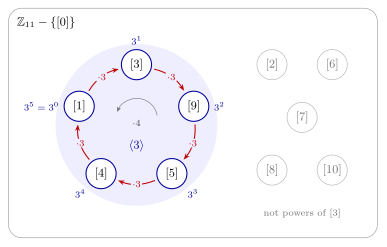
Figure 2: The powers of \([3]\) in \(\mathbb{Z}_{11} - {[0]}\). Each arrow multiplies by \([3]\). Starting from \([3]\) the powers run \([3], [9], [5], [4], [1]\), and since \([3]^5 = [1]\) the next step is back at \([3]\), so the powers go round a loop of five and \(\langle 3 \rangle = {1, 3, 4, 5, 9}\). Going round backwards is multiplying by \([3]^{-1} = [4]\), which gives the negative powers and stays on the same loop. The other five elements of the group are not powers of \([3]\), so \(\langle 3 \rangle\) is a subgroup, not the whole group.
\(\langle 3 \rangle\) has 5 of the group’s 10 elements, so \(3\) does not generate the whole group. Another element does: the powers of \(2\) are all ten elements (practice-problems, Q4).
Worked: all the cyclic subgroups of \((\mathbb{Z}_8, +)\)
Determine all the cyclic subgroups of \((\mathbb{Z}_8, +)\).
\(\mathbb{Z}_8 = \{0, 1, 2, 3, 4, 5, 6, 7\}\), writing the classes without brackets, and any representative names its class, so \(9 = 1\) and \(8 = 0\). The operation is \(+\), so a power is a repeated sum: \(2^3 = 2 + 2 + 2 = 6\). One cyclic subgroup for each element, starting with the identity:
\[\begin{aligned} \langle 0 \rangle &= \{0\} \\ \langle 1 \rangle &= \{1, 2, 3, 4, 5, 6, 7, 8 = 0\} = \mathbb{Z}_8 \\ \langle 2 \rangle &= \{2^n : n \in \mathbb{Z}\} = \{2^1, 2^2, 2^3, 2^4, \ldots\} = \{2, 4, 6, 0\} \\ \langle 3 \rangle &= \{3, 6, 9 = 1, 4, 7, 10 = 2, 5, 0\} = \mathbb{Z}_8 \\ \langle 4 \rangle &= \{4, 8 = 0\} = \{0, 4\} \end{aligned}\]
Each list stops at \(0\), the identity, because the next power is back at the start. The last three need no more work, because \(5 = -3\), \(6 = -2\) and \(7 = -1\) are inverses of elements already done:
\[\langle 5 \rangle = \langle 3^{-1} \rangle = \mathbb{Z}_8, \qquad \langle 6 \rangle = \langle 2^{-1} \rangle = \{0, 2, 4, 6\}, \qquad \langle 7 \rangle = \langle 1^{-1} \rangle = \mathbb{Z}_8.\]
Two rules were used:
- \(\langle \text{identity} \rangle = \{\text{identity}\}\). Every power of \(e\) is \(e\).
- \(\langle a \rangle = \langle a^{-1} \rangle\). The powers of \(a^{-1}\) are \((a^{-1})^i = a^{-i}\), the powers of \(a\) in the opposite order, so they make the same set. Directly: \(\langle 5 \rangle = \{5, 10 = 2, 15 = 7, 20 = 4, 25 = 1, 30 = 6, 35 = 3, 40 = 0\}\), which is \(\langle 3 \rangle\) listed backwards.
So \((\mathbb{Z}_8, +)\) has eight elements but only four different cyclic subgroups, and each one sits inside the next:
\[\{0\} \ \subset\ \{0, 4\} \ \subset\ \{0, 2, 4, 6\} \ \subset\ \mathbb{Z}_8.\]
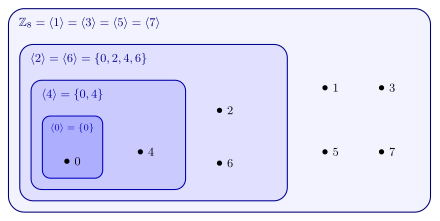
Figure 3: The four cyclic subgroups of \((\mathbb{Z}_8, +)\), each drawn inside the next. Every element generates exactly the smallest region it sits in: \(0\) generates only \({0}\), \(4\) generates \({0, 4}\), \(2\) and \(6\) generate \({0, 2, 4, 6}\), and the four odd elements \(1, 3, 5, 7\) each generate all of \(\mathbb{Z}_8\). Elements that are inverses of each other, such as \(2\) and \(6\), always land in the same region, because \(\langle a \rangle = \langle a^{-1} \rangle\).
Four of the eight elements, \(1, 3, 5, 7\), generate the whole of \(\mathbb{Z}_8\). That makes \(\mathbb{Z}_8\) a cyclic group.
Cyclic groups
The group \((G, *)\) is cyclic if there exists an \(a \in G\) such that \(\langle a \rangle = G\).
That answers the question in the goals: a group is cyclic when every one of its elements is a power of a single element \(a\), called a generator. So far:
- \(\mathbb{Z}_8\) is cyclic: \(\langle 1 \rangle = \langle 3 \rangle = \langle 5 \rangle = \langle 7 \rangle = \mathbb{Z}_8\).
- \(\mathbb{Z}_6\) is cyclic, generated by \([1]\), since \([1], [1] + [1], \ldots\) runs through all six classes. Its subgroup \(\{[0], [2], [4]\} = \langle [2] \rangle\), from the table above, is a cyclic subgroup that is not the whole group.
- \(\mathbb{Z}_{11} - \{[0]\}\) is cyclic, generated by \(2\), even though \(3\) is not a generator. One generator is all it takes.
How to prove a group is cyclic, and how to prove it is not, is in subgroups-and-cyclic-groups.
Worked: which of these groups are cyclic?
Which of the following groups are cyclic? \((\mathbb{Z}_{10}, +)\), \(\ (\mathbb{Z}_5 - \{[0]\}, \cdot)\), \(\ (\mathbb{Z}, +)\), \(\ (\mathbb{Q}, +)\).
| Group | Cyclic? | Generated by |
|---|---|---|
| \((\mathbb{Z}_{10}, +)\) | \(\checkmark\) yes | \(1\) |
| \((\mathbb{Z}_5 - \{[0]\}, \cdot)\) | \(\checkmark\) yes | \(2\) |
| \((\mathbb{Z}, +)\) | \(\checkmark\) yes | \(1\) |
| \((\mathbb{Q}, +)\) | \(\times\) no | nothing |
\((\mathbb{Z}_{10}, +)\). \(1^n = 1 + 1 + \cdots + 1 = n\), so the powers of \(1\) are \(1, 2, \ldots, 9, 10 = 0\): every element. \(\mathbb{Z}_{10} = \langle 1 \rangle\).
\((\mathbb{Z}_5 - \{[0]\}, \cdot)\). The set is \(\{1, 2, 3, 4\}\). The identity is no use, since \(\langle 1 \rangle = \{1\}\). Try \(2\): \(2^1 = 2\), \(2^2 = 4\), \(2^3 = 8 = 3\), \(2^4 = 16 = 1\). So \(\langle 2 \rangle = \{2, 4, 3, 1\}\), the whole group. (\(3\) is also a generator; \(4\) is not, since \(\langle 4 \rangle = \{4, 1\}\).)
\((\mathbb{Z}, +)\). Here the negative powers are essential:
\[\langle 1 \rangle = \{1^n : n \in \mathbb{Z}\} = \{\ldots, 1^{-2}, 1^{-1}, 1^0, 1^1, 1^2, \ldots\} = \{\ldots, -2, -1, 0, 1, 2, \ldots\} = \mathbb{Z}.\]
The positive powers of \(1\) give only \(1, 2, 3, \ldots\). The zero power is the identity \(0\), and \(1^{-n} = (-1) + \cdots + (-1) = -n\) fills in the negatives.
\((\mathbb{Q}, +)\). Not cyclic. That means showing that no \(a \in \mathbb{Q}\) generates it. In \((\mathbb{Q}, +)\) the powers of \(a\) are its integer multiples, so \(\langle a \rangle = \{na : n \in \mathbb{Z}\}\).
- If \(a = 0\), then \(\langle a \rangle = \{0\} \neq \mathbb{Q}\).
- If \(a = \frac{p}{q} \neq 0\), where \(p, q \in \mathbb{Z}\) and \(q \neq 0\), then \(\frac{p}{2q} = \frac{a}{2} \in \mathbb{Q}\). But \(\frac{p}{2q} = n \cdot \frac{p}{q}\) would need \(n = \frac12\), which is not an integer. So \(\frac{p}{2q} \notin \left\langle \frac{p}{q} \right\rangle\), and \(\langle a \rangle \neq \mathbb{Q}\).
Either way \(\langle a \rangle \neq \mathbb{Q}\), so \((\mathbb{Q}, +)\) is not cyclic. The multiples of any one rational are evenly spaced with gaps, and half of it falls in the first gap. A picture is in subgroups-and-cyclic-groups.
Worked: \(\mathbb{Z}_2 \times \mathbb{Z}_3\) is cyclic
Consider the group \((\mathbb{Z}_2 \times \mathbb{Z}_3, +)\) where \((a, b) + (c, d) = \big((a + c) \bmod 2,\ (b + d) \bmod 3\big)\). Show that this group is cyclic.
The group has \(2 \cdot 3 = 6\) elements, the pairs \((a, b)\) with \(a \in \{0, 1\}\) and \(b \in \{0, 1, 2\}\), and its identity is \((0, 0)\). Take \((a, b) = (1, 1)\) and add it on each time:
\[\begin{aligned} (1,1)^1 &= (1, 1) \\ (1,1)^2 &= (1,1) + (1,1) = (2 \bmod 2,\ 2 \bmod 3) = (0, 2) \\ (1,1)^3 &= (1,1)^2 + (1,1) = (0,2) + (1,1) = (1, 0) \\ (1,1)^4 &= (1,0) + (1,1) = (0, 1) \\ (1,1)^5 &= (0,1) + (1,1) = (1, 2) \\ (1,1)^6 &= (1,2) + (1,1) = (0, 0) \end{aligned}\]
The six powers are six different elements, so they are the whole group: \(\mathbb{Z}_2 \times \mathbb{Z}_3 = \langle (1, 1) \rangle\), and the group is cyclic. \(\blacksquare\)
It works because the first coordinate comes back to \(0\) every 2 steps and the second every 3 steps, and the two are back at \(0\) together for the first time at step 6. Not every element generates: \((0, 1)\) gives only \(\{(0,0), (0,1), (0,2)\}\) and \((1, 0)\) only \(\{(0,0), (1,0)\}\). These three are drawn in subgroups-and-cyclic-groups.
See also
- subgroups-and-cyclic-groups — subgroups, powers and the power laws, \(\langle a \rangle\), and cyclic groups, with more examples
- groups — the four properties, and the elementary properties: unique identity and inverses, the inverse of a product
- cayley-tables — reading a subgroup off a table by listing its elements first
- integers-modulo-n — \(\mathbb{Z}_n\) and \(\mathbb{Z}_n - \{[0]\}\), the groups most of the examples live in
- composition-of-functions · inverse-functions — the operation and the inverses in the group \((F, \circ)\)
- symmetric-group — the cyclic subgroups of \(S_3\), which is not cyclic
- 2026-09-24-definitions-and-examples-of-groups — Lecture 26 · 2026-10-08-definitions-and-examples-of-fields — Lecture 28
- practice-problems — §34, with full worked solutions