Inverse Functions
When a function can be run backwards, what the backwards function is, and the one notational trap: \(f^{-1}\) means two different things, and the braces tell you which. Builds on one-to-one-and-onto-functions; the preimage half is from functions-on-general-sets; the lecture is 2026-09-07-functions-one-to-one-onto-inverse.
Bijections have inverses
A function that is both one-to-one and onto is said to be a bijection.
A bijection \(f : X \to Y\) has an inverse function \(f^{-1} : Y \to X\), where for all \(y \in Y\), \[f^{-1}(y) = x \text{ where } x \text{ is the unique } x \in X \text{ such that } f(x) = y.\]
Note the direction: \(f : X \to Y\) gives \(f^{-1} : Y \to X\). The inverse’s domain is \(f\)’s co-domain and vice versa.
The definition is exactly one sentence, and both properties are inside it:
- “\(x\) … such that \(f(x) = y\)” — such an \(x\) exists for every \(y\) because \(f\) is onto.
- “the unique \(x\)” — there is only one because \(f\) is one-to-one.
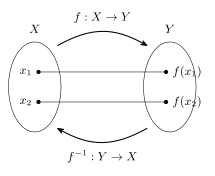
Figure 1: A bijection \(f\) pairs \(x_1\) with \(f(x_1)\) and \(x_2\) with \(f(x_2)\), one arrow each, nothing shared, nothing missed — and so the arrows can be read backwards. The curved arrow above is \(f : X \to Y\); the one below is \(f^{-1} : Y \to X\), the same pairs in the other direction.
Drop either and \(f^{-1}\) is not a function: if \(f\) is not onto, some \(y\) has nowhere to go; if \(f\) is not one-to-one, some \(y\) has two places to go. Both failures are drawn in 2026-09-07-functions-one-to-one-onto-inverse. And the converse holds too:
\[f \text{ has an inverse} \iff f \text{ is a bijection.}\]
Finding the inverse
The onto proof computes it. Proving \(f\) onto means taking an arbitrary \(y\) (or \((a,b)\)) and producing the \(x\) that maps to it, as a formula in \(y\). That formula is \(f^{-1}\). It is a function whether or not \(f\) is one-to-one; one-to-one is what makes it the inverse, by guaranteeing the \(x\) it produces is the only preimage, so that \(f^{-1} \circ f\) is the identity and not merely \(f \circ f^{-1}\).
\(f : \mathbb{R} \times \mathbb{R} \to \mathbb{R} \times \mathbb{R}\), \(f((x,y)) = (y+1, 2x)\) — a bijection (proved in one-to-one-and-onto-functions).
The onto proof took, for \((a,b)\), the candidate \(\left(\frac{b}{2}, a - 1\right)\). So
\[f^{-1} : \mathbb{R} \times \mathbb{R} \to \mathbb{R} \times \mathbb{R}, \qquad f^{-1}((a,b)) = \left(\tfrac{b}{2}, \; a - 1\right), \quad\text{i.e.}\quad f^{-1}((x,y)) = \left(\tfrac{y}{2}, \; x - 1\right).\]
Sense check, both ways: \[f\!\left(f^{-1}((x,y))\right) = f\!\left(\left(\tfrac{y}{2}, x-1\right)\right) = \left((x-1)+1, \; 2 \cdot \tfrac{y}{2}\right) = (x,y),\] \[f^{-1}\!\left(f((x,y))\right) = f^{-1}((y+1, 2x)) = \left(\tfrac{2x}{2}, \; (y+1) - 1\right) = (x,y).\]
In the language of composition-of-functions: \(f \circ f^{-1}\) and \(f^{-1} \circ f\) are both the identity, and checking one of them is the standard way to confirm an inverse has been computed correctly.
For a function given by a formula in one variable the procedure is the same: set \(f(x) = y\), solve for \(x\) in terms of \(y\), and the solution is \(f^{-1}(y)\) — provided the solution is unique and always in the domain, which is what “bijection” guarantees.
The two meanings of \(f^{-1}\)
This is the most common source of wrong answers in this topic.
1. Preimage. If \(f : X \to Y\) is any function and \(A \subseteq Y\), then the inverse image or preimage of \(A\) is \[f^{-1}(A) = \{x \in X : f(x) \in A\}.\] The preimage function is a function \(f^{-1} : \mathcal{P}(Y) \to \mathcal{P}(X)\).
2. Inverse function. If \(f : X \to Y\) is a bijection, then the inverse function of \(f\) is \(f^{-1} : Y \to X\) with $f^{-1}(y) = $ the unique \(x\) such that \(f(x) = y\). The inverse function is a function \(f^{-1} : Y \to X\).
| Takes | Gives | Exists | |
|---|---|---|---|
| preimage \(f^{-1}(A)\) | a subset \(A \subseteq Y\) | a subset of \(X\) | for every function |
| inverse function \(f^{-1}(y)\) | an element \(y \in Y\) | an element of \(X\) | only if \(f\) is a bijection |
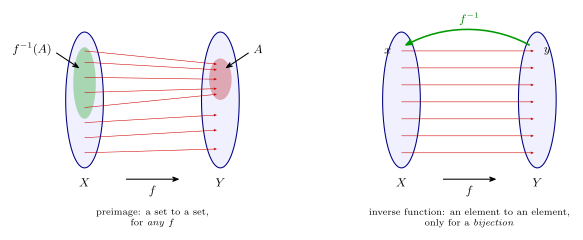
Figure 2: The two meanings side by side. Left: a many-to-one \(f\), with a subset \(A\) of \(Y\) (red) and its preimage \(f^{-1}(A)\) (green) — every \(x\) whose arrow lands in \(A\). This exists for any function, and it is a set. Right: a bijective \(f\), every arrow its own, and the single green arrow \(f^{-1}\) running one element back from \(y\) to \(x\). Same symbol; the first eats sets and the second eats elements.
The braces decide. \(f^{-1}(\{a\})\) has a set inside, so it is a preimage and always means something. \(f^{-1}(a)\) has an element inside, so it is the inverse function and means something only if \(f\) is a bijection.
Worked: reading the braces
\(f : \{1,2,3,4\} \to \{a,b,c\}\), \(f = \{(1,a), (2,a), (3,b), (4,b)\}\).
\(f\) is not one-to-one (\(1, 2 \mapsto a\)) and not onto (\(c\) unreached), so it is not a bijection.
| Statement | Because | |
|---|---|---|
| The inverse function \(f^{-1}\) does not exist. | T | \(f\) is not a bijection |
| \(f^{-1}(\{a\}) = \{1,2\}\). | T | preimage: 1 and 2 map to \(a\), nothing else does |
| \(f^{-1}(a)\) is not defined. | T | \(a\) is an element, so this is the inverse function, which does not exist |
| \(f^{-1}(\{c\}) = \emptyset\). | T | preimage: nothing maps to \(c\), and \(\emptyset\) is a perfectly good answer |
All four are true. The second and third differ only in the braces, and one is a set while the other is undefined.
When \(f\) is a bijection the two meanings agree in the obvious way: \(f^{-1}(\{y\}) = \{f^{-1}(y)\}\), a one-element set whose element is the inverse function’s value. That is the only case in which it is safe to blur them, and even then the types differ.
See also
- one-to-one-and-onto-functions — the two properties a bijection needs, and how to prove them
- composition-of-functions — \(f \circ f^{-1}\) and \(f^{-1} \circ f\)
- symmetric-group — the inverse function as the inverse of an element of a group
- groups — \(f(x) = ax + b\) with \(a \neq 0\) has inverse \(f^{-1}(x) = \frac1a x - \frac{b}{a}\), its inverse in the group of such functions
- functions-on-general-sets — image and preimage, where meaning 1 comes from
- sets-and-set-notation — power sets, which the preimage function maps between
- 2026-09-07-functions-one-to-one-onto-inverse — Lecture 19 · 2026-09-08-composition-of-functions — Lecture 20
- practice-problems — §25