Functions on General Sets
The set-theoretic definition of a function — not “a rule” or “a formula”, but a particular kind of subset of a Cartesian product. See sets-and-set-notation for the Cartesian products this is built on.
The definition
A function \(f : X \to Y\) is a subset \(f \subseteq X \times Y\) such that for each \(x \in X\), there is a unique \(y \in Y\) such that \((x,y) \in f\).
The function is the set of pairs. There is no separate “rule” object — the familiar notations are all names for the same set:
\[y = 2x + 1 \qquad\text{or}\qquad f(x) = 2x + 1 \qquad\text{or}\qquad f = \{(x,y) \in \mathbb{R} \times \mathbb{R} : y = 2x+1\}\]
and the bridge between the two styles is
\[f(x) = y \quad\Longleftrightarrow\quad (x,y) \in f\]
Defining a function this way costs a little intuition and buys a great deal of precision: the definition applies to any sets at all, not just sets of numbers, and questions like “are these two functions equal?” become ordinary questions about set equality.
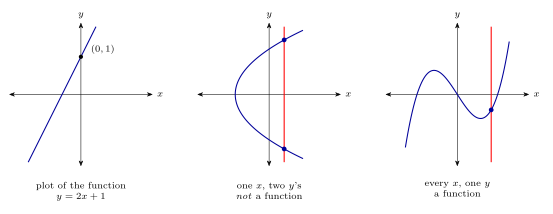
Worked: which of these is a function?
Let \(X = \{1,2,3\}\) and \(Y = \{1,2,3,4\}\). Which one of the following is a function from \(X\) to \(Y\)?
| Candidate | Why | ||
|---|---|---|---|
| (a) | \(\{(1,2), (1,3), (2,4)\}\) | ✗ | \(f(1) = 2\) and \(f(1) = 3\) — the value at \(1\) is not unique. (Also \(3\) is unused.) |
| (b) | \(\{(1,2), (2,3), (3,2), (4,1)\}\) | ✗ | \(4 \notin X\) — a pair whose first coordinate is outside the domain |
| (c) | \(\{(1,2), (2,3), (3,5)\}\) | ✗ | \(5 \notin Y\) — a value outside the codomain |
| (d) | \(\{(1,2), (2,1), (3,1)\}\) | ✓ | all first coordinates in \(X\), all second in \(Y\), each of \(1,2,3\) used exactly once |
Each wrong answer breaks a different one of the three conditions, which is what makes this a good question: the three failures are not variations on one mistake.
For (d): \(f(1) = 2\), \(f(2) = 1\), \(f(3) = 1\). Note \(f(2) = f(3)\) — two inputs sharing a value is not a problem, for exactly the reason the picture above shows.
Codomain and range
The two are constantly confused, and the difference is one word:
For a function \(f : X \to Y\), the co-domain is \(Y\), and the range is \(f(X) = \{f(x) : x \in X\}\), which is a subset of \(Y\).
| Is | Determined by | |
|---|---|---|
| Co-domain | \(Y\) — where values are allowed to land | the declaration \(f : X \to Y\) |
| Range | \(f(X)\) — where values actually land | the pairs in \(f\) |
So the codomain is a choice you make when you write down the function, and the range is a fact you compute. Always \(f(X) \subseteq Y\), and the containment is often proper.
For the function (d) above, \(f = \{(1,2),(2,1),(3,1)\}\):
\[\text{co-domain} = Y = \{1,2,3,4\} \qquad\qquad \text{range} = f(X) = \{1,2\} \subseteq Y\]
\(3\) and \(4\) are in the codomain and not in the range — they are permitted values that this particular function never takes.
Image and preimage
The two definitions generalise “range” to any subset, in each of the two directions:
If \(f : X \to Y\) is any function and \(A\) is any subset of \(X\), then the image of \(A\) is \[f(A) = \{f(x) : x \in A\}\]
If \(f : X \to Y\) is any function and \(B\) is any subset of \(Y\), then the inverse image or preimage of \(B\) is \[f^{-1}(B) = \{x \in X : f(x) \in B\}\]
Both take a set and return a set — \(A \subseteq X\) gives \(f(A) \subseteq Y\), and \(B \subseteq Y\) gives \(f^{-1}(B) \subseteq X\). The range is then just the image of the whole domain, \(f(X)\).
The notation \(f^{-1}\) here does not mean an inverse function. \(f^{-1}(B)\) is defined for any function, invertible or not — the emphasis on any in both definitions is the point. It is a set-to-set operation that always exists; an inverse function is a different thing that usually does not.
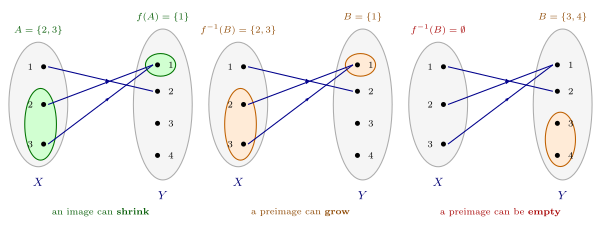
Figure 2: Image and preimage of the same function, read in opposite directions. Following the lines forward from a subset of X collects a subset of Y; following them backwards from a subset of Y collects every x that lands in it — which can be several elements, or none at all. In each panel the domain is on the left and the co-domain on the right, each line runs from an element of X to its value in Y, and the subset under discussion is outlined in colour with its expression in the same colour.
Worked
Let \(X = \{1,2,3\}\), \(Y = \{1,2,3,4\}\) and \(f = \{(1,2), (2,1), (3,1)\}\), the function from the question above. So \(f(1) = 2\), \(f(2) = 1\), \(f(3) = 1\).
| Asked for | Working | Answer | |
|---|---|---|---|
| (a) | image of \(\{1\}\) | \(f(1) = 2\) | \(f(\{1\}) = \{2\}\) |
| (b) | image of \(\{2,3\}\) | \(f(2) = 1\), \(f(3) = 1\) | \(f(\{2,3\}) = \{1\}\) |
| (c) | inverse image of \(\{2\}\) | which \(x\) have \(f(x) = 2\)? only \(x=1\) | \(f^{-1}(\{2\}) = \{1\}\) |
| (d) | preimage of \(\{1\}\) | which \(x\) have \(f(x) = 1\)? \(x = 2\) and \(x = 3\) | \(f^{-1}(\{1\}) = \{2,3\}\) |
| (e) | preimage of \(\{3,4\}\) | no \(x\) maps to \(3\) or \(4\) | \(f^{-1}(\{3,4\}) = \emptyset\) |
Three things this table is designed to show — they are the three panels of Figure 2:
- (b): an image can be smaller than the set you started with. \(\{2,3\}\) has two elements, \(f(\{2,3\})\) has one, because \(f\) sends both to the same place.
- (d): a preimage can be larger than the set you started with. One element of \(Y\) pulls back to two of \(X\).
- (e): a preimage can be empty. \(\{3,4\}\) lies outside the range entirely. Note this is a perfectly good answer, not a failure — \(\emptyset\) is a subset of \(X\) like any other, and it is the reason \(f^{-1}\) needs no invertibility to be defined.
Always write the answers as sets: \(f^{-1}(\{2\}) = \{1\}\), not \(= 1\). The operation returns a subset, and dropping the braces is the standard slip.
See also
- sets-and-set-notation — Cartesian products, and the \(\in\) / \(\subseteq\) distinction these definitions lean on
- proving-set-properties — the proof methods, for arguing about images and preimages
- relations-on-sets — functions as the relations with exactly one arrow out of each element
- 2026-09-03-set-properties-and-functions — Lecture 18
- practice-problems — §24 Functions Defined on General Sets, with full worked solutions