Cayley Tables
A Cayley table writes out every product in a finite set with an operation. For a group, most of the definition can be read straight off it. The definition is in groups. The tables for \(\mathbb{Z}_7 - \{[0]\}\) and for \(S_3\) are built in 2026-09-24-definitions-and-examples-of-groups. With the right ordering of the headings, a subgroup shows up as a block of the table (below, and subgroups-and-cyclic-groups).
What a Cayley table is
One row and one column for each element, in the same order, with the operation’s symbol in the corner. The entry in the row of \(g\) and the column of \(h\) is \(g * h\): row first, then column.
The order matters whenever the operation is not commutative. In the table of \(S_3\) the entry in row \(f_2\), column \(f_3\) is \(f_6\), so \(f_2 \circ f_3 = f_6\) (2026-09-24-definitions-and-examples-of-groups). The entry in row \(f_3\), column \(f_2\) is a different element, \(f_5\).
Reading the properties off a table
| Property | What to look for in the table |
|---|---|
| closure | The body uses only the elements in the headings. |
| associativity | Cannot be seen. It has to be argued separately, or be given. |
| identity | A row that repeats the column headings and a column that repeats the row headings, belonging to the same element. |
| inverses | The identity \(e\) appears in every row. If \(e\) is in row \(g\) and column \(h\), then \(g * h = e\). |
| abelian | The table is its own mirror image in the main diagonal (top left to bottom right). |
For \(\mathbb{Z}_7 - \{[0]\}\) the checks read: closure, because the body of the table uses only \([1], \dots, [6]\); associativity, given; identity \([1]\), since \([1] \cdot g = g \cdot [1] = g\); and six inverses, one from each \([1]\) in the body (2026-09-24-definitions-and-examples-of-groups).
Three details:
- Identity needs the row and the column. The row of \(e\) shows \(e * g = g\), and the column shows \(g * e = g\). The definition asks for both.
- Inverses need both orders too. \(g * h = e\) and \(h * g = e\) are two different cells, mirror images of each other. So the \(e\)s in a group’s table are placed symmetrically about the diagonal, even when the table as a whole is not symmetric. In \(S_3\), \(f_5 \circ f_6 = f_1\) and \(f_6 \circ f_5 = f_1\).
- An \(e\) on the diagonal means an element is its own inverse. In \(\mathbb{Z}_7 - \{[0]\}\) those are \([1]\) and \([6]\).
The figure below marks the same three things on a second table, the one for \(\mathbb{Z}_5 - \{[0]\}\) from practice-problems, Q4.
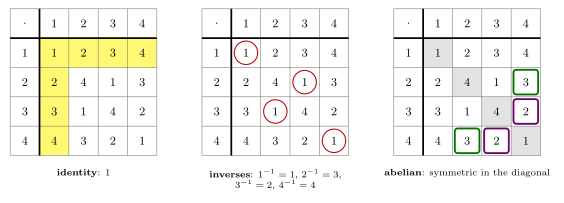
Figure 1: Three readings of one table, \(\mathbb{Z}_5 - {[0]}\) under multiplication, written without brackets. Left: the row and the column of 1, in yellow, repeat the headings, so 1 is the identity. Middle: the identity appears once in every row. The ring in row 2 is in column 3, so \(2^{-1} = 3\); the rings on the diagonal show that 1 and 4 are their own inverses. Right: each entry equals its mirror image in the shaded diagonal, such as the two boxed 3s and the two boxed 2s, so the operation is commutative and the group is abelian.
Rows and columns have no repeats
In a Cayley table for a group, the elements in each row are distinct.
A similar argument shows that the elements in each column are distinct.
Rows. By contradiction (2026-09-24-definitions-and-examples-of-groups). Suppose row \(a\) has the same entry \(x\) in two different columns \(b \neq c\), so \(a * b = a * c\). Apply \(a^{-1}\) on the left of both sides:
\[a^{-1} * (a * b) = a^{-1} * (a * c) \ \Longrightarrow\ (a^{-1} * a) * b = (a^{-1} * a) * c \ \Longrightarrow\ e * b = e * c \ \Longrightarrow\ b = c,\]
using inverses, associativity, inverses and identity in turn. That contradicts \(b \neq c\). \((\Rightarrow\Leftarrow)\)
Columns. The “similar argument”, written out. Suppose column \(a\) has the same entry in two different rows \(b \neq c\), so \(b * a = c * a\). Now \(a\) is on the right, so apply \(a^{-1}\) on the right:
\[(b * a) * a^{-1} = (c * a) * a^{-1} \ \Longrightarrow\ b * (a * a^{-1}) = c * (a * a^{-1}) \ \Longrightarrow\ b * e = c * e \ \Longrightarrow\ b = c,\]
a contradiction again. The figure below shows both cases.
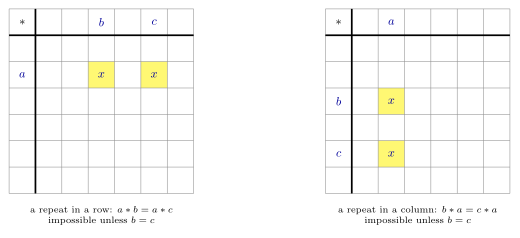
Figure 2: What the two results forbid. Left: the same element \(x\) twice in the row of \(a\), in the columns of two different elements \(b\) and \(c\). That would mean \(a * b = a * c\), and applying \(a^{-1}\) on the left gives \(b = c\). Right, the column version: the same \(x\) twice in the column of \(a\), which would mean \(b * a = c * a\), and applying \(a^{-1}\) on the right gives \(b = c\). Neither picture can occur in the table of a group.
The two results are cancellation: from \(a * b = a * c\) conclude \(b = c\), and from \(b * a = c * a\) conclude \(b = c\). The \(a\) being cancelled must be on the same side in both products. \(a * b = c * a\) does not give \(b = c\) unless the group is abelian.
What it gives for a finite table
In a group with \(n\) elements, a row has \(n\) entries, all different, all taken from the \(n\) elements. So every element appears exactly once in every row, and likewise in every column. Check it against the tables for \(\mathbb{Z}_7 - \{[0]\}\) and \(S_3\). Three uses:
- Finishing a table. A row with one empty cell must be completed by the one element not yet in it. Suppose the last row of the \(S_3\) table has only \(f_5\) filled in, in its last cell, and the other five cells empty. Once four of them are worked out, \(f_6, f_4, f_2, f_3\), the remaining one must be \(f_1\).
- Spotting a non-group. A repeat in a row or a column means the table is not a group’s. Multiplication mod 9 on \(\{1, \dots, 8\}\) has \(3 \cdot 1 = 3\) and \(3 \cdot 4 = 12 \equiv 3\) in the row of 3. That set is also not closed, since \(3 \cdot 3 \equiv 0\) (practice-problems, Q1).
- Finding inverses. \(e\) appears exactly once in each row, so each element has exactly one inverse to read off.
No repeats does not show that a table is a group’s. Associativity still cannot be seen in a table.
Subgroups in a table
A subgroup is a subset that is a group under the same operation (subgroups-and-cyclic-groups). To see one in a table, list its elements first, in the same order along the top and down the side. Then the top-left block of the table holds every product of two of its elements: it is the subgroup’s own table, and the checks are read off the block.
| Check | What to look for in the block |
|---|---|
| closure | The body of the block uses only the block’s own headings. |
| identity | The identity of the group is among the block’s headings. |
| inverses | The identity appears in every row of the block. |
| associativity | Nothing to check: it is inherited from the whole group. |
\((\mathbb{Z}_6, +)\) with \([0], [2], [4]\) listed first is drawn in 2026-10-06-elementary-properties-of-groups. The same works in a non-abelian group. In \(S_3\), list \(f_1, f_5, f_6\) first:
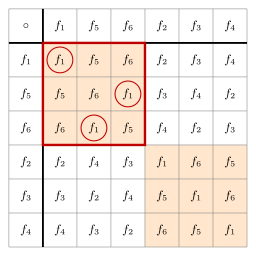
Figure 3: The Cayley table of \(S_3\) with \(f_1, f_5, f_6\) listed first; the entry in the row of \(f\) and the column of \(g\) is \(f \circ g\). The outlined top-left block uses only \(f_1, f_5, f_6\), so that set is closed under composition. It contains the identity \(f_1\), and the rings show \(f_1\) in every row of the block, so each of the three has its inverse among them: \(f_5 \circ f_6 = f_6 \circ f_5 = f_1\). So \({f_1, f_5, f_6}\) is a subgroup of \(S_3\). Shaded cells hold \(f_1\), \(f_5\) or \(f_6\). As with the even classes of \(\mathbb{Z}_6\), the table falls into four blocks, each using only the subgroup’s elements or only the other three.
\(\{f_1, f_5, f_6\}\) is every power of \(f_5\), since \(f_5^2 = f_6\) and \(f_5^3 = f_1\), so it is the cyclic subgroup \(\langle f_5 \rangle\) (symmetric-group).
A subset that is not a subgroup leaks. List \(f_1, f_2, f_3\) first instead. The block then contains \(f_2 \circ f_3 = f_6\), which is not one of its headings, so \(\{f_1, f_2, f_3\}\) is not closed and is not a subgroup. In \(\mathbb{Z}_6\), the block for \(\{[0], [1]\}\) contains \([1] + [1] = [2]\), and fails the same way.
The tables in the course so far
| Group | Elements | Abelian? | Where |
|---|---|---|---|
| \((\mathbb{Z}_7 - \{[0]\}, \cdot)\) | 6 | yes | 2026-09-24-definitions-and-examples-of-groups |
| \((S_3, \circ)\) | 6 | no | 2026-09-24-definitions-and-examples-of-groups |
| \((\mathbb{Z}_5 - \{[0]\}, \cdot)\) | 4 | yes | practice-problems, Q4; above |
| \((\mathbb{Z}_2 \times \mathbb{Z}_2, +)\) | 4 | yes | the same practice set, Q5 |
| \((\mathbb{Z}_3, +)\) | 3 | yes | integers-modulo-n |
| \((\mathbb{Z}_6, +)\), even classes first | 6 | yes | 2026-10-06-elementary-properties-of-groups |
| \((S_3, \circ)\), \(f_1, f_5, f_6\) first | 6 | no | above |
The first two have the same number of elements and are different kinds of group: one is abelian and the other is not. The size of a group does not determine it.
Common mistakes
- Reading the entry as column \(*\) row. It is row \(*\) column. For an abelian group the mistake is invisible. For \(S_3\) it gives wrong answers.
- Listing the rows and columns in different orders. The diagonal symmetry test needs the same order on both.
- Claiming the identity from its row alone.
- “The table has no repeats, so it is a group.” Closure, identity and inverses can be read off. Associativity cannot.
- Forgetting closure. An entry in the body that is not one of the headings ends the matter at once.
See also
- groups — the four properties the table is checked against, and cancellation as solving \(a * x = b\)
- integers-modulo-n — the groups \(\mathbb{Z}_n\) and \(\mathbb{Z}_n - \{[0]\}\) behind the first tables
- symmetric-group — \(S_3\), whose table is not symmetric
- subgroups-and-cyclic-groups — subgroups and cyclic subgroups, the blocks found above
- proof-techniques — proof by contradiction, the method of the rows result
- 2026-09-24-definitions-and-examples-of-groups — Lecture 26 · 2026-10-06-elementary-properties-of-groups — Lecture 27 · 2026-10-08-definitions-and-examples-of-fields — Lecture 28, where the table of \(\mathbb{Z}_4 - \{[0]\}\) fails closure
- practice-problems — §33, with full worked solutions