Fields
A field is a set with two operations, \(+\) and \(\cdot\), in which you can add, subtract, multiply, and divide by anything except 0, with all the usual rules holding. Formally it is two abelian groups on one set, \((F, +)\) on all of it and \((F - \{0\}, \cdot)\) on everything but 0, tied together by the distributive laws. \(\mathbb{Q}\) and \(\mathbb{R}\) are fields, \(\mathbb{Z}\) is not, and \(\mathbb{Z}_n\) (integers-modulo-n) is a field exactly when \(n\) is prime. In a field every linear equation \(ax + b = c\) with \(a \neq 0\) has exactly one solution. First met in 2026-10-08-definitions-and-examples-of-fields.
The definition
Definition. A field \((F, +, \cdot)\) is a set \(F\) with two binary operations \(+\) and \(\cdot\) such that
(1) \((F, +)\) is an abelian group;
(2) \((F - \{0\}, \cdot)\) is an abelian group, where \(0\) is the identity of \((F, +)\); and
(3) for all \(f, g, h \in F\), \(\ f \cdot (g + h) = (f \cdot g) + (f \cdot h)\) and \((f + g) \cdot h = (f \cdot h) + (g \cdot h)\).
Written out, conditions (1) and (2) are five checks each, side by side:
| Addition, on \(F\) | Multiplication, on \(F - \{0\}\) | |
|---|---|---|
| closure | \(f + g \in F\) | \(f, g \neq 0 \Rightarrow f \cdot g \neq 0\) |
| associativity | \((f + g) + h = f + (g + h)\) | \((f \cdot g) \cdot h = f \cdot (g \cdot h)\) |
| identity | \(0\), with \(0 + f = f + 0 = f\) | \(1\), with \(1 \cdot f = f \cdot 1 = f\) |
| inverses | every \(f\) has \(-f\), with \(f + (-f) = 0\) | every \(f \neq 0\) has \(f^{-1}\), with \(f \cdot f^{-1} = 1\) |
| commutativity | \(f + g = g + f\) | \(f \cdot g = g \cdot f\) |
Condition (3) is the two distributive laws, which hold for all \(f, g, h \in F\), zero included.
Points that are easy to read past:
- The two identities are named 0 and 1 by their jobs, not because they are the integers 0 and 1. In \(\mathbb{Z}_n\) they are \([0]\) and \([1]\). The “0” removed in condition (2) is whatever the additive identity is.
- Closure in (2) is a real condition. It says that a product of two non-zero elements is never 0. It is the condition \(\mathbb{Z}_4\) and \(\mathbb{Z}_{15}\) fail.
- \(-f\) and \(f^{-1}\) are different inverses. Each element has an additive inverse, and each non-zero element has a multiplicative one as well. In \(\mathbb{Z}_5\), \(-[2] = [3]\) and \([2]^{-1} = [3]\) happen to agree, but \(-[4] = [1]\) while \([4]^{-1} = [4]\).
- The distributive laws are the only link between the operations. Without (3), a field would be two unrelated groups that happen to share a set.
Why 0 is left out of (2). In any field, \(0 \cdot f = 0\) for every \(f\). By the distributive law, \[0 \cdot f = (0 + 0) \cdot f = (0 \cdot f) + (0 \cdot f),\] and adding \(-(0 \cdot f)\) to both sides leaves \(0 = 0 \cdot f\). So \(0 \cdot y = 1\) has no solution, and 0 can never have a multiplicative inverse. Asking for a group on all of \(F\) under \(\cdot\) would rule out every field, just as 0 stops \((\mathbb{R}, \cdot)\) being a group (groups).
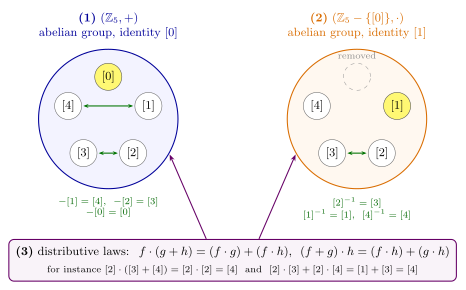
Figure 1: A field is two abelian groups on one set, shown for \(\mathbb{Z}_5\). Left: all five classes under addition, identity \([0]\). A line joins each class to its additive inverse; \([0]\) is its own. Right: the same classes under multiplication, with \([0]\) taken out and identity \([1]\). \([2]\) and \([3]\) are inverses, and \([1]\) and \([4]\) are their own. The same class can have different inverses in the two groups: \(-[4] = [1]\) but \([4]^{-1} = [4]\). Below: the distributive laws, the one condition that mentions both operations, checked on one instance.
Examples and non-examples
| Field? | Why | |
|---|---|---|
| \((\mathbb{Q}, +, \cdot)\) | yes | every non-zero \(\frac{a}{b}\) has inverse \(\frac{b}{a}\) |
| \((\mathbb{R}, +, \cdot)\) | yes | every non-zero \(x\) has inverse \(\frac1x\) |
| \((\mathbb{Z}, +, \cdot)\) | no | 2 has no multiplicative inverse in \(\mathbb{Z}\) |
| \((\mathbb{Z}_7, +, \cdot)\) | yes | 7 is prime |
| \((\mathbb{Z}_4, +, \cdot)\) | no | \([2] \cdot [2] = [0]\): closure fails in (2) |
| \((\mathbb{Z}_{15}, +, \cdot)\) | no | \([3] \cdot [5] = [0]\): closure fails in (2) |
| \((\mathbb{Z}_{12}, +, \cdot)\) | no | \([2]\) has no inverse, since \(2k\) is even and never \(\equiv 1 \pmod{12}\) |
\(\mathbb{Z}\), \(\mathbb{Z}_4\), \(\mathbb{Z}_7\) and \(\mathbb{Z}_{15}\) are worked in 2026-10-08-definitions-and-examples-of-fields and 2026-10-08-definitions-and-examples-of-fields. \(\mathbb{Z}_{12}\) is Q2 of practice-problems, and Q3 of the same set checks every condition for an unfamiliar field on \(\mathbb{Q} \times \mathbb{Q}\).
Every one of the non-examples passes (1) and (3) and fails (2). That is the usual pattern: addition is rarely the problem, and the work in deciding whether something is a field is in the multiplicative group.
To show something is not a field, one failure with specific elements is enough, as for groups: “2 has no inverse in \(\mathbb{Z}\)”, or “\([3] \cdot [5] = [0]\) in \(\mathbb{Z}_{15}\)”.
\(\mathbb{Z}_n\) is a field exactly when \(n\) is prime
\((\mathbb{Z}_n, +)\) is a group for every \(n \in \mathbb{Z}^{+}\).
\((\mathbb{Z}_p, +, \cdot)\) is a field when \(p\) is prime.
For any \(n\), condition (1) holds (integers-modulo-n), and condition (3), associativity, commutativity and the identity \([1]\) for multiplication are all inherited from the integers, for example \([a]([b] + [c]) = [a(b + c)] = [ab + ac] = [a][b] + [a][c]\). So whether \(\mathbb{Z}_n\) is a field comes down to two things about \(\mathbb{Z}_n - \{[0]\}\): is it closed under multiplication, and does every class in it have an inverse?
When \(n\) is composite, closure fails. Write \(n = rs\) with \(1 < r, s < n\). Then \([r]\) and \([s]\) are non-zero, but \[[r] \cdot [s] = [rs] = [n] = [0].\] \(\mathbb{Z}_4\) (\(2 \cdot 2\)), \(\mathbb{Z}_6\) (\(2 \cdot 3\)), \(\mathbb{Z}_{12}\) (\(3 \cdot 4\)) and \(\mathbb{Z}_{15}\) (\(3 \cdot 5\)) all fail this way. A non-zero class that multiplies something non-zero into \([0]\) also has no inverse: if \([a][b] = [0]\) with \([b] \neq [0]\), multiplying both sides by an inverse of \([a]\) would give \([b] = [0]\). That is why \([2]\), with \([2][6] = [0]\), has no inverse in \(\mathbb{Z}_{12}\).
When \(n = p\) is prime, both hold.
- Closure. If \([a] \cdot [b] = [0]\) then \(p \mid ab\). The prime \(p\) appears in the prime factorisation of \(ab\), which is the factorisation of \(a\) together with that of \(b\) (divisibility-and-factorisation), so \(p \mid a\) or \(p \mid b\). That is, \([a] = [0]\) or \([b] = [0]\). A product of non-zero classes is non-zero.
- Inverses. Fix \([a] \neq [0]\) and look at its row of the table, \([a][1], [a][2], \dots, [a][p-1]\). By closure none of these is \([0]\). No two are equal: if \([a][b] = [a][c]\) then \(p \mid a(b - c)\), and since \(p \nmid a\), the same argument gives \(p \mid (b - c)\), so \([b] = [c]\). That is \(p - 1\) different non-zero classes, which is all of them, so one of them is \([1]\). Whichever \([b]\) gives it is \([a]^{-1}\).
So \(\mathbb{Z}_n\) is a field for \(n = 2, 3, 5, 7, 11, 13, \dots\) and for no other \(n \geq 2\). (\(\mathbb{Z}_1\) has one class, \(\mathbb{Z}_1 - \{[0]\}\) is empty, and the empty set has no identity, so it is not a field either.)
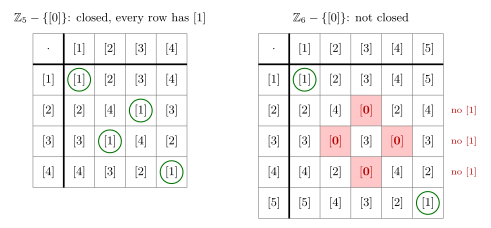
Figure 2: Multiplication on the non-zero classes of \(\mathbb{Z}_5\) and of \(\mathbb{Z}_6\). Left, \(p = 5\) prime: no product is \([0]\), so the set is closed, and \([1]\) (ringed) appears once in every row and every column, so every class has an inverse. Right, \(n = 6 = 2 \cdot 3\): the red cells are products of two non-zero classes that come out as \([0]\), so closure fails. The rows of \([2]\), \([3]\) and \([4]\), the classes sharing a factor with 6, contain no \([1]\), so those classes have no inverse. Only \([1]\) and \([5]\) do.
Calculating in a field
The two inverses give the other two operations:
- Subtraction is adding the additive inverse: \(f - g = f + (-g)\).
- Division is multiplying by the multiplicative inverse: \(f \div g = f \cdot g^{-1}\), for \(g \neq 0\).
In \(\mathbb{Q}\) and \(\mathbb{R}\) these are the familiar operations. In \(\mathbb{Z}_p\):
- \(-[a] = [-a] = [p - a]\). In \(\mathbb{Z}_{11}\), \(-[3] = [8]\), because \([3] + [8] = [11] = [0]\).
- \([a]^{-1}\) is the class \([b]\) with \(ab \equiv 1 \pmod p\). It is never a fraction: in \(\mathbb{Z}_{11}\), \([2]^{-1} = [6]\), because \(2 \cdot 6 = 12 \equiv 1\). Ways to find it are in integers-modulo-n.
So “\(5 \div 2\)” in \(\mathbb{Z}_{11}\) is \([5] \cdot [6] = [30] = [8]\), and indeed \([2] \cdot [8] = [16] = [5]\).
Solving linear equations
To solve \(ax + b = c\) in a field, with \(a \neq 0\):
- Add \(-b\) to both sides, which exists by (1): \(ax = c + (-b)\).
- Multiply both sides by \(a^{-1}\), which exists by (2) because \(a \neq 0\): \(x = a^{-1} \cdot (c + (-b))\).
- Check by substituting back.
Each step is reversible, since \(b\) and \(a\) can be put back by adding \(b\) and multiplying by \(a\). So the equation has exactly one solution, \(x = a^{-1}(c - b)\). It is the two-group version of solving \(a * x = b\) in a group (groups).
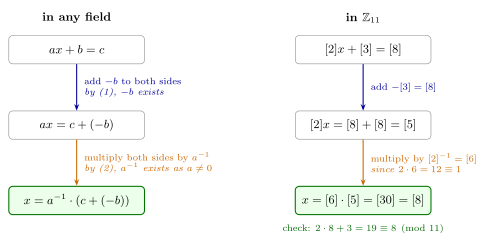
Figure 3: Solving \(ax + b = c\) in a field, on the left in general and on the right for \(2x + 3 = 8\) in \(\mathbb{Z}_{11}\). Each arrow applies one inverse to both sides. The first uses the additive group, condition (1): every element, here \([3]\), has a negative, \([-3] = [8]\). The second uses the multiplicative group, condition (2): every non-zero element, here \([2]\), has an inverse, \([6]\). Neither step can fail in a field, so the equation always has exactly one solution.
Worked: an equation in \(\mathbb{Z}_{13}\)
Solve \(5x + 7 = 3\) in the field \((\mathbb{Z}_{13}, +, \cdot)\).
\[\begin{aligned} 5x + 7 &= 3 \\ 5x &= 3 + (-7) = -4 = 9 && \text{add } -7 \\ 8 \cdot 5x &= 8 \cdot 9 && [5]^{-1} = [8], \text{ since } 5 \cdot 8 = 40 = 3 \cdot 13 + 1 \\ x &= 72 = 7 && 72 = 5 \cdot 13 + 7 \end{aligned}\]
Check: \(5 \cdot 7 + 7 = 42 = 3 \cdot 13 + 3 \equiv 3 \pmod{13}\). \(\checkmark\) So \(x = [7]\).
With a bracket, multiply by the inverse first. For \(3(x + 2) = 5\) in \(\mathbb{Z}_7\): \([3]^{-1} = [5]\), so \(x + 2 = 5 \cdot 5 = 25 = 4\), and \(x = 4 - 2 = [2]\). Check: \(3(2 + 2) = 12 \equiv 5 \pmod 7\). Expanding with the distributive law first, \(3x + 6 = 5\), gives the same answer by the usual two steps.
The two equations of 2026-10-08-definitions-and-examples-of-fields are worked the same way: \(2x + 3 = 8\) in \(\mathbb{Z}_{11}\) gives \(x = [8]\), and \(10x + 9 = 6\) in \(\mathbb{Z}_{17}\) gives \(x = [15]\). More are in practice-problems, Q1.
From a class to an integer
A solution in \(\mathbb{Z}_p\) is a class, and the integers \(y\) satisfying the matching congruence are exactly the members of that class. For \(2y + 3 \equiv 8 \pmod{11}\) they are \([8] = \{\dots, -3, 8, 19, \dots\}\). The smallest positive one is the usual representative of the class when that is between 1 and \(p - 1\), and \(p\) itself when the solution is \([0]\). In the column picture of integers-modulo-n it is the shaded entry of the column, or the entry just below it for \([0]\). A negative representative, such as \(-2\) for \([15]\) in \(\mathbb{Z}_{17}\), names the right class but is not the positive integer asked for.
When the set is not a field
In \(\mathbb{Z}_{15}\), \([3]\) has no inverse, and the method breaks in both possible ways:
- \(3x = 5\) has no solution, because \(3x\) is always one of \([0], [3], [6], [9], [12]\);
- \(3x = 6\) has three, \(x = [2], [7], [12]\).
Exactly one solution for every \(a \neq 0\) is what being a field buys.
Common mistakes
- Checking only addition. \((F, +)\) is usually the easy part. The work is in \((F - \{0\}, \cdot)\), and that is where \(\mathbb{Z}\), \(\mathbb{Z}_4\) and \(\mathbb{Z}_{15}\) fail.
- Asking 0 for a multiplicative inverse, or forgetting to remove it. Condition (2) is about \(F - \{0\}\).
- Assuming every \(\mathbb{Z}_n\) is a field. Only prime \(n\) works. For composite \(n\), removing \([0]\) is not enough, because other products land on \([0]\).
- Leaving a fraction in \(\mathbb{Z}_p\). \(2x = 5\) in \(\mathbb{Z}_{11}\) does not give \(x = \frac52\). It gives \(x = [6][5] = [8]\).
- Using the wrong inverse. To clear “\(+ 3\)” add \(-[3]\); to clear “\(2 \cdot\)” multiply by \([2]^{-1}\). In \(\mathbb{Z}_{11}\) these are \([8]\) and \([6]\), different classes.
- Not reducing the answer. \(x = [-36]\) in \(\mathbb{Z}_{17}\) is correct but unfinished: it is \([15]\). If a question wants the smallest positive integer, a negative representative is not it.
- Skipping the check. Substituting back takes one line and catches an inverse found wrongly.
- Forgetting the distributive laws when checking an unfamiliar structure. They are a separate condition, and two groups on one set without them are not a field.
See also
- groups — the four properties behind conditions (1) and (2), and solving \(a * x = b\)
- integers-modulo-n — \(\mathbb{Z}_n\), \(\mathbb{Z}_p\), and finding multiplicative inverses mod \(p\)
- subgroups-and-cyclic-groups — subgroups, \(\langle a \rangle\), and cyclic groups
- divisibility-and-factorisation — unique factorisation, used for why \(\mathbb{Z}_p\) is a field
- cayley-tables — reading closure and inverses off a table
- 2026-10-08-definitions-and-examples-of-fields — Lecture 28
- practice-problems — §36, with full worked solutions