Exceptions
See csse2002 for course logistics. A supplementary lecture on java-version-control also ran this week.
Code samples are in the course CodeCamp playlist and Git repo.
Outline
- Exceptions: what an exception is, the hierarchy, checked vs unchecked,
try/catch,throw,throws,finally, custom exceptions. - Specification: Javadoc → Restrictiveness → Generality → Formality → Contracts → Defensive Programming.
Exceptions
See java-exceptions — the exception hierarchy, checked vs unchecked exceptions, try/catch/throw/throws/finally, and custom exceptions. The finally exercise (Good Morning / hello / world) is worked there; week5-tutorial-exceptions then pushes the same tracing into nested blocks.
Specification
This repeats Week 3’s material: Javadoc, restrictiveness, generality, clarity, formality, contracts, defensive programming. See java-specification, which also has an early-return variant of the search generality example and an Effective Java citation for defensive programming/doc comments.
The rest of this section covers the examples that are not in that note.
The search array — why “an index” isn’t a specification
Restrictiveness on search, in three steps. The first spec:
/**
 * Returns an index (i) of ar such that ar[i] == x, if any.
 */
public int search(int[] ar, int x) { … }
This is a bad specification. It is silent about x not being in ar, and by its silence it allows any value to be returned. A return of 1 or 0 could equally mean “it’s at index 1/0” or “I didn’t find it”.
Adding else, return -1 is better but still bad. This array is why:
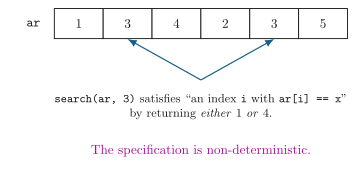
Figure 1: The array ar is the counterexample to the improved spec: 3 sits at both index 1 and index 4, so a specification asking only for an index i with ar[i] == x lets an implementation return either, and lets it return a different one on each call.
Nothing in that spec requires that you get the lowest index, or that you get the same answer running multiple times. Only “return the smallest index (i) of ar such that ar[i] == x, if any, else return -1” fixes both. Two different implementations can both satisfy that wording, which is the generality example.
Worked: is this a good specification?
Four specs, each judged against the three criteria: restrictive, general, clear.
/**
 * Sorts the given array.
 */
public void sort(int[] ar) { … }
Not restrictive enough: ascending or descending is never stated, so both satisfy it.
/**
 * Calculate x to the power of two with Math.pow.
 */
public int square(int x) { … }
Not general enough — the classic generality failure. It names an implementation (Math.pow), so it describes how rather than what, and an x * x implementation that computes exactly the same answer technically violates it.
/**
 * Returns the list of ResourceContainers stored by this instance.
 */
public List<ResourceContainer> getResources() { … }
Not restrictive enough about aliasing: it doesn’t say whether the caller gets the internal list or a copy, so it doesn’t say whether adding to the returned list changes the object — see java-mutability.
/**
 * Calculate the nth value of the fibonacci sequence.
 */
public long fib(int n) { … }
Not clear enough: it doesn’t fix the indexing (is fib(0) 0 or 1?), and says nothing about negative n or about n large enough to overflow long.
Contracts — the caller’s obligation, and \result
The contract form of withdraw carries a postcondition on the return value as well as on the state. The call site follows it:
/**
 * Withdraws an amount from this account.
 *
 * @require amount >= 0
 * @require amount <= getBalance()
 * @ensure getBalance == \old(getBalance()) - amount
 * @ensure \result == getBalance()
 */
public int withdraw(int amount) {
    // no need to check the conditions
}
int balance = myAccount.withdraw(amt);The method body needs no checks at all, because it is up to the calling code to make sure it fulfils its side of the contract, i.e. 0 <= amt <= myAccount.getBalance(). Written without a contract, the same method checks both conditions itself and returns the sentinel -1 on failure, which pushes an if (balance == -1) { … } into every call site.
The tags are spelt @require/@ensure here and @requires/@ensures elsewhere. Both spellings are used across the course. In the first @ensure line the left-hand getBalance is the call getBalance().
findMax — the undefended version, then the defended one
Defensive programming, before and after. The undefended version is code only, with no Javadoc:
public int findMax(int[] numbers) {
    int max = Integer.MIN_VALUE;
    for (int i = 0; i < numbers.length-1; i++) {
        if (numbers[i] > max) {
            max = numbers[i];
        }
    }
    return max;
}
The defended version adds the full specification (@param, @return, @throws IllegalArgumentException if the array is null or empty, @requires numbers != null && numbers.length > 0, @ensures the maximum is returned) and the guard clause that throws it. That version is in java-specification.
The loop bound also changes between the two versions, from i < numbers.length-1 to i < numbers.length. The undefended version never examines the last element.
Key takeaways
- A specification describes the contract between a method and its client.
- It explains what the method does, not how it is implemented.
- A good specification clearly states its preconditions (true before the call), postconditions (true after it finishes successfully), and side effects (any other changes it makes to the system).
- Clear specifications make code easier to understand, use, and maintain.
Further reading: Oracle’s Preconditions, Postconditions, and Class Invariants and Assertions guides, plus Effective Java (3rd Edition) Item 56, “Write doc comments for all exposed API elements”.