Sorting Algorithms
Five ways to solve one problem — sorting a list. Each is derived from a different restriction: suppose the only thing you could do was X, could you still sort? Taken together they are the course’s worked example for comparing algorithms, which is what algorithmic-complexity formalises.
Sorting is also the course’s very first example of an algorithm at all (2025-07-29-a-brief-history-of-computing). The selection-sort trace below needs no code beside it: what is being expressed matters more than the language it is expressed in.
Selection sort
Suppose we could only select (find the index of) the largest element from a list.
Find the largest member of xs and make it the last element. Then find the next largest and make it the second last, and so on. After \(k\) passes the last \(k\) elements are in their final positions.
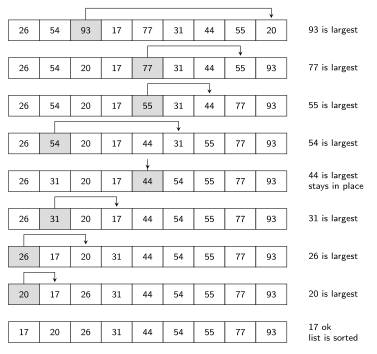
Figure 1: Selection sort on a list of nine. Each row is one pass; time runs downward. The grey cell is the largest element of the still-unsorted prefix and the arrow above the row takes it to the position it will keep, so after \(k\) rows the last \(k\) cells are final. In row five 44 is already where it belongs, so the arrow points straight down and nothing moves.
Two things the trace shows that the one-line description does not. The list of nine takes only eight passes — once the last eight are placed the first element has nowhere else to go, which is the 17 ok row. And the work is invisible in the picture: each row costs a full scan of the unsorted prefix to find its grey cell, and it is those scans, not the eight moves, that make selection sort quadratic.
Insertion sort
Suppose we could only place an element correctly into an already-sorted list.
Sort the list by inserting elements repeatedly into the front portion of the list. After \(k\) steps the first \(k\) elements of the list are sorted (though not necessarily in their final positions relative to the rest).
Bubble sort
Suppose the only operation we could perform was swapping adjacent cells.
Pass through the list swapping neighbouring elements so that larger elements move forward — larger elements “bubble” to the top. Make repeated passes until the list is sorted.
Merge sort
Suppose the only operation we could perform was merging two sorted lists into one sorted list.
Break the list in half, sort each half (using merge sort — this is recursion), then merge the two sorted halves.
The evaluation has the same two phases as any recursion: a winding phase where the list is repeatedly halved down to trivial pieces, and an unwinding phase where the sorted pieces are merged back up.
Quick sort
Could we sort a list if all we could do was split a list into two pieces based on some predicate?
Divide the list into two lists — those greater than or equal to the head, and those less than or equal to the head. Sort those lists (recursively) and then just concatenate them.
Which is best?
Rather than timing them, count how many times the characteristic operations are performed — for sorting, that means comparisons and swaps.
| Algorithm | Complexity |
|---|---|
| Selection sort | \(O(n^2)\) |
| Insertion sort | \(O(n^2)\) |
| Bubble sort | \(O(n^2)\) |
| Merge sort | \(O(n \ln n)\) |
Merge sort’s divide-and-conquer structure is what buys it the better class: the halving contributes a \(\log n\) factor and each level of the recursion does \(O(n)\) merging work.
Exercise: implement selection, insertion, bubble and merge sort. The hanoi function in 2025-10-20-recursion is the closest worked example of the same divide-and-conquer shape that merge sort and quick sort use.