Programming Paradigms
A paradigm is the style in which you describe a computation to a machine. The top-level split is between saying how to do something and saying what you want.
| Question answered | |
|---|---|
| Imperative | How to do it |
| Declarative | What to do |
Imperative programming
The programmer spells out how to do it, step by step. (Imperative, as an adjective, means giving an authoritative command.) It divides further by how those commands are grouped:
- Procedural — groups instructions into functions. This is everything up to week 7: python-functions, python-if-statements, python-while-loops, python-for-loops.
- Object-oriented — groups instructions into objects that combine data (state, attributes) and behaviour (methods). This is weeks 7–11: python-classes-and-objects onward.
Both are imperative — OOP does not stop you writing step-by-step instructions, it just changes what those instructions are attached to.
Declarative programming
The programmer declares what they want, through:
- Functional — a series of function applications.
- Logic — a question asked about a system of facts and rules.
- Mathematical optimization — an objective and a set of constraints.
Python is not a declarative language, but it has declarative moments. A list comprehension is the clearest one:
# imperative: how to build the list
acc = []
for k in range(4):
    acc.append(k**2)

# declarative: what the list is
[k**2 for k in range(4)]
The comprehension reads like the set-builder notation \(\{k^2 : k \in \{0,1,2,3\}\}\) — you state the set, not the procedure for accumulating it. See python-comprehensions.
Paradigm is not the same as level of abstraction
Take one program written six times over — integer exponentiation, power(x, y) — in six languages, from raw x86 bytes up to Python (the listings themselves are walked through in history-of-computing). It is tempting to read that ladder as a tour of paradigms. It is not. Every rung is imperative: set an accumulator to 1, run a loop y times, multiply.
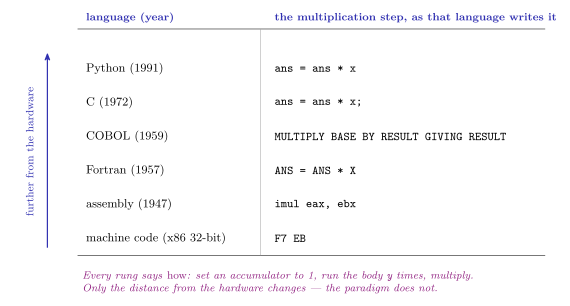
Figure 1: The one step that survives all six languages. Each row is that language’s way of writing multiply the accumulator by x. The rows run from the oldest language at the bottom to the newest at the top. The bottom two rows are the same instruction twice: F7 EB is what the machine stores, imul eax, ebx is the assembly for it.
The loop is the clearest tell. All six spell out how to repeat:
| Language | How it repeats |
|---|---|
| machine code | 74 09 and EB F5 — a conditional jump 9 bytes forward, an unconditional jump 11 bytes back |
| assembly | test ecx, ecx / jz .done … jmp .loop |
| Fortran | DO 10 I = 1, Y … 10 CONTINUE |
| COBOL | PERFORM UNTIL COUNTER = 0 … END-PERFORM. |
| C | for (int i = 0; i < y; i++) |
| Python | for _ in range(y) |
COBOL looks least like the rest. MULTIPLY BASE BY RESULT GIVING RESULT is English, and that was the point: Grace Hopper’s contribution was machine independent programming based on english words. But English-like syntax is not a declarative paradigm — the COBOL program still names every step and every repetition, in order. It is imperative prose.
So the ladder measures a different axis from the imperative/declarative split:
- Level of abstraction — how much of the machine you have to say out loud. This is what changes from
F7 EBtoans = ans * x. - Paradigm — whether you say how or what. This does not change anywhere on the ladder.
Python’s ** operator (see 2025-07-29-python-as-a-calculator) needs no loop written at all, and is one more step up the first axis: x ** y hands the repetition to the language. That still is not a change of paradigm — a single operator call is an abstraction, not a style of description. The genuine paradigm shift is the one shown further up, where a comprehension replaces the accumulation with a statement of what the result is. For ** alongside the rest of the arithmetic, see python-operator-precedence-and-associativity.
Why Python has several
Python was created to support a variety of programming styles rather than enforce one (see history-of-computing). CSSE1001 uses this deliberately: the course is structured as procedural first, then object-oriented, then (in the final, non-assessed week) a look at the functional style.
Where OOP fits
The fundamental building block of object-oriented programming is the class or object. In this paradigm, the design principle is to solve a problem by creating objects that interact with one another.
An object is a collection of fields and attributes (the data comprising the object’s state) along with methods (class-scoped functions) that can act on the object itself. An object can reference and change its own state, and has a notion of self.
Continue in python-classes-and-objects for the mechanics, and 2025-09-09-object-oriented-programming for the lecture that introduces them.