Sample Mid-Semester Exams
Two sample papers, both Semester Two Sample Mid-Semester Examinations, 2021, identically shaped. They are the only guide to the format of the real in-semester exam (20%, sitting between 5/09 and 20/09 — see math1061).
Each paper has a solutions version with a complete worked solution to every question, Part A included.
How the two parts are marked
Part A is answer-only: the ten letters are the entire mark, and working is not required for marks. So in Part A, work only as far as the letter. Part B is the reverse. Its rubric reads
Answers will be assessed on correctness, quality of explanation, and quality of expression.
and the model Part B answers are full prose proofs, with every deduction justified by naming the premise or the definition it came from. The explanation carries the marks, not just the result.
Structure
| Part | Questions | Marks | Format |
|---|---|---|---|
| A — Multiple choice | Q1–Q10 | 1 mark each, 10 total | Options (A)–(E); Q4 in both papers, and Q10 in Sample 1, stop at (D) |
| B — Short answer | Q11–Q13 | Sample 1: \(5+5+(3+2) = \mathbf{15}\). Sample 2: \(5+5+6 = \mathbf{16}\) | Answered in the space provided, using the backs of pages if needed |
Adding the per-question marks gives 25 for Sample 1 and 26 for Sample 2 — the two papers are not quite equally weighted. No total or time allowance appears on the pages available, because page 1 is missing from all four files: the solutions begin at “Page 2 of 7” and the question papers at “Page 2 of 8”. The real in-semester exam is 10 minutes perusal + 60 minutes working (math1061).
The solutions versions run to 7 pages and the question papers to 8; apart from pagination and the worked solutions, they are the same document.
Sample 1, Part A
| Q | What it asks | Answer | Working |
|---|---|---|---|
| 1 | A statement logically equivalent to \(p \to\ \sim q\) | (E) \(\sim(p \wedge q)\) | \(p \to\ \sim q\ \equiv\ \sim p\ \vee \sim q\) (def), \(\equiv\ \sim(p \wedge q)\) (de Morgan) |
| 2 | What can be deduced from \((p\ \vee \sim q) \to q\) being true | (B) \(q\) is true | \((p\ \vee \sim q) \to q\ \equiv\ \sim(p\ \vee \sim q) \vee q\ \equiv\ (\sim p \wedge q) \vee q\ \equiv\ q\) (absorption law). A truth table also works |
| 3 | The negation of “for any rational \(r\), if \(s\) is irrational then \(r+s\) is rational” | (C) there exists a rational \(r\) such that \(s\) is irrational and \(r+s\) is irrational | — |
| 4 | I: \(\exists x \in \mathbb{Z}\) such that \(\forall y \in \mathbb{Z}\), \(x+y=0\); II: \(\forall x \in \mathbb{Z}\), \(\exists y \in \mathbb{Z}\) such that \(x+y=0\) | (B) I false, II true | I is false: the order of the quantifiers matters, and \(x\) has to be chosen before \(y\) is known. II is true: for any given \(x \in \mathbb{Z}\) choose \(y=-x\). Then \(y \in \mathbb{Z}\) and \(x+y = x-x = 0\) |
| 5 | The contrapositive of \(\forall m,n \in \mathbb{Z}\), if \(m+n\) is odd then \(m\) is odd or \(n\) is odd | (E) if \(m\) and \(n\) are both even then \(m+n\) is even | Call the antecedent \(p\) and the consequent \(q\); the contrapositive is \(\sim q \to\ \sim p\) |
| 6 | A condition sufficient but not necessary for \(4 \mid n\) | (D) \(n = 52\) | “\(n\) divisible by 2” is necessary but not sufficient; “\(n\) a multiple of 4” and “\(\tfrac{n}{2}\) an even integer” are both necessary and sufficient; \(n \geq 4\) is ruled out as well |
| 7 | A possible \(a \in \mathbb{Z}\) with \(2a \equiv 5 \pmod 7\) | (E) \(-8\) | Test every option: \(\tfrac52\) ✗ (need \(a \in \mathbb{Z}\)); \(2(3)=6 \not\equiv 5\); \(2(7)=14 \equiv 0\); \(2(-6)=-12 \equiv 2\); \(2(-8)=-16 \equiv 5 \pmod 7\), since \(-16 = 7(-3)+5\) |
| 8 | Smallest positive \(n\) making \(mn\) a perfect square, for \(m = p^3q^2r\) | (E) \(pr\) | See Figure 1 |
| 9 | Applying \(j = i-1\) to \(\sum_{i=2}^{n}(10-3i)\) | (A) \(\sum_{j=1}^{n-1}(7-3j)\) | When \(i=2\), \(j=1\); when \(i=n\), \(j=n-1\). Then \(i=j+1\), and \(\sum_{j=1}^{n-1} 10-3(j+1) = \sum_{j=1}^{n-1} 10-3j-3 = \sum_{j=1}^{n-1}(7-3j)\) |
| 10 | Which of four sets has a least element | (C) the primes congruent to \(3 \pmod 5\) | In the set of primes, each element is greater than 1. The set of primes congruent to 3 mod 5 is non-empty (3 is in it, for example). So this is a non-empty set in which every element is greater than 1 |
Three of these need more explanation.
Q2 is an equivalence problem in disguise. The question sounds like a deduction — “what follows from this being true?” — but the way to answer it is to simplify the premise until only \(q\) is left. Three laws do that: the definition of \(\to\) turns the conditional into a disjunction, De Morgan’s law clears the negated bracket, and the absorption law collapses \((\sim p \wedge q) \vee q\) to \(q\). Of the three, only the definition of \(\to\) is missing from the formula page (see below).
Q9’s three checks are the standard ones — lower limit, upper limit, general term, in that order. The middle step is where the marks go: the inverse substitution \(i = j+1\) is what turns \(10-3i\) into \(10-3(j+1)\). See sequences-and-summations.
Q10 is the well-ordering principle. The working establishes two things: the set is non-empty, and every element is greater than 1 (so it is bounded below). Those are the hypotheses of the principle, so by the well-ordering principle the set has a least element. The other three options fail: the even integers and the integers \(\equiv 3 \pmod 5\) both run downwards forever, and the positive reals are not a set of integers at all (and have no least element regardless). See strong-induction-and-the-well-ordering-principle.
Sample 2, Part A
| Q | What it asks | Answer | Working |
|---|---|---|---|
| 1 | A statement equivalent to the negation of \(\sim p \to q\) | (C) \(\sim p\ \wedge \sim q\) | \(\sim(\sim p \to q) \equiv\ \sim(p \vee q) \equiv\ \sim p\ \wedge \sim q\), since \(a \to b \equiv\ \sim a \vee b\) |
| 2 | Symbolising “there are two integers whose sum is zero” | (E) \(\exists x,y \in \mathbb{Z}\) such that \(x+y=0\) | “There are” and “integers” are the two phrases that fix the quantifier and the domain |
| 3 | The negation of \(\forall x \in \mathbb{Z}\), \(\exists y \in \mathbb{Z}^{+}\) such that \(xy \geq 0\) | (C) \(\exists x \in \mathbb{Z}\) such that \(\forall y \in \mathbb{Z}^{+}\), \(xy < 0\) | Quantifiers swap and \(\geq\) becomes \(<\) |
| 4 | I: \(\exists x \in \mathbb{R}\) such that \(\forall y \in \mathbb{R}\), \(\tfrac{x}{y} \in \mathbb{Z}\); II: \(\forall x \in \mathbb{R}\), \(\exists y \in \mathbb{R}\) such that \(\tfrac{x}{y} \in \mathbb{Z}\) | (B) I false, II true | I is false: no choice of \(x\) works for \(y=0\). II is true by a case split on \(x\) — see the errata |
| 5 | “\(p\) is necessary for \(q\)” | (B) \(q \to p\) | If we don’t have \(p\), we cannot have \(q\). That is, \(\sim p \to\ \sim q\ \equiv\ q \to p\) |
| 6 | A counterexample to \(\forall a,b,c \in \mathbb{Z}^{+}\), if \(\gcd(a,b)=1\) then \(\gcd(a+b,c) = \gcd(a,c)\gcd(b,c)\) | (B) \(a=2\), \(b=3\), \(c=10\) | Need an example with the hypothesis true and the conclusion false. (A): \(\gcd(5,7)=1\), but \(\gcd(12,17)=1\) and \(\gcd(5,17)=\gcd(7,17)=1\), so it holds. (B): \(\gcd(2,3)=1\), \(\gcd(5,10)=5\), while \(\gcd(2,10)\times\gcd(3,10) = 2\times 1 \neq 5\) |
| 7 | \((m^2-3n) \bmod 5\), given \(m \bmod 5 = 2\) and \(n \bmod 5 = 4\) | (C) \(2\) | \(m^2-3n \equiv (2)(2)-3(4) \equiv -8 \equiv 2 \pmod 5\), since \(m \equiv 2 \bmod 5\) and \(n \equiv 4 \bmod 5\) |
| 8 | \(\operatorname{lcm}(18p, 15q)\) for distinct primes \(p,q \geq 11\) | (D) \(90pq\) | See Figure 1 |
| 9 | How many steps of \(\gcd(22050,231)\) have a non-zero remainder | (B) \(2\) | See Figure 3 |
| 10 | \(a_0=2\), \(a_1=3\), \(a_k = \sum_{i=1}^{k-1}(2a_i - a_{i-1})\) for \(k \geq 2\); find \(a_3\) | (D) \(9\) | \(a_2 = \sum_{i=1}^{1}(2a_i-a_{i-1}) = 2a_1-a_0 = 2(3)-2 = 4\); then \(a_3 = \sum_{i=1}^{2}(2a_i-a_{i-1}) = (2a_1-a_0)+(2a_2-a_1) = 2a_2+a_1-a_0 = 2(4)+3-2 = 9\) |
Q6 is a counterexample question. Before testing anything, separate the hypothesis from the conclusion and mark what is needed: the hypothesis true and the conclusion false. A counterexample has to do both jobs; an option that merely fails the hypothesis is not a counterexample. Option (A) is then worked through in full even though it is wrong: the test is applied to each option, not guessed. See proof-techniques and gcd-lcm-and-euclidean-algorithm.
Q7 uses the same shortcut twice. Both \(m\) and \(n\) are replaced by their residues before any arithmetic happens, and \(-8\) is only then reduced to \(2\). Reducing first is the whole point of congruence arithmetic — see modular-arithmetic.
Q10’s trap is that \(a_2\) is not given. The definition is a summation, not a two-term recurrence, so \(a_3\) cannot be reached without computing \(a_2\) from the same formula first. That makes two separate calculations.
The two Q8s: reason in the prime-exponent columns
Both papers put a question at Q8 that is solved the same way — write each number in standard factored form, line the primes up as columns, and read a rule off the exponents. Only the rule differs: parity for a perfect square, maximum for an lcm.
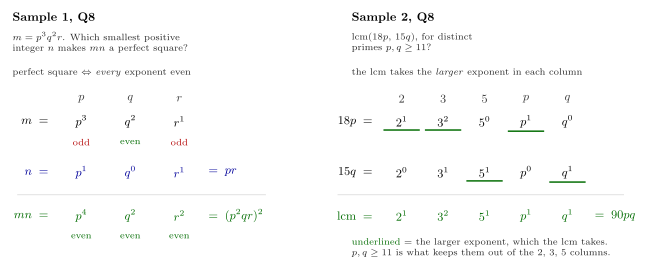
Figure 1: The two Q8s side by side, laid out as prime columns. Sample 1: a perfect square is exactly a number whose every exponent is even, so the odd columns of \(m = p^3q^2r\) are the ones needing a partner, and the smallest \(n\) that fixes them is \(pr\). Sample 2: the lcm takes the larger exponent in each column, so \(2 \cdot 3^2 \cdot 5 \cdot p \cdot q = 90pq\). The same exponent-column layout is used in gcd-lcm-and-euclidean-algorithm.
For Sample 1’s Q8 the reason fits in one line: \(mn = x^2\) \(\Leftarrow\) the prime factorisation has only even exponents. So \(n\) needs \(p^1\) and \(r^1\) in its prime factorisation, so that the exponents of \(p\) and \(r\) in the prime factorisation of \(mn\) are even. Option (A) goes separately: \(n = 0\) is impossible because \(n\) has to be a positive integer.
Sample 2’s Q8 is as short: write the two factorisations; the lcm must contain each of them and be the smallest such number. Both arguments are the Unique Factorisation Theorem doing its work — see divisibility-and-factorisation.
Part B, Q11: the same argument-validity search, twice
Both papers make Q11 a 5-mark validity question with four premises, and the model answers use the same method both times: assume every premise is true and the conclusion false, then follow what that forces. No truth table, no rules of inference — the search either closes on a contradiction, in which case the argument is valid, or it runs to completion, in which case the values it ends with are the counterexample.
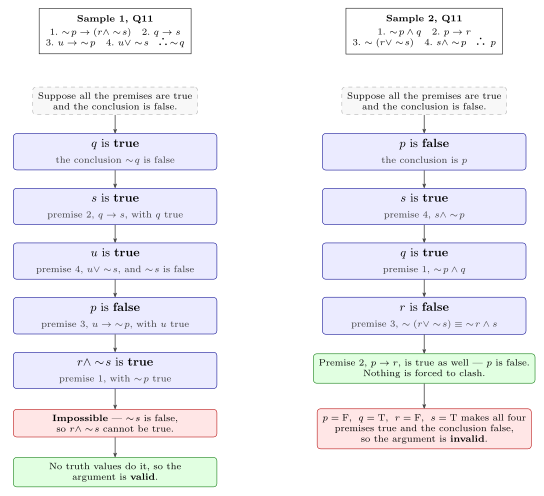
Figure 2: Part B Q11 of each paper: one search, two possible endings. Sample 1’s search closes — premise 1 demands that \(r\ \wedge \sim s\) be true, but \(\sim s\) was forced false three steps earlier, so no row can make the premises true and the conclusion false, and the argument is valid. Sample 2’s search never collides, and the four values it ends with are themselves the counterexample, so the argument is invalid. The same cascade layout is used in determining-argument-validity.
Two habits from the model answers are worth copying into your own answer.
Box every forced value as it lands — “\(q\) is true”, “\(s\) is true”, “\(u\) is true”, “\(p\) is false” — and name on each line the premise that forced it, in the form “Since premise 2 (\(q \to s\)) is true and \(q\) is true, \(s\) is true”. That is the “quality of explanation” the rubric asks for, and it costs one clause per line.
Write the verdict out in full. Sample 1 ends “So it is impossible for the argument to be invalid \(\therefore\) the argument is valid”. Sample 2 ends by restating the whole assignment — “Since truth values \(p\) false, \(q\) true, \(r\) false, \(s\) true make all premises true and the conclusion false, the argument is invalid” — because on an invalid argument the assignment is the proof, and a bare verdict has nothing behind it.
Sample 2’s premise 2 is never used to force anything; it is merely checked, at the end, and found to be satisfied automatically because \(p\) is false. Checking the unused premises is not optional — the counterexample has to make all four premises true. The full method is in determining-argument-validity, and the nine named argument forms it is an alternative to are in valid-argument-forms.
Part B, Q12: prove it or break it
Sample 1 Q12 (5 marks). Prove that for all real numbers \(q, r, s\), if \(q\) is rational, \(r\) is a non-zero rational and \(s\) is irrational, then \(q + rs\) is irrational. The model answer is a proof by contradiction, and reproducing its shape is most of the mark:
Proof (by contradiction). Suppose the statement is false. Then \(\exists q,r,s \in \mathbb{R}\) such that \(q \in \mathbb{Q}\), \(r \in \mathbb{Q}\), \(r \neq 0\) and \(s \in \overline{\mathbb{Q}}\), but \(q + rs \in \mathbb{Q}\).
Since \(q\), \(r\) and \(q+rs\) are rational, \[q = \frac{a}{b} \text{ for some } a,b \in \mathbb{Z},\ b \neq 0; \qquad r = \frac{c}{d} \text{ for some } c,d \in \mathbb{Z},\ d \neq 0,\ \text{and } c \neq 0 \text{ (since } r \neq 0);\] \[\text{and } q + rs = \frac{e}{f} \text{ for some } e,f \in \mathbb{Z},\ f \neq 0.\]
Thus \[\frac{a}{b} + \frac{c}{d}s = \frac{e}{f}, \qquad \frac{c}{d}s = \frac{e}{f} - \frac{a}{b} = \frac{eb-af}{bf}, \qquad s = \frac{d(eb-af)}{cbf}.\]
Since \(a,b,c,d,e,f \in \mathbb{Z}\), \(d(eb-af) \in \mathbb{Z}\) and \(cbf \in \mathbb{Z}\). Also \(cbf \neq 0\) since \(c \neq 0\), \(b \neq 0\) and \(f \neq 0\). Thus \(s \in \mathbb{Q}\), which is a contradiction.
\(\therefore\) The original statement is true. \(\square\)
Three details are doing the work, and each is a place marks are lost. A new letter for every new existential: six of them, \(a\) through \(f\), never reused. The non-zero conditions are tracked from the start — \(c \neq 0\) is justified on the line it is introduced, by \(r \neq 0\), and it is the only thing that makes the final division legal. And the contradiction is declared at the line it lands on — “Thus \(s \in \mathbb{Q}\), which is a contradiction” — the assumption it breaks being the \(s \in \overline{\mathbb{Q}}\) set up in the opening line. Irrational numbers are written \(\overline{\mathbb{Q}}\), the course’s notation; see rational-and-irrational-numbers and proof-techniques.
Sample 2 Q12 (5 marks) asks for a true/false verdict on two statements, with a proof or a counterexample.
(a) For all \(m,n \in \mathbb{Z}\), if \(m \mid n^2\) then \(m \mid n\). False.
Take \(m = 4\) and \(n = 2\). Then \(m,n \in \mathbb{Z}\) and \(m \mid n^2\) (since \(4 \mid 4\)) but \(m \nmid n\) (since \(4 \nmid 2\)).
That is the whole answer, and it is the course’s disproof-by-counterexample skeleton exactly: exhibit the values, check the hypothesis holds, check the conclusion fails. See divisibility-and-factorisation.
(b) For all \(n \in \mathbb{Z}^{+}\), if \(n \bmod 3 = 2\) then \(\lceil \tfrac{n}{3} \rceil = \tfrac{n+1}{3}\). True.
Proof. Let \(n \in \mathbb{Z}^{+}\) and suppose \(n \bmod 3 = 2\). Then \(n = 3k+2\) for some \(k \in \mathbb{Z}\).
Now \(\left\lceil \dfrac{n}{3} \right\rceil = \left\lceil \dfrac{3k+2}{3} \right\rceil = \left\lceil k + \dfrac{2}{3} \right\rceil = k+1\).
Also \(\dfrac{n+1}{3} = \dfrac{(3k+2)+1}{3} = \dfrac{3k+3}{3} = k+1\).
\(\therefore\ \left\lceil \dfrac{n}{3} \right\rceil = \dfrac{n+1}{3}\). \(\square\)
The move that makes it work is turning \(n \bmod 3 = 2\) into \(n = 3k+2\) immediately — the Quotient-Remainder Theorem in its usual role, converting a statement about a remainder into an algebraic form you can compute with. The two sides are then evaluated separately and shown to land on the same value, rather than being manipulated into each other; that is the same LHS/RHS discipline the course uses in induction proofs. See modular-arithmetic.
Part B, Q13: the Euclidean algorithm, and strong induction
Sample 1 Q13 runs the Euclidean algorithm and then converts the answer into an lcm. Sample 2’s Q9 runs the same algorithm on different numbers but asks something different about it, so the two are worth reading together.
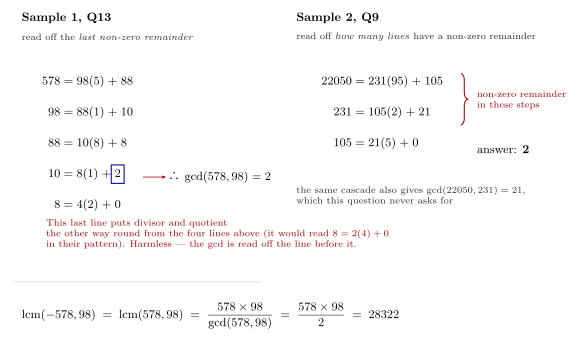
Figure 3: One algorithm, two questions. Sample 1’s Q13(a) wants the gcd, which is the last non-zero remainder — boxed at the fourth line — and part (b) then feeds it into the lcm. Sample 2’s Q9 runs the same cascade but wants only the number of lines whose remainder is non-zero, which the brace marks off. Sample 2’s cascade also yields a gcd that the question does not ask for. The last line of Sample 1’s cascade is as the solutions write it, with divisor and quotient swapped.
Part (b) is only two marks but it hides two separate facts, neither of which is on the formula page:
- \(\operatorname{lcm}(-578, 98) = \operatorname{lcm}(578, 98)\), because a number and its negative have the same multiples;
- \(\operatorname{lcm}(a,b) \cdot \gcd(a,b) = ab\), which is what makes part (a) usable in part (b) at all — and is exactly why the question says “use your answer to part (a)”.
Both are in gcd-lcm-and-euclidean-algorithm. The negative argument is the whole point of the part; it is there to catch anyone who reaches for a formula without checking what it needs.
Sample 2 Q13 (6 marks) is a strong induction: for \(a_0 = 1\), \(a_1 = 4\) and \(a_i = 2a_{i-1} + 3a_{i-2}\) for \(i \geq 2\), prove \(a_n \leq 4^n\) for every integer \(n \geq 0\).
Proof. Let \(P(n)\) be the predicate \(a_n \leq 4^n\).
Basis: Consider \(n = 0\). \(a_0 = 1\) and \(4^0 = 1\), so \(P(0)\) holds. Consider \(n=1\). \(a_1 = 4\) and \(4^1 = 4\), so \(P(1)\) holds.
Inductive hypothesis: Suppose \(k \geq 1\) is an integer and that \(P(0), P(1), \dots, P(k)\) are all true.
Consider \(n = k+1\): \[a_{k+1} = 2a_k + 3a_{k-1} \leq 2(4^k) + 3(4^{k-1}) \quad \text{by the Ind.\ Hyp.}\] \[= 4^{k-1}(2 \cdot 4 + 3) = 4^{k-1}(11) < 4^{k-1}(16) = 4^{k-1}(4^2) = 4^{k+1}.\]
\(\therefore a_{k+1} \leq 4^{k+1}\), so \(P(k+1)\) is true. Thus by the PSMI, \(a_n \leq 4^n\) for all integers \(n \geq 0\). \(\square\)
Four things this proof does deliberately:
- Two base cases, because the recurrence reaches two positions back. \(a_{k+1}\) needs both \(a_k\) and \(a_{k-1}\), so ordinary induction is not enough and one base case is not enough.
- \(k \geq 1\), not \(k \geq 0\), in the hypothesis. At \(k=0\) the step would ask for \(a_{-1}\), which does not exist. That single inequality is where a proof of this shape is most often quietly wrong.
- The inequality is used, then let go. After the first line the argument is pure algebra on \(4^{k-1}\) — factor it out, evaluate \(2\cdot 4 + 3 = 11\), and then loosen \(11\) to \(16\) because \(16 = 4^2\) is what rebuilds the power. Loosening a bound to make it fit is the move, and it is why the statement was \(\leq\) rather than \(=\) in the first place.
- The step is labelled where the hypothesis is used, on the same line — “by the Ind. Hyp.”
The principle is named “PSMI” here; the course also writes SMI, MI, PMI and the full phrase for the same two principles, so any of them is safe. See strong-induction-and-the-well-ordering-principle and mathematical-induction.
What the formula page does and does not cover
The formula-sheet is provided in the exam, so it is worth being exact about which of these questions it actually helps with. It carries the eleven named logical equivalences, the nine valid argument forms, the twelve set identities, the Quotient-Remainder Theorem, the Unique Factorisation Theorem, Schröder-Bernstein and the Binomial Theorem.
Genuinely on the page, and used: De Morgan’s and absorption (Sample 1 Q1, Q2); the Unique Factorisation Theorem behind both Q8s; the Quotient-Remainder Theorem behind Sample 1 Q7, Sample 2 Q7 and Sample 2 Q12(b); the argument forms, if you choose to do Q11 by rules of inference instead of the forced-value search.
Not on the page, and needed anyway — this is the more useful list:
- \(p \to q \equiv\ \sim p \vee q\). The definition of the conditional is not one of the eleven named equivalences, and both papers open with a Q1 that cannot be started without it.
- The contrapositive, \(p \to q \equiv\ \sim q \to\ \sim p\) (Sample 1 Q5, and the reasoning in Sample 2 Q5).
- The quantifier negation rules (Sample 1 Q3, Sample 2 Q3) — see quantified-statements.
- Necessary versus sufficient (Sample 1 Q6, Sample 2 Q5) — see conditional-statements.
- Change of variable in a summation (Sample 1 Q9).
- The well-ordering principle (Sample 1 Q10).
- The Euclidean algorithm, \(\gcd \cdot \operatorname{lcm} = ab\), and the min/max exponent rules (Sample 1 Q13; Sample 2 Q6, Q8, Q9).
- Floor and ceiling (Sample 2 Q12(b)).
- Induction in every form (Sample 2 Q13).
Nothing about proof technique is on the page either, and Part B is 15 or 16 of the marks.
Errata and wording differences
Small things, but worth knowing before you trust a line of the solutions.
Sample 2 Q4, statement II. The solutions say: “if \(x \neq 0\), take \(y = \frac{1}{x}\). Then \(\frac{x}{y} = \frac{x}{1/x} = 1 \in \mathbb{Z}\).” The conclusion is right and the verdict (statement II is true) is right, but the witness is not: \(\frac{x}{1/x} = x^2\), not \(1\). The choice that gives \(\frac{x}{y} = 1\) is \(y = x\), which is presumably what was meant — and the case split is still needed, because \(y = x\) fails at \(x = 0\), where the solutions’ second case, \(y = 1\), gives \(\frac{0}{1} = 0 \in \mathbb{Z}\).
Sample 1 Q13(a), last line. In the solutions the cascade’s first four lines are written as dividend \(=\) divisor(quotient) \(+\) remainder; the fifth is written \(8 = 4(2) + 0\), with divisor and quotient swapped. It changes nothing — the gcd is read off the line above — but the pattern breaks there. Figure 3 keeps the line as the solutions have it.
Sample 2 Q9 is worded differently in the two files. The question paper asks for “the number of steps of the algorithm in which there is a non-zero remainder”; the solutions version reads “the number of steps the algorithm in which there is a non-zero remainder when applying the quotient remainder theorem”. Same question, same answer.
Sample 2’s Q11 premise 4 is a conjunction in both files, and is worth reading twice because it is easy to see as a disjunction. Both the question paper and the solutions have \(s\ \wedge \sim p\), and the worked solution uses it as a conjunction: “Since premise 4 is true, \(s\ \wedge \sim p\) is true, so \(s\) is true”. Were it \(s\ \vee \sim p\), the search would force nothing there at all — \(\sim p\) is already true, so the disjunction would hold whatever \(s\) is.
Coverage, and what to drill
Both papers span exactly lectures 1–14 — logic, quantifiers, proof techniques, rational and irrational numbers, divisibility, modular arithmetic, the Euclidean algorithm, sequences and induction. Nothing from recursive definitions, solving recurrence relations or set theory appears in either. Every question maps onto an existing note.
The shape repeats question for question, which makes it drillable:
| Slot | Sample 1 | Sample 2 | Note |
|---|---|---|---|
| Q1–Q2 | equivalence and deduction | negation of a conditional | logical-equivalence-laws |
| Q3–Q4 | negating a quantified conditional; \(\exists\forall\) vs \(\forall\exists\) | symbolising; negating; \(\exists\forall\) vs \(\forall\exists\) | quantified-statements |
| Q5–Q6 | contrapositive; sufficient not necessary | necessary for; gcd counterexample | conditional-statements |
| Q7–Q8 | linear congruence; perfect square from a factorisation | \(\bmod\) arithmetic; lcm from factorisations | modular-arithmetic, divisibility-and-factorisation |
| Q9–Q10 | change of variable; least element | Euclidean algorithm steps; a summation-defined sequence | sequences-and-summations, strong-induction-and-the-well-ordering-principle |
| Q11 | argument validity — valid | argument validity — invalid | determining-argument-validity |
| Q12 | proof by contradiction (irrationality) | counterexample + a ceiling proof | proof-techniques |
| Q13 | Euclidean algorithm and lcm | strong induction | gcd-lcm-and-euclidean-algorithm, strong-induction-and-the-well-ordering-principle |
Part B is where the marks concentrate — 15 or 16 of 25 or 26, across three questions — and it is consistently one argument-validity question, one proof question, and one number-theory-or-induction question. Rehearse those three shapes and the layout of each; the marks for expression are handed out for exactly the habits the model answers show. More drill material is in practice-problems.