Generics in Java
See csse2002 for course logistics.
Outline
- Generics
- Bounded Generics
- Bounds through Wildcards
- Type Erasure
- Practical Example
Definitions, the full listings and the bookshop worked example are in java-generics. What follows is the order of the argument and the exercises.
Why generics
There are two reasons for generics, and they have nothing to do with each other. Keep them apart:
- Type safety — without a declared element type, a collection accepts anything and hands everything back as
Object, so the caller casts, and a wrong cast is a run-time crash. - Reuse — without a type parameter, a class that works on one type has to be copied once per type.
Everything after that is the same parameter T being progressively constrained: unbounded (<T>) → bounded at the declaration site (<T extends Number>) → bounded at the use site (? extends T, ? super T) → and finally erased entirely, so none of it survives compilation.
Why 01 — the cast you should not have to write
Prior to Java 1.5 collection classes could hold any type of object: ArrayList declared public boolean add(Object o). Every element comes back as Object, so each get needs a cast, and the compiler cannot check that the cast is right.
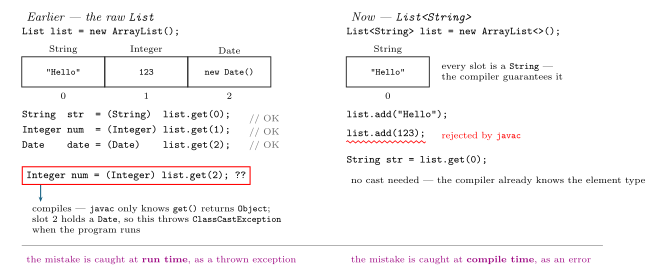
Figure 1: Type safety with and without generics. Left: a raw List holding a String, an Integer and a Date, with each cell’s type above it and its index below. The three casts that match the element types all succeed. The boxed line, Integer num = (Integer) list.get(2);, compiles, but slot 2 holds a Date, so it throws ClassCastException when the program runs. Right: the same list parameterised by String, where the bad line list.add(123) is refused before the program ever runs and get needs no cast. The red squiggle marks a compile-time error. The magenta lines give the verdict: the raw list’s mistake is caught at run time, the generic list’s at compile time.
Generics provide type safety. Type safety allows us to catch and prevent type-related errors early and thus prevent unintended bugs. A shopping cart is a second example: a raw List cart accepts new Product("Laptop") and then, by accident, "Not a product". The generic version turns that second add into a compile-time error and drops the (Product) cast from the loop.
See java-casting for what the cast itself is doing, and java-exceptions for ClassCastException.
Object
List<Object> list = new ArrayList<>(); accepts both "Hello" and 123, and both come back as Object. What that shows is written up in java-generics.
Why 02 — the class you should not have to copy
The second motivation is duplication. A class that prints an Integer has to be written again for Double, Float and String. The four classes differ in one word, and one generic class replaces them.
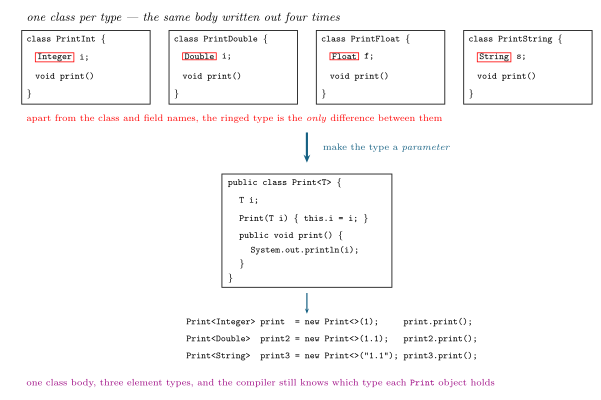
Figure 2: Reuse: four classes whose bodies are identical apart from one word, and the single generic class Print<T> that replaces them. Apart from the class and field names, the type outlined in red (Integer/Double/Float/String) is the only difference between the four. Each of the four is a public class and also carries a constructor and a one-line print() body (System.out.println(...)); all of that is elided here so the four fit in one row. At the bottom, three instantiations of the generic class with three different element types.
Generics enable reference types — Integer, String, … and user-defined types — to be parameters when defining classes, interfaces and methods. The word reference matters: Print<int> is not legal, only Print<Integer>.
Naming the type parameter
The convention is a single letter. These show up often in the Java libraries:
| Letter | Stands for |
|---|---|
T |
Type |
E |
Element — used extensively by the Java Collections Framework (java-collections-framework) |
K |
Key |
V |
Value |
N |
Number |
S, U, V… |
2nd, 3rd, 4th types |
Generic methods, and the two exercises
A method can carry its own type parameter, declared between the modifiers and the return type, whether or not its class is generic:
public <T> void genericsMethod(T data) { /* do something with data */ }

public <T> T genericsMethod(T data) {
    // do something with data here
    return data;                       // returning any T-type value
}
Several at once are allowed, and the return type may be a third one:
public <T, S, R> R genericMethod(T value1, S value2) {
    return null;
}

String result = genericMethod(42, 3.14);   // T = Integer, S = Double, R = String
The two exercises take one method — Printer.print — through three signatures. Exercise 02 is an edit to Exercise 01’s answer, so revise them as one sequence.
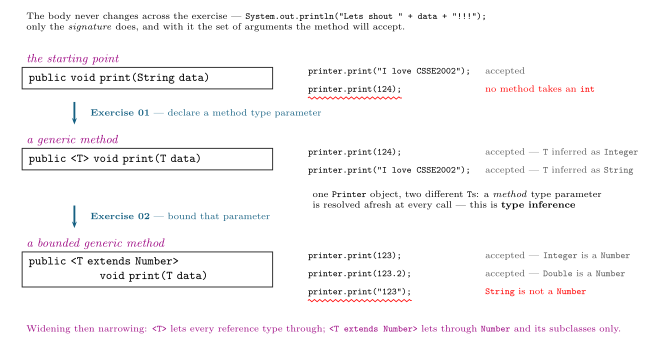
Figure 3: Exercises 01 and 02 as one progression. The body is the same at every stage; only the signature changes, and with it the set of arguments the method accepts. A red squiggle marks a call the compiler rejects. At the starting point printer.print(124) is rejected, and removing that restriction is what Exercise 01 exists to do. Exercise 02 then bounds the parameter, so the String call on the bottom row is rejected. The teal arrows are the two exercises, each a change of signature.
At the middle stage the Java compiler automatically determines the type of T from the type of the argument passed to the method. This is known as type inference.
Bounded generics
In general, the type parameter can accept any reference data type. Bounded generics are used if we want to use generics for some specific types.
The form is <T extends X>: T can only accept data that are subtypes of X. It is the java-inheritance relation being used as a constraint. The example classes are Person, Student and Professor.
Despite the keyword, extends in a bound also covers implementing an interface. There is no implements form of a bound. This is needed to read library signatures.
Bounds through wildcards
The bound above sits at the declaration site. Wildcards move the same idea to the use site — a parameter list. There are three forms:
| Form | Name | Use |
|---|---|---|
List<?> |
unbounded wildcard | read only; writing is refused outright |
? extends T |
upper bound wildcard | mainly to read data from a structure |
? super T |
lower bound wildcard | to perform write operations |
Choosing between <T> and <?>:
- Use
<T>when you need to work with the type. - Use
<?>when you only need to read values. - Wildcards are usually bounded (
<? extends T>,<? super T>) to reduce flexibility and improve safety.
The reason upper bounds are needed at all is invariance (Effective Java, Item 31): parameterized types are invariant, so List<Type1> is neither a subtype nor a supertype of List<Type2>. So sum(List<Number>) rejects a List<Double> even though Number n = 5.0; is fine. Widening the parameter to sum(List<? extends Number>) fixes it.
java-generics carries the code for all three forms, the addSomething / sum / addNumbers examples, and a figure of the Number tree showing which lists each wildcard admits.
Type erasure
All of the above is compile time only. Java implements generics by erasing every type parameter during compilation — replacing it with its upper bound, or with Object if unbounded — so generic type information is not available at run time. The compiler then inserts the casts the erased code needs. The (String) cast that generics took out of the source is still there in the compiled code; you just did not type it.
The two erasure examples and the compile-time/run-time pair are drawn out in java-generics.
Practical example: the bookshop
A worked design problem: a bookshop selling Fiction, Action and Fantasy books held in bookshelves. There are three designs: one BookShelf of Book (reusable, needs casts, and one line throws), a separate shelf class per genre (type safe, duplicated), and finally BookShelf<T extends Book> (both). The listings and a figure comparing the three designs are in java-generics.
The bound is needed in that last version: displayBooks() calls book.getGenre(), which is only legal because the compiler knows every T is at least a Book. An unbounded BookShelf<T> would not compile.
Homework
- What if we use a generic class instead? Rewrite the
Printerexercise with the type parameter on the class rather than the method, then work out whyprinter.print(123)is now an error on aPrinter<String>. The reasoning is written up in java-generics.
Further reading
- https://docs.oracle.com/javase/tutorial/java/generics/index.html
- https://www.baeldung.com/java-generics
- https://youtu.be/K1iu1kXkVoA
The course’s CodeCamp playlist has supplementary material, and the course Git repo has the code samples.
Generics come back in the Week 12 practical, week12-lab-generics.
Applied class
See week9-tutorial-substitution-principle-and-pre-post-conditions — more practice with the Liskov Substitution Principle (from java-solid-principles, Week 7) and pre/postconditions (from java-specification, Week 3). It runs in three parts: ranking six pairs of predicates by strength; deciding, for each of those pairs, whether putting them in as preconditions or as postconditions keeps substitutability; and then writing Javadoc for a small q2 method — @param/@return first, then @requires/@ensures, then a frame condition saying the method changes nothing in the array.
The worked X/Y/Z example is the one to remember: Y widens the precondition and narrows the postcondition, so it is legal; Z narrows the postcondition correctly but also narrows the precondition (> 5 instead of >= 5, forbidding 5), and that is the violation.
Practical
See week9-lab-refactoring — refactoring in the small and in the large, extending java-refactoring (Week 6). The “in the small” half is a Connect 4 class taken through style fixes, better names, while→for, magic numbers to constants, decomposition into helper methods, comments, and finally removing the duplicated win-checking code into checkWin / checkHorizontalWin / checkVerticalWin. The “in the large” half breaks a monolithic Library class into Book, BookShelf, Borrower and BorrowingSystem — see java-cohesion-and-coupling.
That practical solution lands on Book and BookShelf — the same two classes the bookshop generics example is built from, arrived at from cohesion rather than from type safety.