SOLID Principles II
See csse2002 for course logistics. Continues 2026-04-02-refactoring (Week 6), which has Single Responsibility and Open-Closed. The remaining three SOLID principles are below. The code-level treatment of all five is in java-solid-principles.
Outline
- Liskov Substitution Principle (and substitution with contracts)
- Interface Segregation Principle
- Dependency Inversion Principle
Why SOLID (recap)
Large software tends towards becoming rigid and fragile.
- Rigid software — difficult to change. Changes, even small changes, require many modifications in many parts of the codebase.
- Fragile software — likely to break when a change is made. Sometimes the breakage occurs in parts of the codebase that appear to have no relation to the change.
SOLID principles are a way to help prevent rigidity and fragility. Many of them were floating around before becoming “SOLID”; Robert Martin combined them in Design Principles and Design Patterns (2000).
| Principle | Notes | |
|---|---|---|
| S | Single Responsibility | Week 6 — 2026-04-02-refactoring |
| O | Open-closed Principle | Week 6 — 2026-04-02-refactoring |
| L | Liskov Substitution Principle | Week 7 — below |
| I | Interface Segregation Principle | Week 7 — below |
| D | Dependency Inversion | Week 7 — below |
Liskov Substitution Principle
Subclasses should be substitutable for their parent classes.
Defined by Barbara Liskov in a 1987 keynote. In full: an instance of a subclass type can be used wherever an instance of a superclass type is expected, without breaking the correctness of the program. That last clause is the whole content of the principle.
The motivating example is an Animal supertype with Cat and Mouse subclasses, each declaring + eat(f: Food) : void, and a client that only ever talks to the supertype (see java-polymorphism, java-inheritance):
List<Animal> animals = new ArrayList<>();
animals.add(new Cat());
animals.add(new Mouse());
for (Animal animal : animals) {
    animal.eat(new Food());
}
A violation: the postgraduate GPA
Different types of students (undergraduates and postgraduates) should behave consistently when calculating GPA.
class Student {
    protected List<Course> courses;

    public double calculateGPA() {
        double totalPoints = 0;
        for (Course course : courses) {
            totalPoints += course.getGradePoints();
        }
        return totalPoints / courses.size();
    }
}

class PostgraduateStudent extends Student {
    @Override
    public double calculateGPA() {
        throw new UnsupportedOperationException("Postgraduates have a different GPA system.");
    }
}
The failure is entirely in the client code:
Student undergraduate = new UndergraduateStudent();
double gpa = undergraduate.calculateGPA();

Student postgraduate = new PostgraduateStudent();
// This will throw an exception!
gpa = postgraduate.calculateGPA();
Both variables are declared Student. The second one is not usable where a Student is expected, so PostgraduateStudent is not a substitutable subclass. This compiles perfectly and only breaks at run time — see java-exceptions.
Substitution with contracts
Substitutability is made precise using the method’s contract (see java-specification):
class Parent {
    /**
     * @requires x > 0
     * @ensures \result > 'A' && \result < 'Z'
     */
    char f(int x);
}
A subclass of Parent can override f. Even when the implementation changes, the override must still follow the contract commitments of the original version.
The course spells these tags two ways: @requires / @ensures as above, and @require / @ensure (no trailing s) as in the examples further down. The Week 4 tag table and the exam preparation both use @requires / @ensures. Neither spelling is “the” course form — see csse2002-diagram-notation.
Preconditions
Suppose Child extends Parent, but Child.f() can deal with negative numbers as well. What should the precondition of Child.f() be? There are two options:
- Leave it as
x > 0. - Change it to
x != 0.
A possible problem with option 1 is confusion for readers about why the limitation is there when the code is more capable.
Option 2 does not violate the substitution principle. Compare the sets of inputs each precondition allows. Everything in the first set (x > 0) is also in the second set (x != 0), so the second precondition is weaker, that is, less strict. It does not reject any state the first one would allow. Stated as an implication:
x > 0 \(\Rightarrow\) x != 0
Preconditions in a subclass must be no stronger than those in the superclass; they may be weaker or remain the same.
Postconditions
What if Child.f() only returned 'K', 'L', or 'M' — would \result > 'J' && \result < 'N' be an acceptable postcondition?
Yes. Every result still fits within the original postcondition, so the new postcondition is stronger (more restrictive). Stated as an implication, the Child postcondition implies the Parent postcondition:
\result > 'J' && \result < 'N' \(\Rightarrow\) \result > 'A' && \result < 'Z'
Postconditions in a subclass must be no weaker than those in the superclass; they may be stronger or remain the same.
The rule
A subclass must not strengthen preconditions or weaken postconditions.
The implications run in opposite directions: for preconditions the parent’s condition implies the child’s; for postconditions the child’s implies the parent’s.
The funnel picture
The rule can be drawn as well as stated. A method is a box; the cone above it is the set of inputs it will accept, the cone below is the set of outcomes it may produce. Width means permissiveness, so a wide top is a weak precondition and a wide bottom is a weak postcondition.
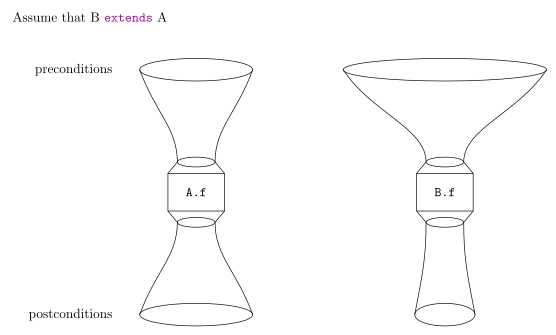
Figure 1: A method’s contract drawn as a funnel. The cone above A.f is the set of inputs it accepts — its precondition; the cone below is the set of outcomes it may produce — its postcondition. A wider mouth is a weaker condition, so the legal override B.f has a wider top (weaker precondition) and a narrower bottom (stronger postcondition).
Superimposing the two funnels turns the rule into a containment statement:
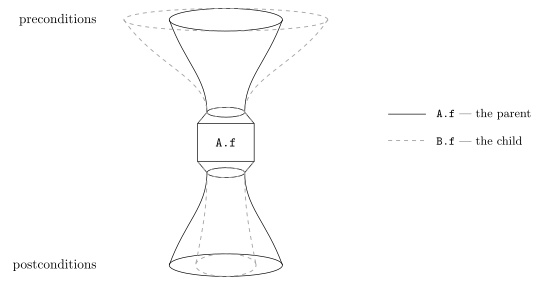
Figure 2: The same two funnels superimposed, the parent A.f solid and the child B.f dashed: the child’s precondition mouth contains the parent’s, and the parent’s postcondition mouth contains the child’s. The child should accept all inputs the parent accepts, and it should still guarantee outputs that satisfy everything the parent guarantees.
Worked example: One and Two
The question. Does Two satisfy the substitution principle with respect to One?
class One {
    /**
     * @require row != null && col != null && 0 < val && val < 100
     * @ensure \result is the list of all of the positive
     *     integers n < val that appear in either row or col
     */
    public List<Integer> calc(int[] row, int[] col, int val) {
    }
}

class Two extends One {
    /**
     * @require row != null && col != null && 0 < val &&
     *       val < 100 && row only contains positive integers
     * @ensure \result is the list of all of the positive
     *     integers n < val that appear in either row and col
     */
    @Override
    public List<Integer> calc(int[] row, int[] col, int val) {
    }
}
The answer. Read Two’s @ensure as “either row or col” (identical to One’s), so that the only thing left differing is the precondition. The input sets each precondition admits are:
Class One |
Class Two |
|
|---|---|---|
row |
…, -1, 0, 1, 2, 3 … | 1, 2, 3, … |
col |
…, -1, 0, 1, … | …, -1, 0, 1, … |
val |
1, 2, 3, 4, …, 99 | 1, 2, 3, 4, …, 99 |
col and val admit exactly the same values in both. row does not: One accepts any integers, Two accepts only positive ones. So there are inputs One would accept that Two rejects — One’s precondition does not imply Two’s. That is a strengthened precondition, and it breaks substitutability: client code written against One that happens to pass a row containing a negative number would break the moment a Two were substituted in.
Reading it off Figure 1: Two.calc’s top mouth is narrower than One.calc’s, which is exactly the shape the rule forbids.
A variant (homework). Remove && val < 100 && row only contains positive integers from Two’s precondition and change its postcondition to the integers appearing in BOTH row and col, leaving:
class Two extends One {
    /**
     * @require row != null && col != null && 0 < val
     * @ensure \result is the list of all of the positive
     *     integers n < val that appear in BOTH row and col
     */
    @Override
    public List<Integer> calc(int[] row, int[] col, int val) {
    }
}
val < 100 is gone as well, so Two’s precondition is now weaker than One’s, not equal to it. That is allowed, so the precondition side is settled. The question left is entirely about the postcondition: does that satisfy the substitution principle?
One promises the union — the positive integers below val appearing in row or col. Two now promises the intersection — those appearing in both. Take row = [1, 2], col = [2, 3], val = 10: One must return [1, 2, 3], Two returns [2]. Both postconditions pin the result down to a single list, and those lists differ, so Two’s postcondition does not imply One’s. Since the rule demands exactly that implication, it fails and LSP is violated. (The two are in fact incomparable — neither implies the other — which is still a failure, because “no weaker” means “implies”.)
In funnel terms: Two.calc’s bottom mouth is not contained in One.calc’s; it juts outside it, and containment is what the rule demands. Client code that relied on One’s promise — say, looking up 3 in the returned list — silently gets a wrong answer rather than an exception, which is the fragility SOLID exists to prevent.
This example is drilled again in week9-tutorial-substitution-principle-and-pre-post-conditions.
Interface Segregation Principle
Many client specific interfaces are better than one general purpose interface.
ISP builds on coupling — the degree of interdependence between modules, classes or components — and its seven levels from Content (tightly coupled, “needy”) down to None (loosely coupled, “independent”). The levels are from Week 6: see java-cohesion-and-coupling for the levels and worked classifications, and week10-tutorial-coupling-and-cohesion for the applied class.
The bridge from coupling to ISP is the class R example and its risk of causing incidental dependencies:
public class R {
    int x, y, z;
    char a, b, c;
}

public static void compute(R r) {
    return r.x * r.y;
}

public static void run() {
    R r = new R(1, 2, 3, 'a', 'b', 'c');
    compute(r);
}
compute is handed the whole of R but only reads two of its six fields (stamp coupling). ISP is that observation applied to a type’s public surface:
- Shrink interfaces to minimize incidental dependencies.
- Larger interfaces should be split into smaller ones, to ensure that implementing classes only need to be concerned about the methods that are of interest to them.
The problem
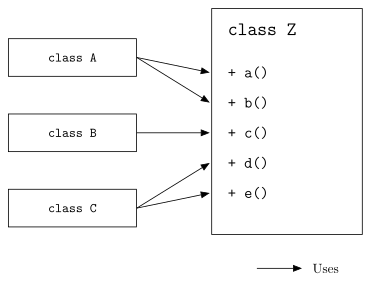
Figure 3: Despite only using a small subset of Z, each class inadvertently depends on all of Z. A node is a rectangle labelled with its Java keyword and name, with its members listed inside the same box as + a() and no compartment rule. The solid Uses arrow points from the depender to the thing depended on, and ends on the member row it uses, not on the box edge.
The cost: when Z changes, clients A, B, and C may all be affected, even if each uses only a small part of Z, so they may need to be recompiled and redeployed.
The solution
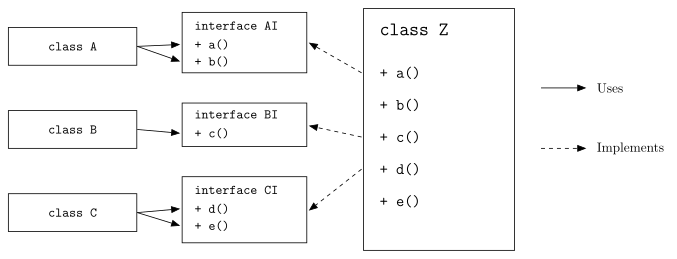
Figure 4: Create interfaces to minimize the incidental dependencies: A now depends only on AI, B only on BI, C only on CI, and Z implements all three. A solid line is Uses and a dashed line is Implements, both pointing from the depender to the thing depended on. Both have the same filled arrowhead, so only the line style tells them apart. The interfaces are named AI/BI/CI here and BSpec in the dependency inversion figure; the course does not settle on one naming scheme.
Z is unchanged — it still has all five methods. What changed is that no client can see more of Z than it needs, so a change to d() can no longer force A or B to be recompiled.
Dependency Inversion Principle
Depend upon Abstractions. Do not depend upon concretions.
Entities must depend on abstractions, not on concretions. The high-level module must not depend on the low-level module; both should depend on abstractions.
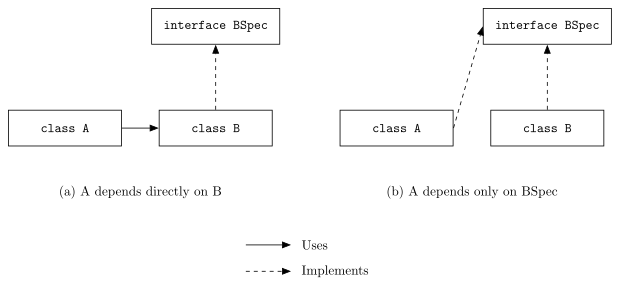
Figure 5: Inverting a dependency. In (a) A depends directly on the concrete B, so changes in the implementation can propagate to A. In (b) A depends only on BSpec, so changes inside B are less likely to affect A as long as BSpec stays the same. The edge from A to BSpec in (b) is drawn dashed, the Implements style, even though A merely uses BSpec.
The cheapest version: program to the interface you already have
The first DIP example changes one type name, in three places. Before:
public static void main(String[] args) {
    ArrayList<Course> courses = new ArrayList<>();
    Student student = new Student(courses);
    double totalGradePoints = student.calculateTotalGradePoints();
}

class Student {
    private ArrayList<Course> courses;
    public Student(ArrayList<Course> courses) { this.courses = courses; }

    public double calculateTotalGradePoints() {
        return totalGradePoints;
    }
}
After: every ArrayList in a declared type position becomes List, while new ArrayList<>() is left alone. The constructor call is the one place a concrete class has to be named.
public static void main(String[] args) {
    List<Course> courses = new ArrayList<>();
    Student student = new Student(courses);
    double totalGradePoints = student.calculateTotalGradePoints();
}

class Student {
    private List<Course> courses;
    public Student(List<Course> courses) { this.courses = courses; }

    public double calculateTotalGradePoints() {
        return totalGradePoints;
    }
}
See java-collections-framework for the List/ArrayList split this relies on, and java-abstraction.
Dependency Injection
Dependency Injection (DI) is a design pattern that implements the Dependency Inversion Principle (DIP), by injecting dependencies into a class instead of creating them internally, promoting loose coupling.
In the Student code above, the Student object receives its dependency through the constructor. The dependency is created in main and handed in — Student never calls new on it.
The full example runs the same move on a service that creates its own collaborator:
class AlertService {
    public void sendAlert(String msg) {
        EmailSender sender = new EmailSender();
        sender.send(msg);
    }
}AlertServiceis tightly coupled toEmailSender.AlertServicecan only send emails.AlertServicecreates its own dependency.
Introducing the abstraction and injecting it fixes all three:
interface MessageSender {
    void send(String msg);
}

class EmailSender implements MessageSender {
    @Override
    public void send(String msg) {
        System.out.println("Sending EMAIL: " + msg);
    }
}

class SmsSender implements MessageSender {
    @Override
    public void send(String msg) {
        System.out.println("Sending SMS: " + msg);
    }
}

class AlertService {
    private MessageSender sender;

    public AlertService(MessageSender sender) {
        this.sender = sender;
    }

    public void sendAlert(String msg) {
        sender.send(msg);
    }
}AlertServiceno longer depends directly onEmailSender.- It depends on the interface
MessageSender. - The actual sender is injected from outside.
Stability, exposure, and the “proper” form of DIP (creating an abstraction where none exists yet) are worked through in java-solid-principles and drilled in week11-tutorial-dependency-inversion.
Summary and key takeaways
The takeaways for the whole block, not only this lecture:
- Test Driven Development — java-testing
- Refactoring — java-refactoring
- Coupling and Cohesion — java-cohesion-and-coupling
- SOLID Principles — java-solid-principles
- Single Responsibility
- Open-closed Principle
- Liskov Substitution Principle
- Interface Segregation Principle
- Dependency Inversion
Further reading
- Design Principles and Design Patterns by Robert C Martin
- https://www.freecodecamp.org/news/solid-principles-explained-in-plain-english/
- https://www.baeldung.com/solid-principles
- https://youtu.be/kF7rQmSRlq0
Applied class
No separate applied-class topic on SOLID this week — see week7-tutorial-black-box-and-glass-box-testing for this week’s applied class (black-box/glass-box testing, a continuation of java-testing from Week 5).