Object Oriented Programming II
See csse2002 for course logistics. Continues 2026-03-05-object-oriented-programming-i.
The week has two parts:
- Object Oriented Programming II: interface vs abstract class, encapsulation revision, mutability, polymorphism, casting.
- Specification: Javadoc, restrictiveness, generality, clarity, formality, contracts, defensive programming.
Three items are homework (self-study): primitive casting, defensive copying, and how a subclass can introduce mutability.
Recap: the four (five) pillars
Week 2 covered objects/classes/OOP, encapsulation, inheritance and abstraction. This week adds polymorphism as the fifth, and goes back over encapsulation and the interface/abstract-class comparison in more depth.
Interface vs abstract class
Week 2 left this comparison as homework. The full treatment is in java-abstraction. In short:
- An interface defines a capability or contract —
Flyable,Runnable,Payable. Unrelated classes can share it:Bird implements FlyableandPlane implements Flyable. - An abstract class defines a shared base implementation — common behaviour that subclasses inherit rather than restate.
In code, the interface carries nothing but a signature. The abstract class carries a finished method alongside an unfinished one.
public interface PaymentProcessor {
    void processPayment(double amount);
}
public abstract class Payment {
public void validateTransaction() {
System.out.println("Validating transaction...");
}
abstract void processPayment(double amount);
}The course’s running Animal example has the same shape. eat() is inherited as-is, and makeSound() must be supplied by each subclass:
abstract class Animal {
    public void eat() {
        System.out.println("Animal is eating");
    }

    public abstract void makeSound();
}

class Dog extends Animal {
    @Override
    public void makeSound() { System.out.println("Dog barks"); }
}

class Cat extends Animal {
    @Override
    public void makeSound() { System.out.println("Cat Meows"); }
}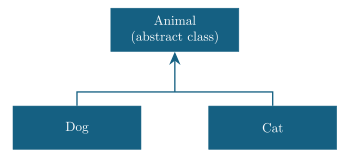
Figure 1: The abstract-class case: shared behaviour (eat()) lives in Animal, while each subclass supplies its own makeSound(). One connector joins both subclasses to the parent, with a single arrowhead into Animal.
The two combine. A class has at most one superclass, as many interfaces as you like.
class Dog  extends Animal implements Runnable, Swimmable
class Duck extends Animal implements Flyable,  Swimmable
Revising encapsulation
Person from java-encapsulation again: private fields with public getters. One field matters for the next section:
public class Person {
    private String name;
    private int age;
    private String email;
    private String[] phoneNumber;   // <- a mutable field

    public Person(String name, int age, String email, String[] phoneNumber) {
        this.name = name;
        this.age = age;
        this.email = email;
        this.phoneNumber = phoneNumber;
    }

    public String getName()          { return name; }
    public int getAge()              { return age; }
    public String getEmail()         { return email; }
    public String[] getPhoneNumber() { return phoneNumber; }
}
The array field is the case where private and final together are still not enough.
Mutable vs immutable classes
See java-mutability — mutable and immutable class design, the arrays/lists gotcha where final protects only the reference, and defensive copying.
Polymorphism
See java-polymorphism — compile-time (overloading), runtime (overriding / dynamic method dispatch), and subtype polymorphism.
Casting
See java-casting — primitive widening/narrowing, and reference upcasting/downcasting. Practised in week4-tutorial-method-dispatch-and-casting.
Worked: what is the parent of Student?
What is the parent of class
Student?
public class Student {
    public void study() {
        System.out.println("CSSE2002");
    }
}Object. A class with no extends clause still has a superclass. The class hierarchy has Object at the root of everything.
Specification
See java-specification — Javadoc, restrictiveness, generality, clarity, formality, contracts, and defensive programming.
Key takeaways
Object oriented programming:
- Encapsulation protects implementation details and prevents direct access to internal state.
- Inheritance lets a class reuse behaviour from another class — but can expose the internal implementation details of a superclass.
- Abstraction hides complex implementation detail: the user knows what it does, not how it works internally.
- Polymorphism lets objects be treated as their common type, and lets different objects respond differently to the same method call.
OOP helps build flexible, reusable, and maintainable software by organizing code around objects and behaviour.
Specification:
- A specification describes the contract between a method and its client.
- It explains what the method does, not how it is implemented.
- A good specification clearly states preconditions (true before the call), postconditions (true after a successful call) and side effects (any other change the method makes to the system).
- Clear specifications make code easier to understand, use and maintain.